Mains: GS III – Disaster Management
Recent Nepal’s disaster underscores the need for India, China, and Nepal to re‑imagine Himalayan borderland governance for resilience and sustainability.
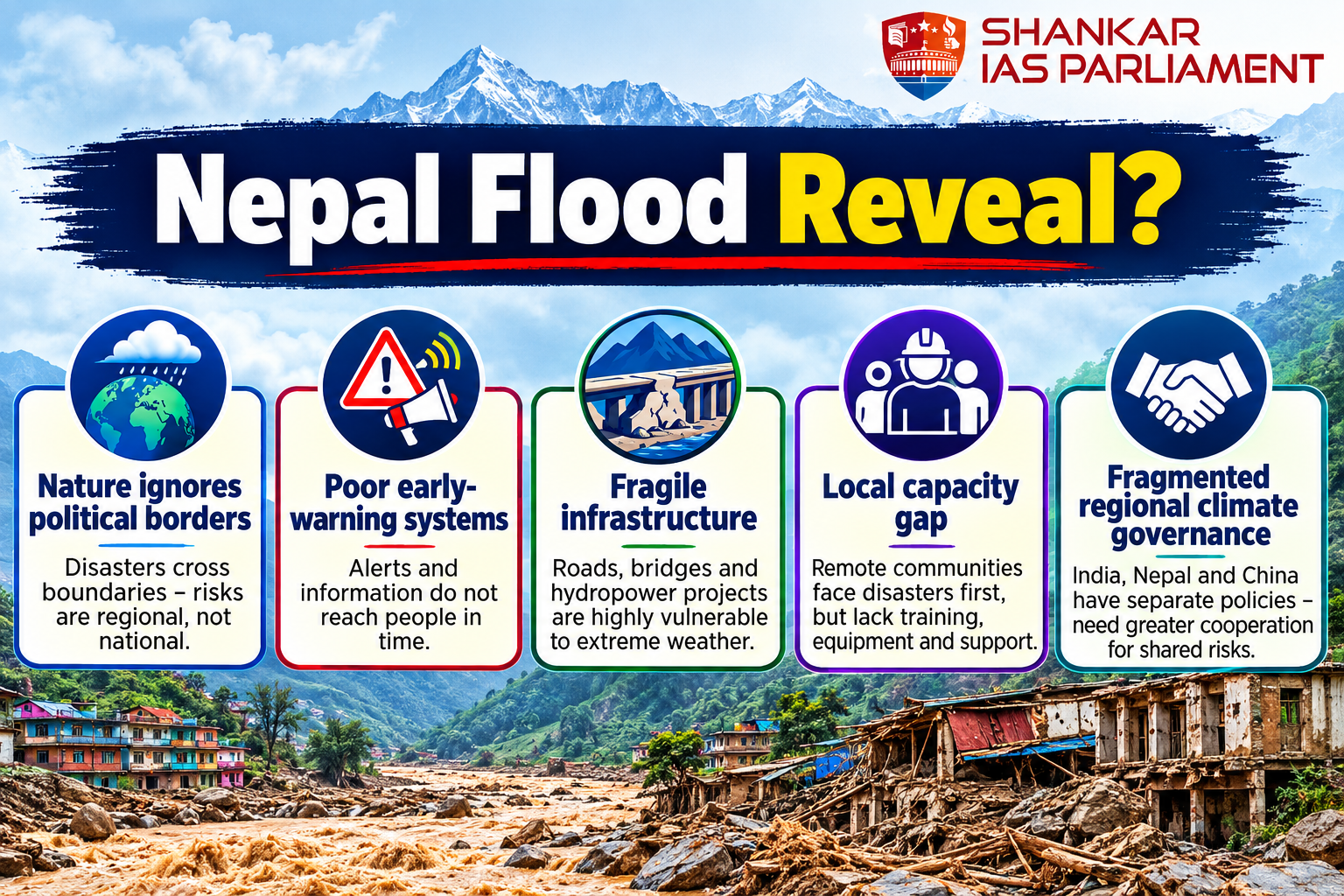
Transboundary Challenges of Natural Hazards – Political boundaries are ineffective in containing floods, avalanches, glacial lake outburst floods (GLOFs), or glacial collapse.
Hazards originating in one country frequently generate cascading impacts downstream in neighboring countries.
Therefore, conventional approaches centered on national sovereignty are inadequate for effective disaster management in the Himalayan region.
Weak Cross-Border Information Sharing – There is a lack of real-time sharing of the following critical data:
Glacier and snow conditions
River discharge
Weather data
Landslide risks
Early-warning information
Reliance on bilateral diplomatic channels often results in delays in the dissemination of critical information.
Fragile Himalayan Infrastructure – Roads, hydropower projects, and settlements are increasingly situated in hazard-prone river valleys and mountain corridors.
Damage to infrastructure can generate secondary economic and environmental risks that extend across national borders.
Linear development along highways further increases exposure to natural hazards.
Local–National Disconnect – Local communities are typically the first affected and often serve as initial responders; however, disaster management resources remain concentrated at the national or capital level.
Local governments frequently lack the following:
Training
Equipment
Technical expertise
Early-warning systems
Disaster-response capacity
Fragmented Climate Governance – Himalayan countries do not possess a unified regional climate policy or institutional framework.
Climate risks are frequently managed in isolation by various ministries, states, and countries.
This approach results in institutional silos, despite the interconnectedness of the Himalayan ecosystem.
Energy and Economic Interdependence – Hydropower projects, electricity grids, and trade routes are highly interconnected across the region.
Destruction of infrastructure in one country can disrupt regional electricity supply and compromise energy security.
Cascading impacts may propagate sequentially from China to Nepal, India, and Bangladesh.
Changing Nature of Security – Traditional border security has primarily focused on military threats.
However, security in the Himalayan region increasingly encompasses the following dimensions:
Climate disasters
Water insecurity
Food insecurity
Energy insecurity
Infrastructure vulnerability
Human displacement
Establish a Himalayan Early-Warning Network – Develop a real-time disaster-warning mechanism involving India, Nepal, and China.
Facilitate the sharing of the following data:
Glacier monitoring data
River levels
Weather forecasts
Avalanche/GLOF alerts
Satellite observations
Ensure that disaster warnings are communicated directly to local communities, rather than being limited to national capitals.
Reconceptualize the Himalayan Borderland – Recognize the Himalayan border as a shared ecological and disaster-risk zone, rather than solely as a security boundary.
Promote cross-border cooperation grounded in principles of human and ecological security.
Enhance Local Disaster Response Capacity – Allocate increased training, equipment, and financial resources to municipalities, panchayats, and border communities.
Provide training for local residents to serve as first responders.
Develop community-level evacuation plans and emergency shelters.
Develop Climate-Resilient Infrastructure – Conduct hazard and carrying-capacity assessments prior to the construction of the following infrastructure:
Hydropower projects
Roads
Bridges
Townships
Tourism infrastructure
Limit construction activities in river corridors and other high-risk zones.
Upgrade existing infrastructure to enhance resilience to climate-related hazards.
Promote Joint Scientific Research – Encourage collaborative Himalayan research initiatives among India, Nepal, and China involving the following disciplines:
Glaciologists
Hydrologists
Climate scientists
Disaster-management experts
Geologists
Integrate satellite data, remote sensing technologies, and indigenous knowledge in research efforts.
Establish a Common Regional Climate Framework – Strengthen existing regional mechanisms and consolidate fragmented initiatives within a unified Himalayan climate platform.
Institutions such as ICIMOD should facilitate scientific cooperation and knowledge sharing.
Existing arrangements, including the SAARC environmental framework, should be further strengthened.
Integrate Traditional and Indigenous Knowledge – Himalayan communities possess valuable knowledge about:
Local weather patterns
River behaviour
Safe settlement locations
Mountain hazards
Combine this knowledge with modern scientific forecasting.
Rethink Border Security – Border forces should receive training to address both conventional security threats and climate-induced disasters, as well as humanitarian emergencies.
Disaster response must be established as a core component of border management strategies.
The recent disaster in Nepal illustrates that the Himalayas function as an interconnected ecological system rather than as separate national territories.
Consequently, India, Nepal, and China should transition from a focus on border security to fostering borderland resilience by implementing shared data systems, collaborative scientific research, early-warning mechanisms, climate-resilient infrastructure, and empowering local communities.
Indian Express | Nepal’s Disaster Lessons for Bordering Countries



