Prelims: Current events of national importance | Biodiversity & Conservation
Why in News?
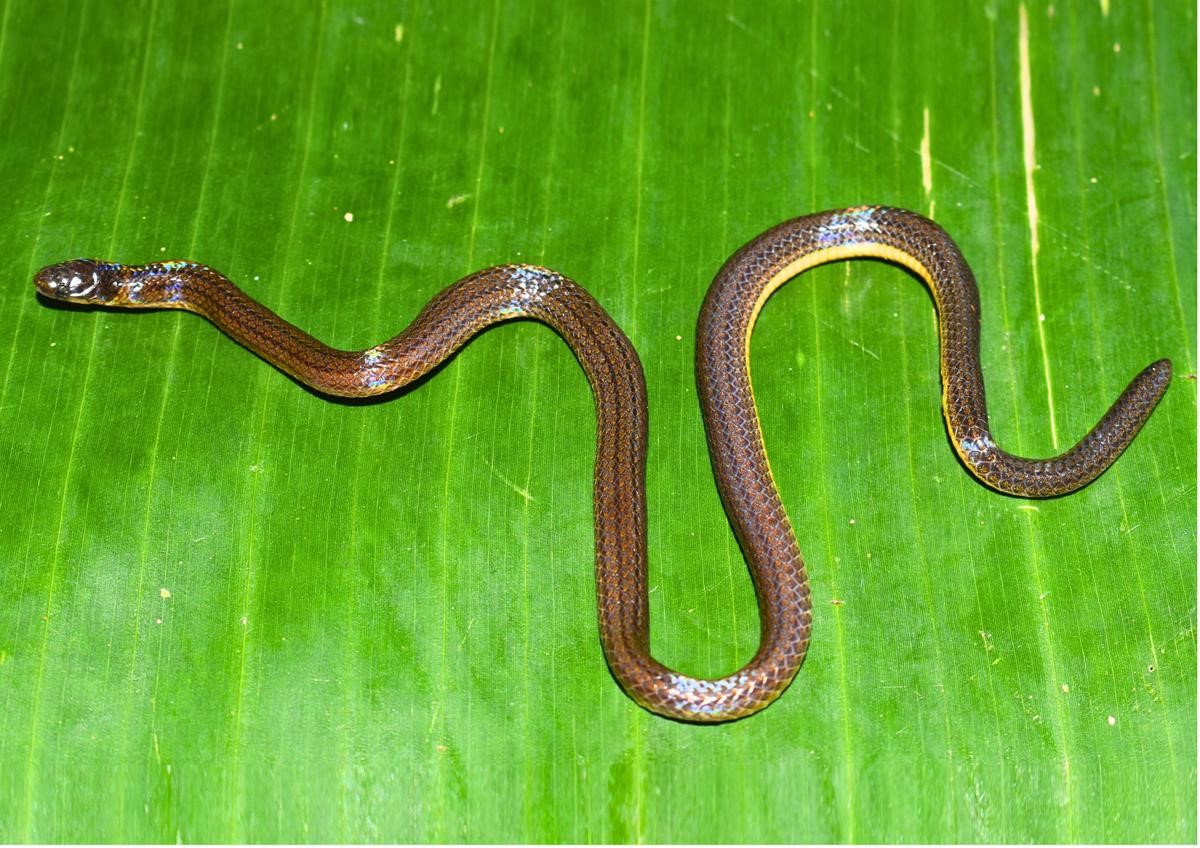
A new species has been discovered in Meghalaya’s West Garo Hills, resolving decades‑long taxonomic confusion in Northeast India’s fossorial snake group.
- Common Name – Meghalaya Burrowing Reed Snake
- Scientific Name – Calamaria garoensis.
- Genus – Calamaria.
- Family – Colubridae.
- Kingdom – Animalia.
- Habitat – Forested, moist soils of Oragitok, West Garo Hills, Meghalaya.
- Distribution – Currently known only from this region, indicating a restricted range and high conservation importance.
- Morphology
- Scales – Smooth dorsal scales in 13 rows.
- Tail – Short, non‑tapering with an obtuse tip.
- Coloration – Broad median black stripe on underside of tail; faint nuchal ring on neck.
- Body Pattern – Longitudinal striping distinct from related species.
- Diet – Primarily insectivorous/vermivorous, feeding on small invertebrates.
- Genetic Distinction
- Phylogenetic Analysis – Closely related to Calamaria mizoramensis but genetically distinct.
- Genetic Divergence – 6.3%, confirming a separate evolutionary lineage.
- Taxonomic Resolution – Previously misidentified as Calamaria pavimentata now recognized as a species complex.
- Ecological Significance
- Burrowing Lifestyle – Fossorial species that aerate soil and regulate invertebrate populations.
- Indicator Role – Reflects hidden biodiversity in Northeast India’s forest ecosystems.
- Conservation Need – Restricted distribution demands habitat protection and further surveys.
- Conservation Status
- IUCN Red List – Not yet assessed (newly described).
- Potential Concern – Limited range and habitat specificity suggest Vulnerable status if assessed.
- Significance - Biodiversity Hotspot – Reinforces Garo Hills as a micro‑endemic zone within the Indo‑Burma biodiversity hotspot.
- Scientific Impact – Highlights importance of integrative taxonomy combining morphology and mitochondrial DNA.
- Conservation – focused protection of lesser‑known fossorial species is necessary.
Reference
The Hindu | Burrowing Reed Snake



