Prelims: Current events of national and international importance | Geography
Why in News?
Recently, Scientists have observed that ongoing El Nino is intensifying into Super El Nino, while the IOD remains negative, these conditions raise concerns of monsoon deficit and drought risk in India.
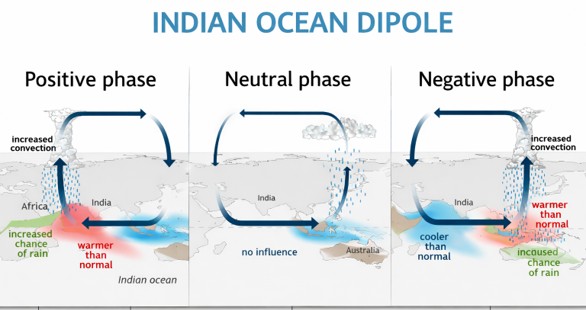
Indian Ocean Dipole (IOD)
- It is a climate pattern in the Indian Ocean.
- It refers to the difference in sea surface temperatures between the western and eastern parts of the ocean.
- Positive Phase – Western Indian Ocean warms, eastern cools.
- Negative Phase – Eastern Indian Ocean warms, western cools.
- Neutral Phase – Temperatures remain near average.
Positive Phase (Indian Nino)
- Temperature – Western Indian Ocean (near Africa) abnormally warm; eastern ocean (near Indonesia/Australia) cooler.
- Winds – Usual westerly winds weaken or reverse.
- Impacts –
- India – Above‑average rainfall, stronger monsoon.
- Africa – Heavy rains, flooding.
- Australia and Indonesia – Severe droughts, bushfires.
Negative Phase
- Temperature – Eastern Indian Ocean abnormally warm; western ocean cools.
- Winds – Equatorial westerly winds intensify.
- Impacts –
- India – Weaker monsoon, below‑average rainfall.
- Australia and Indonesia – Higher humidity, more rainfall, coastal flooding.
- Africa – Drier, drought‑like conditions.
Neutral Phase
- Conditions – Sea temperatures close to average.
- Moisture Circulation – Normal rainfall distribution, balanced weather.
- Significance
- Directly influences Indian monsoon variability.
- Alters rainfall in Africa, Australia, Indonesia.
- Associated sea‑level changes can increase risks of coastal flooding
References
- The Hindu | Super El Nino
- NASA | IOD



