What is the strategic significance of semiconductors for India’s economic and national security?
- Foundational Tech Building Blocks – Semiconductors drive critical sectors like Artificial Intelligence (AI), telecommunications, electric mobility, defence, data centres, 5G/6G, and autonomous systems.
- Mitigating Severe Import Vulnerabilities –
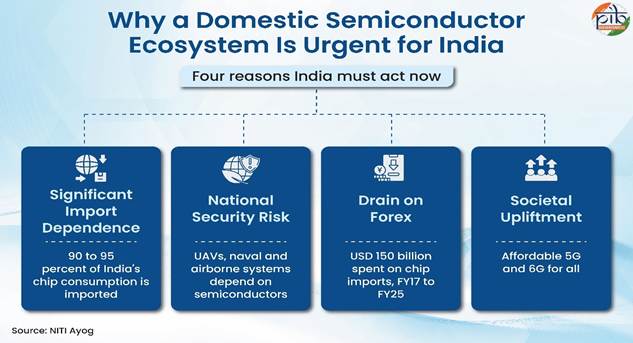
- India spent USD150 billion on semiconductor imports between FY17–FY25, growing at a CAGR of 23%.
- Annual chip imports are projected to reach USD240 billion by 2035 if domestic manufacturing is not scaled rapidly.
- Domestic demand is expected to reach USD110 billion by FY2030 and exceed USD200 billion by FY2035.
- De-risking Geopolitical Concentration – Over 60% of global chip production and nearly 90% of advanced node chips are concentrated in Taiwan.
- India needs trusted, resilient domestic supply chains to avoid global supply shock risks.
- Powering Strategic Missions – India's Semiconductor Laboratory (SCL), Mohali, already produces specialized flight-grade chips (e.g., Vikram processor, radiation-hardened ADCs, and camera chips used in Chandrayaan-3 and Aditya-L1).
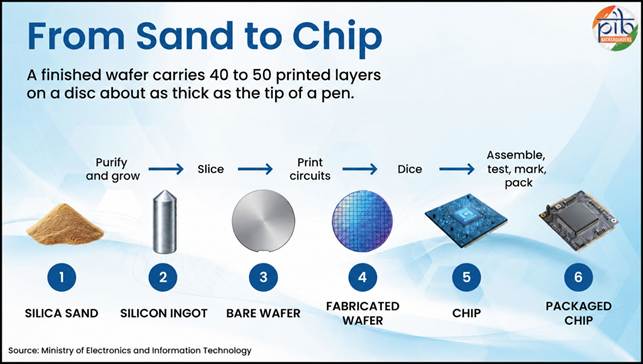
What were the major achievements under the foundational Semicon 1.0 program?
- Financial Outlay – Approved in December 2021 with a budget of Rs.76,000 crore.
- Manufacturing Approvals –
- 12 semiconductor manufacturing units approved with a cumulative investment exceeding Rs.1.64 lakh crore.
- Includes 1 silicon fab, 1 silicon carbide fab, 1 Gallium Nitride Micro LED Display Fab, and 9 ATMP/OSAT units across states like Gujarat, Assam, UP, Odisha, Punjab, and Andhra Pradesh (with 5 units already in commercial production).
- Design Linked Incentive (DLI) Progress –
- 24 chip design projects approved (Rs.900 crore total value).
- Over 1 lakh engineers across 500 organizations (400 academic institutions and 100 start-ups) gained access to advanced chip-design tools, generating >300 chip designs.
- Global Ecosystem Integration – India hosts 7% of global Semiconductor Global Capability Centres (GCCs) and employs 20% of the world's chip design workforce.
- Strategic Alliances – Signed international partnerships with the US, Japan, EU, Singapore, Netherlands, Germany, and joined the Pax Silica initiative at the India AI Impact Summit.
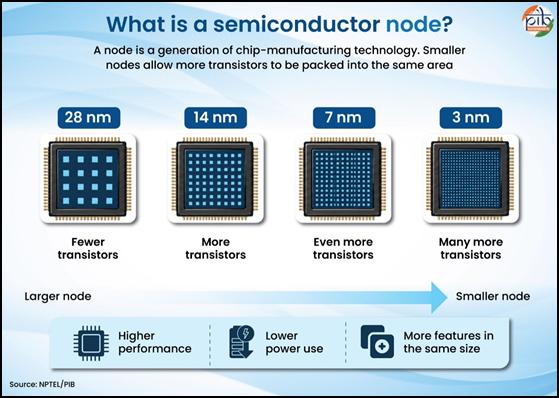
How does Semicon 2.0 expand the scope across the entire semiconductor value chain?
- Financial Scale and Outlay – Approved on 15 July 2026 with a budget of Rs.1,27,500 crore to provide long-term, sustained support.
- Shift from Fabs/ATMP to Whole-Value-Chain Integration – While Phase 1 focused primarily on fabs and packaging, Phase 2 expands into raw materials, chemical equipment, design, and basic R&D.
- The Six Strategic Pillars –
- Research and Development (R&D)
- Chip Design Ecosystem
- Semiconductor Equipment and Raw Materials
- Setting up new Fabs (Established and Advanced Nodes)
- Advanced Packaging (ATMP/OSAT)
- Workforce and Talent Development
What complementary policies form India’s broader ESDM policy framework?
- National Policy on Electronics (NPE) 2019 – Overarching framework for Electronics System Design and Manufacturing (ESDM).
- SPECS (2020) – Provides capital expenditure incentives for domestic component and semiconductor manufacturing.
- EMC 2.0 (2020) – Creates plug-and-play infrastructure and industrial parks for electronics manufacturing.
- PLI Schemes – Large-scale electronics (mobile phones) and IT Hardware PLI 2.0 (laptops, servers, tablets).
- Electronics Components Manufacturing Scheme (2025) – Rs.40,000 crore outlay (Budget 2026–27) to boost Domestic Value Addition (DVA).
- Mobile Phone Manufacturing Scheme (2026) – Focuses on deepening supply chain localization and supporting domestic Indian mobile brands.
- FDI and R&D Directives – 100% FDI under the automatic route alongside the Research, Development and Innovation Scheme.
What critical operational challenges remain for India’s semiconductor ambitions?
- Extreme Capital and Time Intensity – Setting up high-volume fabrication plants requires billions of dollars in recurring capital investments alongside high precision and long gestation periods.
- Resource Dependability – Ultra-clean water supplies, uninterrupted uninterrupted electricity, and specialized ultra-pure gases/chemicals are essential for operational fabs.
- Geopolitical and Technological Competition – Leading global players dominate advanced nodes (sub-5nm), requiring India to strategically balance mature nodes (for automotive, telecom, and power systems) while building advanced R&D.
Reference
PIB | Semicon



