Prelims: Current events of national and international importance | Environment
Why in News?
India signed green ammonia supply agreements between industry, SECI and fertiliser companies under the National Green Hydrogen Mission.
- Ammonia – Ammonia is a pungent gas that is widely used to make agricultural fertilisers.
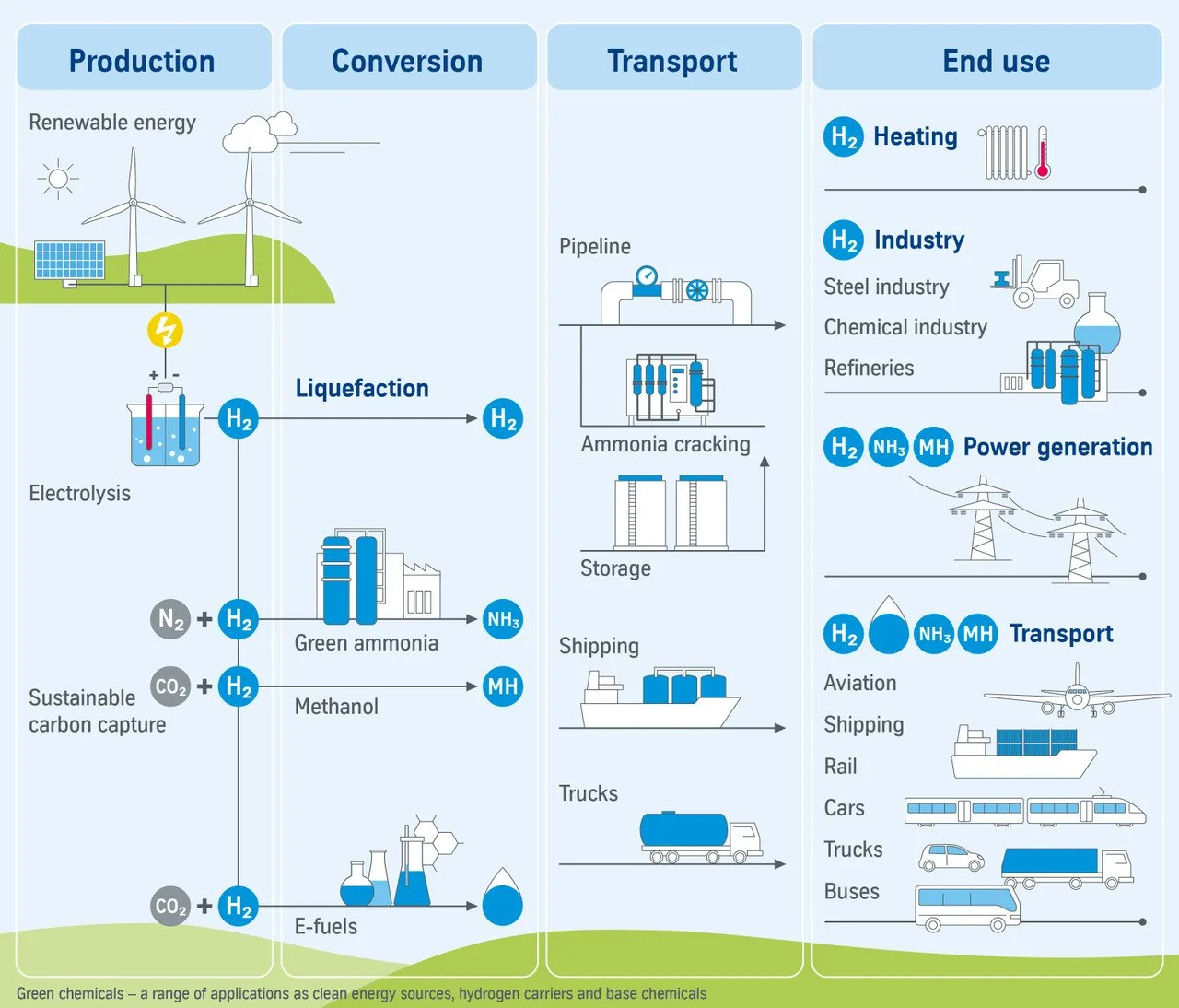
- Green Ammonia – An Ammonia (NH₃) produced using renewable energy (solar, wind, hydro) to generate green hydrogen via electrolysis, which is then combined with nitrogen, making ammonia is 100% renewable and carbon-free.
- Production process
- Make Hydrogen – Use electricity from solar panels or wind turbines to split water in a machine called an electrolyser.
- This gives hydrogen gas, and the leftover oxygen is released into the air.
- Get Nitrogen – Pull nitrogen directly out of the air (since air is mostly nitrogen) using filters or cooling machines.
- Combine Them – Put hydrogen and nitrogen together in a high-pressure chamber with a catalyst, and they bond to form ammonia (NH₃).
- Other Types of Ammonia
|
Grey Ammonia
|
Fossil fuel‑based, high emissions.
|
|
Blue Ammonia
|
Fossil fuel‑based with carbon capture.
|
|
Green Ammonia
|
Renewable‑based, zero carbon emissions.
|
- Applications
- Fertiliser production (urea, ammonium nitrate).
- Shipping fuel (zero‑carbon alternative).
- Power generation (co‑firing or direct combustion).
- Hydrogen carrier (transport and storage of green hydrogen).
India’s Green Ammonia Push
- National Green Hydrogen Mission (NGHM) – Targeting 5 MMT of green hydrogen annually by 2030.
- SIGHT Program – Strategic Interventions for Green Hydrogen Transition, which provides financial incentives for electrolyser manufacturing & green hydrogen production.
- Global Competitiveness – India’s cost advantage makes it a potential exporter of green ammonia.
- Largest Tender Globally – India signed long-term agreements for 724,000 tonnes per year of green ammonia supply to fertiliser units.
- Price Advantage – Indian discovered prices range Rs. 49.75–64.74/kg, far below global benchmarks (~Rs. 110/kg).
- Economic Impact – Forex savings of $2.5 billion over 10 years by replacing imports.
- Significance – Enhance India’s energy security by reducing imports, positioning the country as a global leader in hydrogen derivatives, while directly aligning with India’s Net Zero 2070 target.
References
- PIB | Green Ammonia
- Norton Rose | Green Ammonia



