Prelims: Current events of national and international importance | Conservation
Why in News?
Rcently, 7 endangered Golden Langurs were successfully released back into the wild at Sikhna Jwhwlao National Park in Assam following a major joint anti-trafficking operation.
- Golden Langur – It is an Old-World monkey, known primarily for its distinct, leaf-eating dietary adaptations.
- Scientific Name – Trachypithecus geei.
- Family - Cercopithecidae (Old World Monkeys).
- Discovery – The species was discovered in 1953 by the naturalist E.P. Gee.
- Morphology
- Size – Medium-sized arboreal primate.
- Males are slightly larger and more robust than females.
- Weight – 9.5 – 10.8 kg.
- Height – 50 to 75 cm in head-and-body length.
- Tail – Very long, non-prehensile tail measuring 70 to 100 cm.
Arboreal – Living in, or spending most of its time in, trees.
- Unique Trait – Their striking golden-orange fur, which undergoes fascinating seasonal color changes (dark chestnut in winter to cream-coloured in summer).
- They possess a completely hairless, jet-black face framed by a long, pale beard.
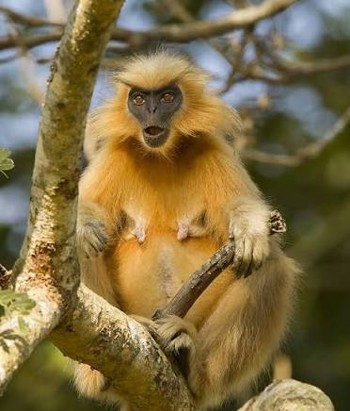
- Habitat – High-canopy subtropical moist deciduous and evergreen forests, highly dependent on contiguous riverine forest ecosystems.
- Distribution – Endemic to a very small region split between Western Assam, India and the neighbouring Black Mountains of Bhutan.
- Geographical Boundaries
- North – Foothills of the Black Mountains in Bhutan.
- South – The Brahmaputra River in Assam, India.
- East – The Manas River.
- West – The Sankosh River
- Diet – Herbivores (folivores)
- Internal Adaptations – They feature a specialized, multi-chambered "tripartite" (three-chambered) stomach utilizes unique microflora to ferment and digest tough cellulose from leaves, fruits, seeds, and buds.
|
Conservation Status
|
|
IUCN Red List
|
Endangered
|
|
Wildlife (Protection) Act of India, 1972
|
Schedule I (offering the highest level of legal protection against hunting and trade).
|
|
CITES
|
Appendix I.
|
- Threats
- Habitat fragmentation,
- Human-wildlife conflicts, and
- Genetic isolation.
Reference
The Hindu | Golden Langur



