Prelims: Current events of national and international importance | Species
Why in News?
According to the study, a group of seven galaxy frogs vanished, all likely to be dead, after multiple photographers descended on their habitat, causing disturbances and behavioural changes.
- Scientific Name – Melanobatrachus indicus
- Family – Microhylidae
- It is a rare, tiny, and most dazzling amphibious creature in the world that lives exclusively under rotten logs in Kerala’s Western Ghats.
- 1st discovered in – Although they were first discovered in 1878, not much is known about them since they are difficult to find.
- Distribution – It is endemic to the Western Ghats, Kerala (India).
- Habitat – It is found primarily under rotting logs, leaf litter, rocks, and other moist ground cover within 10 m of streams or in swampy areas.
- It is found in moist evergreen forests at elevations around 1,000–1,500 m, restricted to small forest patches in the southern Western Ghats.
- Ecological Needs – It requires precise temperature & humidity (cold-blooded, highly sensitive) to survive, because they are cold-blooded animals.
- Size – Each the size of a fingertip, measures just 2-3.5 centimetres (0.8-1.4 inches).
- Appearance – Glossy black skin with blue-white speckles (galaxy-like), orange streaks on limbs, giving supernova effect.
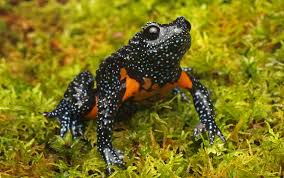
- Unique Trait – They use their spots to communicate, making existing data about their population and breeding behaviour deficient.
- Behaviour – They are primarily nocturnal and do not produce calls, making them incredibly difficult to find.
- When threatened, they exhibit a "contraction" behaviour, arching their backs and keeping their limbs close to their bodies.
- EDGE species – These frogs are the only species in their genus, which makes them evolutionarily unique.
- Because of this, they are listed as Evolutionarily Distinct and Globally Endangered (EDGE) species—one of the world’s most rare and threatened animals.
- Conservation Status
- Threats – Habitat loss due to deforestation and agriculture, disturbance from photo tourism, and extremely limited distribution make it highly sensitive.
References
- Indian Express | 7 of world’s rarest frogs presumed dead
- Amphibia web | Melanobatrachus indicus



