Prelims: Current events of national and international importance | Space
Why in News?
An international team led by Indian astronomers has studied an ultracompact binary system of two white dwarfs, known as eRASSU J0608.
- Study – Rapid Orbital Decay in the Ultracompact Double-Degenerate Binary eRASSU J060839.5–704014
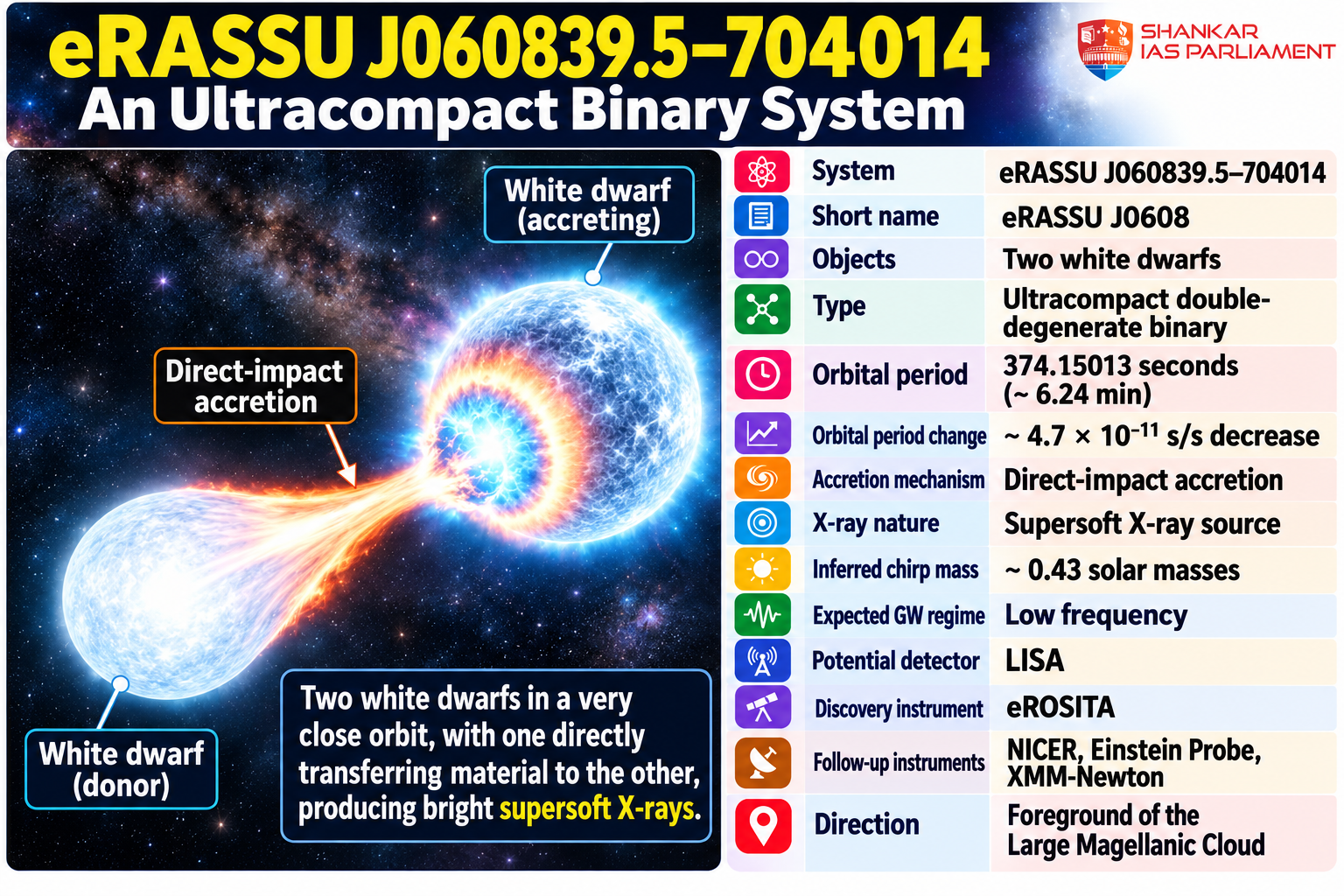
- The system completes a single orbit in 374.15013 seconds, which is approximately 6.24 minutes.
- The orbital period is decreasing at an unusually rapid rate.
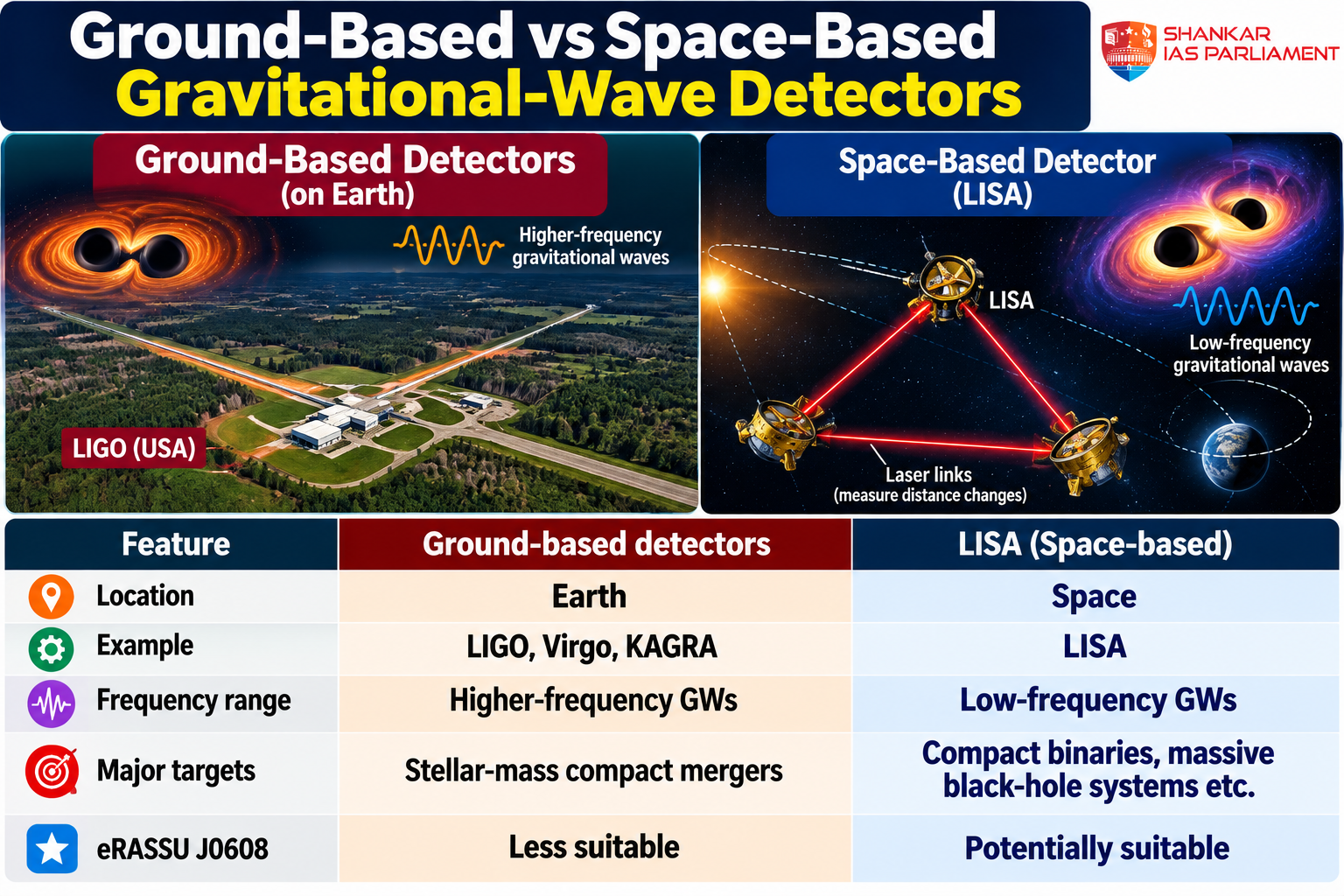
- This system is a potential significant source of low-frequency gravitational waves.
- The system could serve as a verification source for LISA, the planned space-based gravitational-wave observatory.
- Ultracompact double-degenerate binary
- Double-degenerate binary – A binary system composed of two degenerate stellar remnants, such as white dwarfs.
- Ultracompact binary – A binary system in which the two objects are separated by a very small distance and possess an extremely short orbital period.
- Direct-Impact Accretion – Typically, matter transferred between compact stars follows a standard accretion process:
- Donor star → Accretion disc → Companion star
- In contrast, within the eRASSU J0608 system:
- Donor white dwarf → Direct impact → Companion white dwarf
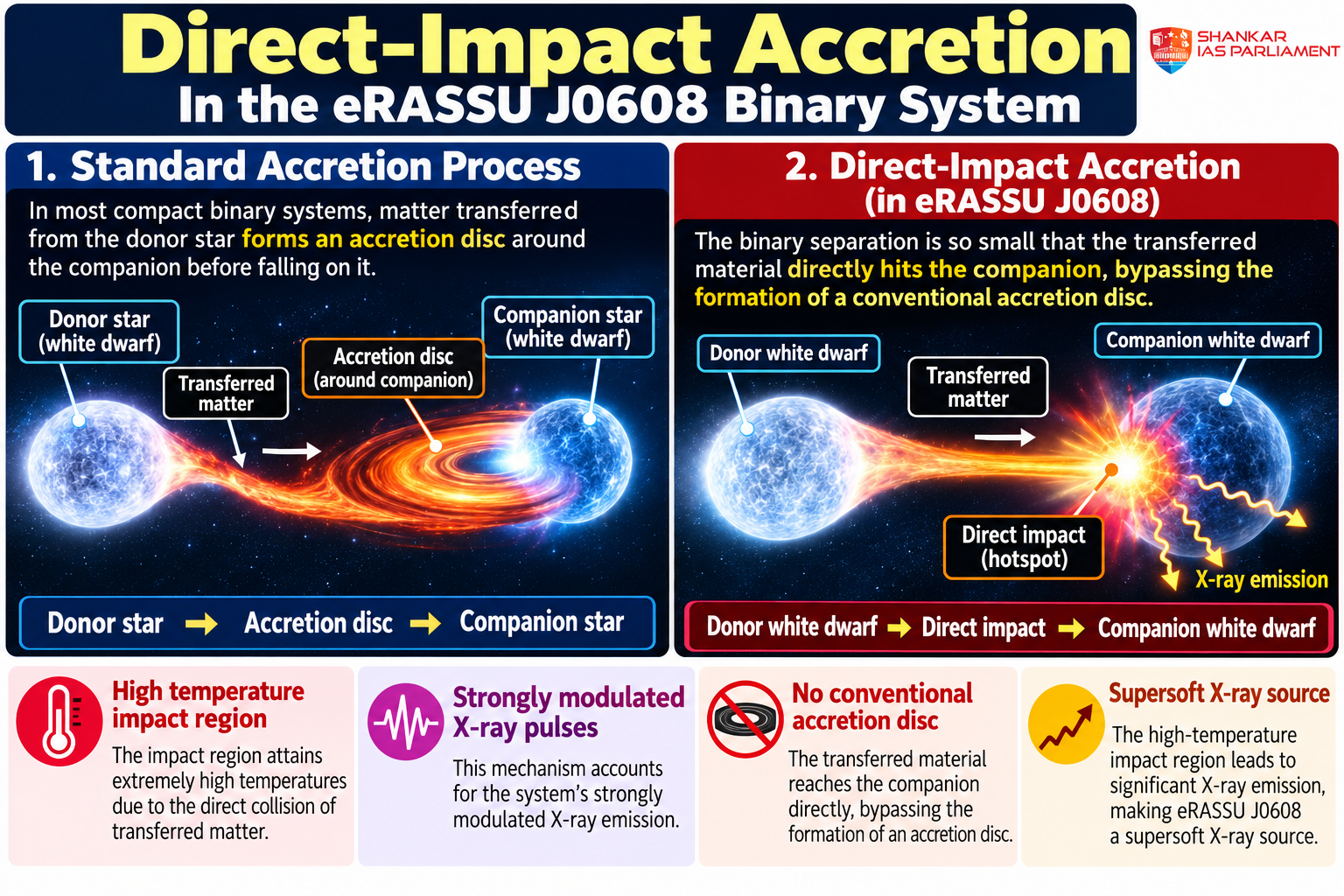
- The binary separation is sufficiently small that transferred material reaches the companion directly, bypassing the formation of a conventional accretion disc.
- As a result,the impact region attains extremely high temperatures, resulting in significant X-ray emission.
- This mechanism accounts for the system's strongly modulated X-ray pulses.
- Chirp mass – It is a parameter calculated from the masses of the two components in a binary system.
- It is particularly important because it determines aspects of:
- Orbital evolution
- Gravitational-wave frequency evolution
- Gravitational-wave amplitude
In the case of eRASSU J0608 – Chirp mass ≈ 0.43 solar masses.
- Large Magellanic Cloud
- The system is positioned in the direction of the Large Magellanic Cloud (LMC).
- However, being located in the direction of the LMC does not necessarily imply physical association with or location within the LMC.
- The study suggests that eRASSU J0608 is likely situated in the foreground of the LMC; however, its precise distance remains undetermined.
|
Large Magellanic Cloud
|
- The Large Magellanic Cloud is a satellite galaxy of the Milky Way.
- It is part of the Local Group of galaxies.
- The Large Magellanic Cloud is classified as a nearby dwarf irregular galaxy.
- It accompanies the Milky Way, together with the Small Magellanic Cloud.
|
Reference
TOI | Ultracompact White-Dwarf Binary



