Prelims: Current events of national and international importance | Science & Technology
Why in news?
Researchers at the University of Gothenburg have successfully created "diamondiyne", a new carbon allotrope that had existed only as a theoretical prediction for about 35 years.
- Diamondiyne – It is a new form (allotrope) of carbon, similar to diamond, graphite, graphene, fullerenes, and carbon nanotubes.
- It consists of carbon atoms linked through triple bonds and arranged into a three-dimensional network of tetrahedra connected corner-to-corner.
- Formation – The scientists synthesised the material in a thin film formed where two liquids meet.
- Using electron microscopy, researchers confirmed the crystal structure in microscopic regions measuring about 10 nanometers on each side. The observed patterns matched earlier theoretical predictions.
- Features – The structure contains voids or pores, making it resemble a porous diamond.
- But unlike diamonds, diamondiyne does not require high pressure to make the carbon atoms bond to one another.
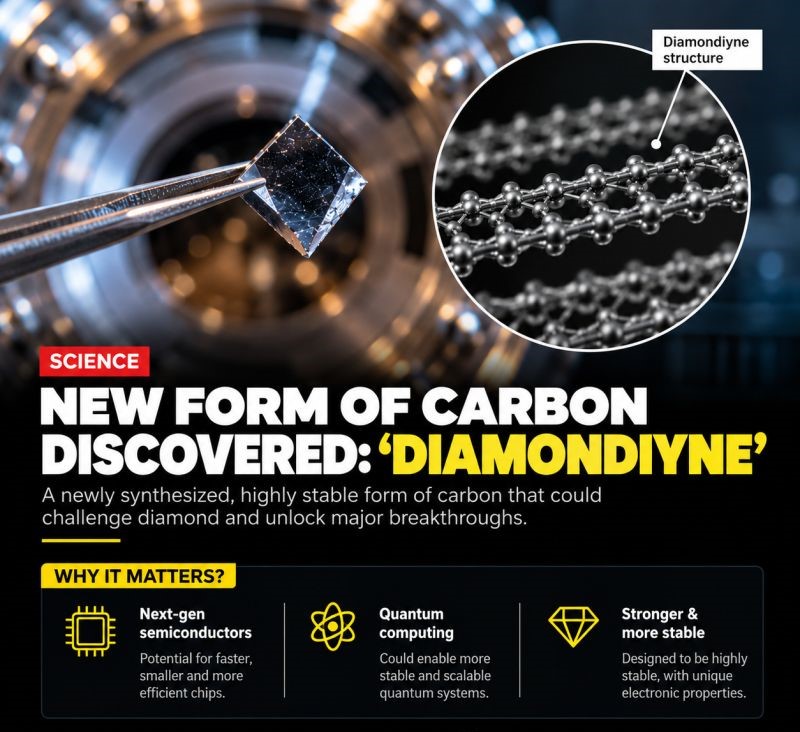
- Potential Applications – Researchers are now investigating its properties.
- One promising feature is its porous 3D architecture, which could allow multiple diamondiyne frameworks to interweave through one another's voids, potentially creating materials with unique mechanical, electronic, or storage properties.
- Significance – Unlike natural diamond, which forms under extremely high pressures, diamondiyne can be produced without high-pressure conditions.
- It is the first newly realised three-dimensional carbon allotrope from a class of theoretically predicted carbon structures.
- The achievement expands the known family of carbon materials and may open new avenues in advanced materials science.
Reference
SciTech Daily | New form of carbon found: diamondiyne



