The Last-Mile Architects of Rural Transformation
A network of trained grassroots workers forms the backbone of decentralized service delivery.
The role of community cadres and frontline workers in ensuring last-mile delivery of government programmes and strengthening rural institutions.
Over 9 lakh Community Resource Persons (CRPs), along with ASHAs, Anganwadi Workers, Swachhagrahis, Awaas Mitras and others, connect rural households with government services.
1. Community Cadres: Backbone of Last-Mile Delivery
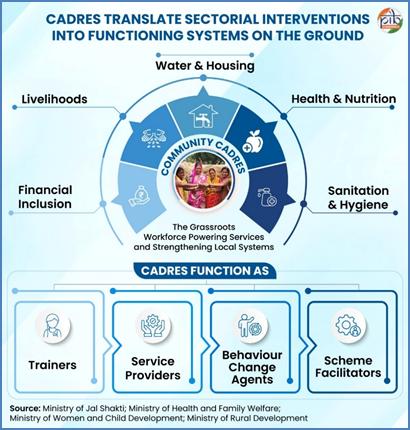
Community cadres act as a bridge between government institutions and rural communities. Their major roles include:
Their remuneration is generally activity-based, with incentives linked to service delivery and community mobilisation.
2. Community Resource Persons under DAY-NRLM
The Deendayal Antyodaya Yojana–National Rural Livelihoods Mission (DAY-NRLM) is central to this community-led approach.
This approach transforms rural women from beneficiaries into trained service providers, community leaders and change agents.
3. Livelihood CRPs
Livelihood cadres support both farm and non-farm activities.
Farm and allied sectors:
More than 4.62 crore Mahila Kisans had been covered under farm livelihood interventions by June 2025.
Non-farm sector:
4. Financial Inclusion at the Grassroots
Bank Sakhis and Business Correspondent (BC) Sakhis provide doorstep banking services such as account opening, deposits, withdrawals and fund transfers.
5. Health, Nutrition and Sanitation
ASHAs serve as the first community-level contact for healthcare, while Anganwadi Workers (AWWs) support nutrition and early childhood development.
Under the Swachh Bharat Mission (Grameen), Swachhagrahis promote sanitation and behavioural change. Over 10.36 lakh functionaries and 36,342 master trainers have been trained.
6. Water and Housing
Under the Jal Jeevan Mission, Gram Panchayats and Village Water & Sanitation Committees (VWSCs/Pani Samitis) undertake village-level water planning and management.
Under PMAY-G, Awaas Mitras assist beneficiaries with identification, documentation, construction monitoring and scheme convergence. PMAY-G aims to construct 4.95 crore houses by March 2029.
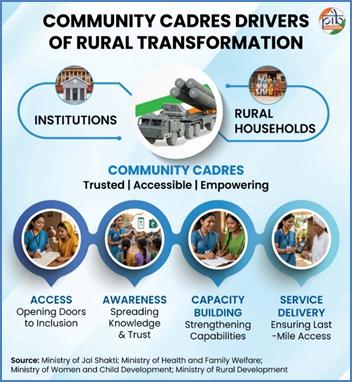
7. Convergence at Household Level
The emerging approach moves beyond sector-specific service delivery towards integrated household development involving:
Livelihoods + Health + Nutrition + Sanitation + Financial Inclusion + Social Protection
Frontline workers facilitate this convergence by linking households with multiple schemes and institutions. Gender CRPs also address gender-based violence, exclusion and inequality.
8. Continuous Capacity Building
Community cadres receive continuous training through:
This model is reflected across NRLM, health, sanitation, water and housing programmes.
Conclusion
Reference



