Prelims: Current events of national and international importance | Science & Technology
Why in News?
The Union Minister of State for Science & Technology formally launched the commercial transition and pilot-scale manufacturing of bio-based, biodegradable polylactic acid (PLA) bioplastics in India.
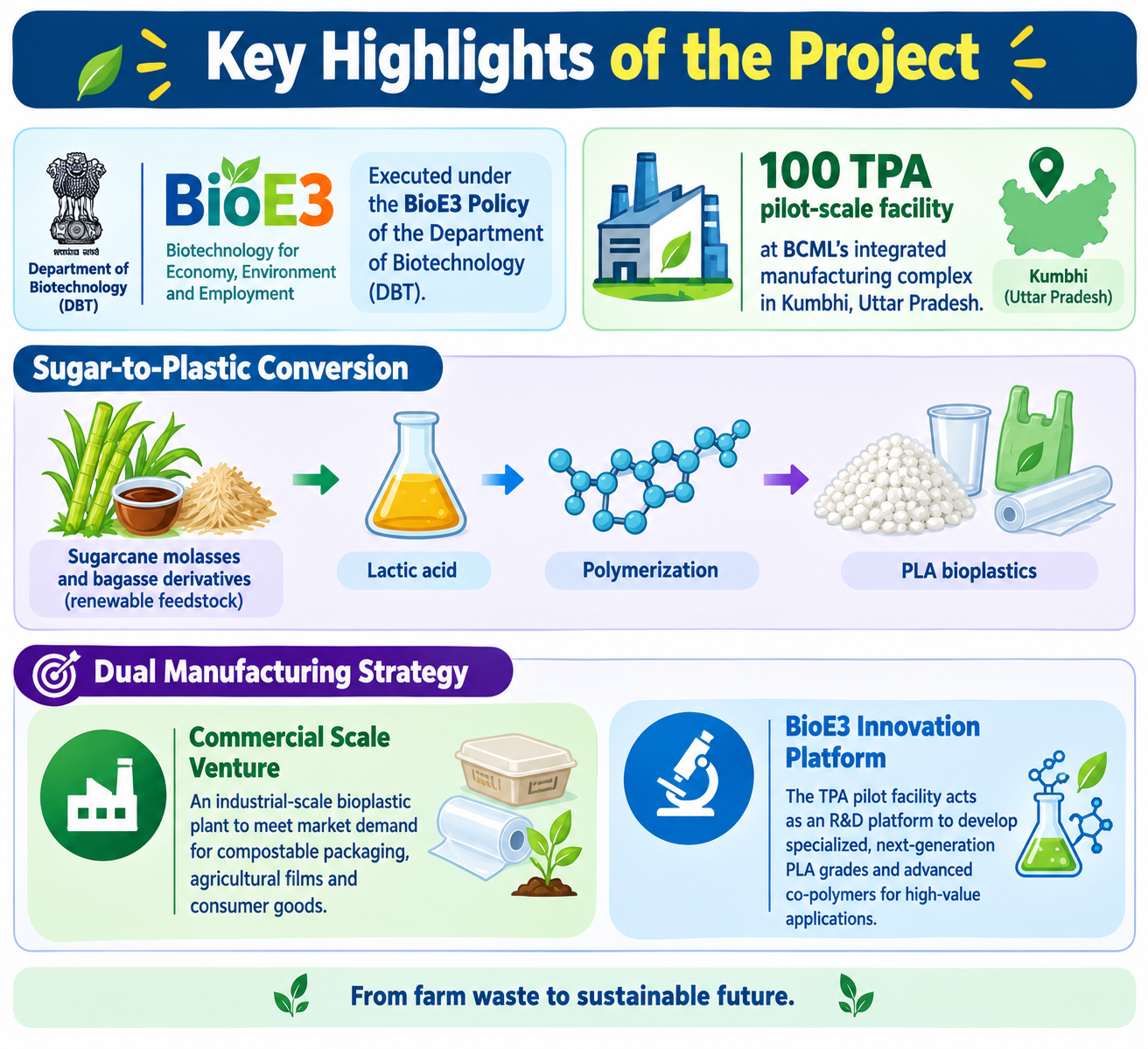
Key Highlights of the Project
- The initiative is executed by under the BioE3 (Biotechnology for Economy, Environment, and Employment) Policy under the Department of Biotechnology (DBT).
- A 100 Tonnes Per Annum (TPA) pilot-scale facility is being established at BCML's integrated manufacturing complex at Kumbhi, Uttar Pradesh.
- Sugar-to-Plastic Conversion- Converts agricultural, sugar-based renewable feedstock (sugarcane molasses and bagasse derivatives) into lactic acid, which is polymerized into PLA bioplastics.
- Dual Manufacturing Strategy
- Commercial Scale Venture- An industrial-scale bioplastic plant to cater to market demand for compostable packaging, agricultural films, and consumer goods.
- BioE3 Innovation Platform-The TPA pilot facility acts as an R&D platform to develop specialized, next-generation PLA grades and advanced co-polymers for high-value applications.
Polylactic Acid (PLA)
- Chemical Nature - A bio-based, aliphatic thermoplastic polyester derived from fermented plant starch (sugarcane, corn, or cassava) rather than petroleum.
- Biodegradability
- Unlike conventional petro-plastics (such as Polyethylene or Polypropylene) which persist for centuries, PLA degrades via hydrolysis followed by microbial digestion into water, carbon dioxide, and organic biomass.
- Fully compostable under industrial composting conditions within 90–180 days without leaving toxic chemical residues or microplastics.
- Carbon Footprint - Emits roughly 60–80% fewer greenhouse gases during production compared to traditional fossil-fuel-derived plastics.
BioE3 Policy & India’s Bioeconomy
- BioE3 Framework (Biotechnology for Economy, Environment, and Employment)- To drive high-performance, sustainable biomanufacturing, shifting India from chemical-based manufacturing to circular bio-foundries.
- Surge in India’s Bioeconomy- India’s bioeconomy expanded from ~$10 billion in 2014 to nearly $195 billion, positioned to reach $300 billion.
- Waste-to-Wealth - Diverts agricultural biomass into high-value biopolymers, providing supplementary income streams for sugarcane farmers and reducing dependence on imported single-use plastics (SUPs).
Significance
- Provides a commercially viable, domestically manufactured substitute for single-use packaging items banned under the Plastic Waste Management Amendment Rules.
- Reduces reliance on imported PLA resins (currently sourced primarily from the US and Europe), building indigenous biomanufacturing capabilities (Vocal for Local to Global).
- Industrial success will depend on establishing dedicated industrial composting infrastructure and lowering synthesis costs to compete with cheap petroleum-based virgin plastics.
Reference
News on Air | commercial use of bio-based biodegradable PLA plastic



