Prelims: Current events of National and International Importance | Science and technology -Defense
Why in News?
Iran's use of cluster munitions in a missile strikes recently injured dozens and marked the first confirmed deployment of the controversial weapon in the ongoing conflict with Israel.
- Cluster munitions are weapons that are designed to release a container mid-air, scattering explosive submunitions or ‘bomblets’ over a wide area.
- Depending on the model, they can disperse anywhere from a few to over 600 bomblets over a large area and are typically delivered via aircraft or missiles.
- Working - Cluster bombs are delivered via rockets, missiles, or bombs. Upon deployment, the main bomb opens in the air.
- Hundreds of bomblets are released and spread out over the target zone. The affected area can span several football fields.
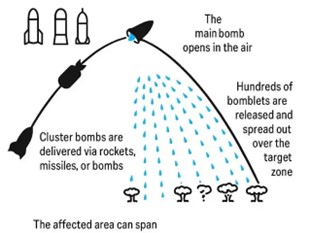
- Impacts - Not all submunitions explode on impact, leaving behind unexploded ordinance (UXO), for years.
- The majority of this - are free falling, meaning that they are not individually guided towards a target.
- Unexploded ordnance poses a serious threat to civilians. Clearance operations are costly, slow, and often hazardous.
- Usage - According to the International Committee of the Red Cross (ICRC), they were first deployed during World War II.
- Their development accelerated during the Cold War era, when they were stockpiled in large numbers.
- These weapons were primarily designed to neutralize spread-out military targets such as tanks or troops over wide battlefields.
- Regulation - The 2008 Convention on Cluster Munitions prohibits the use, production, stockpiling, and transfer of these weapons.
- To date, key nations like Iran, Israel, the United States, and Russia — have refused to join the agreement.
- In 2023, USA sent clustered munitions to Ukraine to use against Russia. Kyiv has accused Russia of deploying the same weapons in return. Like Iran and Israel right now.
- India did not sign the treaty.
Reference
Business Standard| clustered bombs



