Why in News?
Recently, G20 Indian Sherpa India's Amitabh Kant said that circular economy could generate a market value of over $2 trillion and create 10 million jobs by 2050.
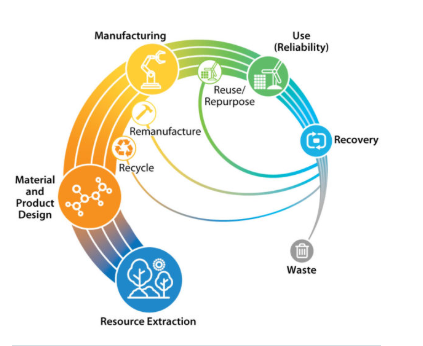
- Circular economy – It refers to an economic system designed to eliminate waste, maximise resource efficiency, and maintain products and materials at their highest quality for as long as possible
- 3 principles of circular economy
- Eliminate waste and pollution
- Circulate products and materials (at their highest value)
- Regenerate nature
- Need – India’s installed solar capacity is 66.7 GW as of FY23, has generated about 100 kilotonnes (kt) of waste, which will increase to 340 kt by 2030.
- Around 67% of this waste is expected to be generated in 5 states- Rajasthan, Gujarat, Karnataka, Andhra Pradesh, and Tamil Nadu.
- The addition of new solar capacities by 2030 to meet India’s nationally determined contribution targets under Paris Agreement could create cumulative solar waste of 19 million tonnes by 2050.
- Circularity in solar sector – It can be done through smarter product design, longer use, recycling and more, as well as regenerate nature.
- Use recycled aluminium in frames
- Use solar glass in new modules
- Reduce use of critical minerals such as copper and silver
- Eliminate use of toxic metals
- Reuse components in new modules
- Recycling of solar waste
Reference
Hindustan Times| Circularity in Solar Sectors



