Mains: GS III – Economy | Infrastructure | Social Issues | Women Development
Why in News?
Recently, the AVPN Global Conference in New Delhi has brought renewed attention to the role of impact investment in building care systems.
What is Care Economy?
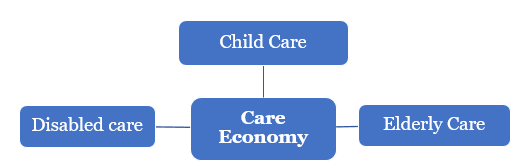
Care Economy – It encompasses both paid and unpaid, as well as direct and indirect, care work delivered through public and private sectors.
This includes micro, small, and medium enterprises (MSMEs), non-profit organizations, the social and solidarity economy, and households.
Nature of Care Work – It consists of activities and relationships that sustain quality of life, nurture human capabilities, foster agency, autonomy, and dignity, and enhance opportunities and resilience for both caregivers and care recipients.
Range of Needs Addressed – It addresses a range of physical, psychological, cognitive, mental health, and developmental needs throughout all life stages, including those of children, youth, adults, older persons, persons with disabilities, and caregivers.
How are women affected by the care burden?
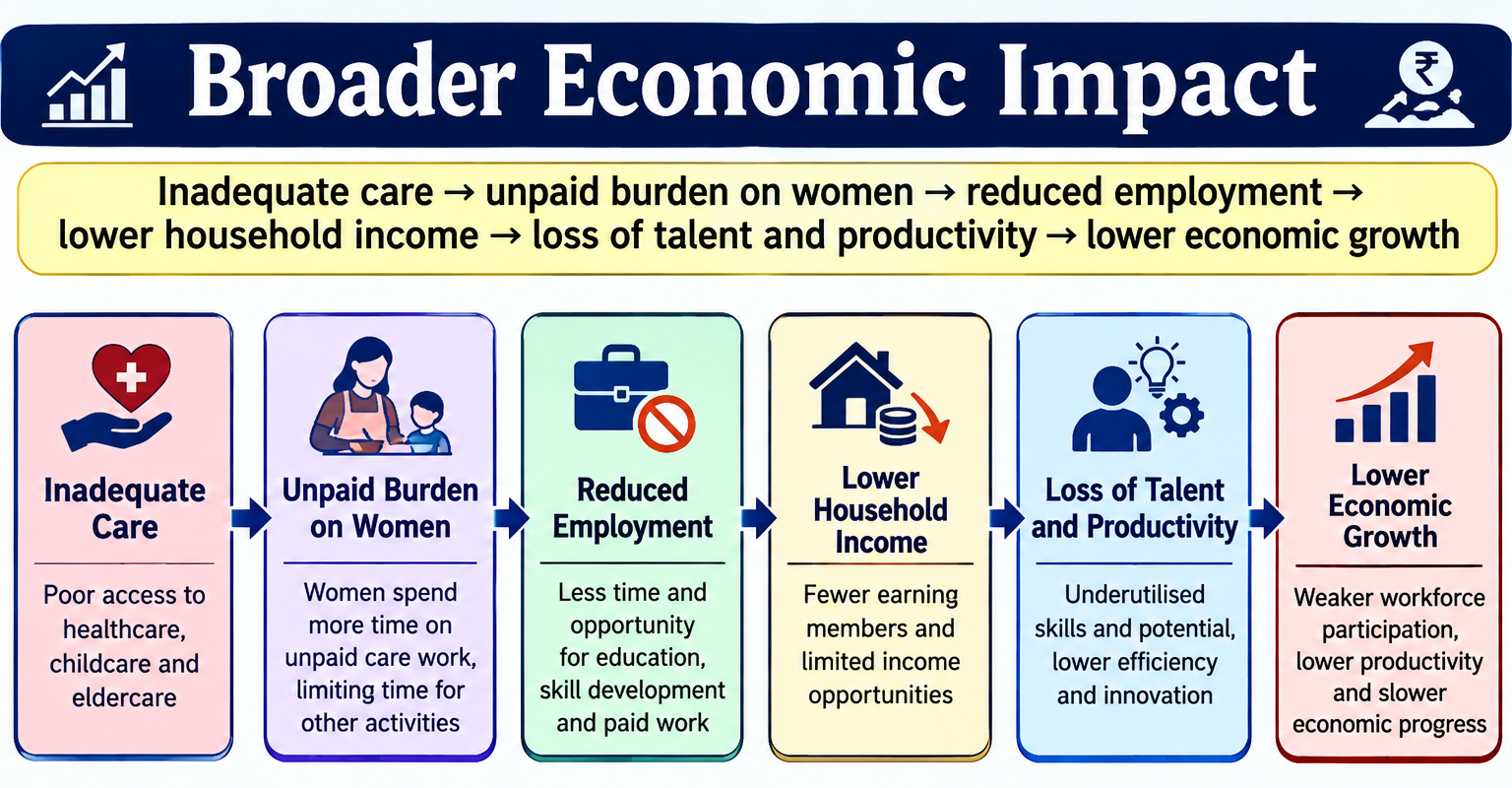
Workforce Withdrawal – Women may exit the workforce, reduce their working hours, or decline career advancement opportunities.
Limited Participation – These factors limit women's participation in the labour force and restrict their income generation.
Entrepreneurship & Skills – Such constraints reduce opportunities for entrepreneurship and hinder skill development among women.
Gender Gap – These dynamics contribute to a persistent gender gap in both employment and wages.
How does the care economy promote society?
Human Development
High-quality childcare enhances early childhood development and improves learning outcomes.
Comprehensive eldercare enables older adults to maintain dignity and independence.
Disability-care services foster social inclusion.
Employment Generation
The care sector creates employment opportunities for caregivers, nurses, therapists, childcare workers, and support staff.
The sector has the potential to generate substantial employment for women.
Women’s Empowerment
Formal care services reduce the burden of unpaid care responsibilities.
These services enable women to participate in and sustain paid employment.
Access to care services supports women’s career advancement and economic independence.
Stronger Communities
Care services alleviate pressure on families.
These services build community resilience in response to demographic and social changes.
Care provision supports intergenerational wellbeing.
Why does India need to focus on the care economy?
Rising female aspirations – An increasing number of women pursue education, employment, entrepreneurship, and professional careers; however, insufficient care infrastructure often limits these opportunities.
Rapid urbanisation – Migration and urbanisation contribute to the erosion of traditional extended-family support systems.
Population ageing – The expansion of India's elderly population is driving greater demand for eldercare, assisted living, and home-based care services.
Changing family structures – The prevalence of smaller family units results in fewer individuals available to provide unpaid care.
Untapped demographic potential – India possesses a substantial working-age population. Enhanced care infrastructure can facilitate increased female participation in the workforce.
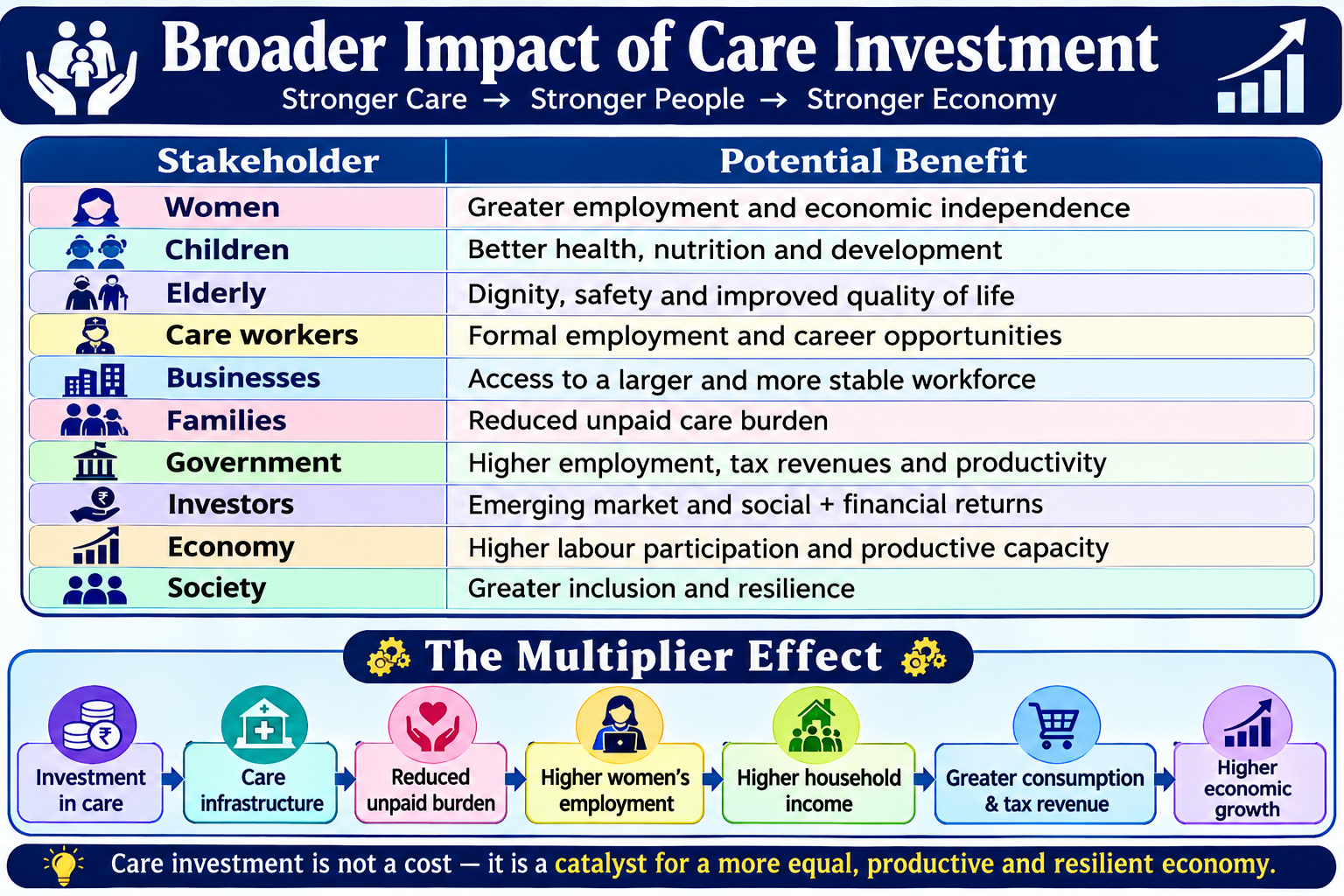
Economic growth – Alleviating constraints related to unpaid care can increase labour supply, enhance productivity, raise household incomes, and boost tax revenues.
What are the prevailing challenges?
Predominance of unpaid care – Care responsibilities predominantly fall within the household domain.
Women undertake a disproportionate amount of unpaid care work.
Underdeveloped care infrastructure – There is a shortage of affordable, high-quality childcare services.
Organised eldercare and disability-care facilities remain limited.
Availability of care services is uneven between urban and rural areas.
Fragmented care ecosystem – Many care providers operate on a small scale, are informal, and are geographically dispersed.
The sector faces challenges in achieving scale and standardisation.
Financing constraints – Care enterprises often operate with uncertain revenue models.
Limited household purchasing capacity constrains the profitability of care enterprises.
Investors frequently perceive the sector as challenging to scale.
Regulatory complexity – Care intersects with:
Health
Education
Labour
Social protection
This intersection often results in complex licensing requirements and inconsistent standards.
Poor quality of care workforce
Care workers typically receive low wages.
Employment in the care sector is often insecure.
Professional recognition for care workers remains limited.
There is a lack of clear career progression pathways for care workers.
Training opportunities for care workers are often inadequate.
Risk of commercialisation without equity – If care services remain accessible only to affluent households,
Social and economic inequality is likely to increase.
Lower-income households may continue to rely on unpaid care.
Care workers may persistently receive low wages.
What are the benefits of investing in the care economy?
What steps need to be taken?
Recognise care as economic infrastructure – Integrate care into the core of economic policy, rather than treating it solely as a social policy concern.
Expand public investment
Expand access to affordable childcare and crèche facilities.
Develop community-based eldercare services.
Enhance the availability of disability-care services.
Strengthen home-based care infrastructure.
Build public–private partnerships – Facilitate joint development of care services by government, businesses, investors, philanthropies, and communities.
Develop an enabling regulatory framework
Implement common quality standards for care provision.
Introduce simplified licensing procedures.
Establish accreditation mechanisms for care providers.
Strengthen monitoring and grievance redressal mechanisms.
Professionalise the care workforce
Implement standardised training and certification programs.
Ensure improved wages and working conditions.
Provide comprehensive social security benefits.
Establish clear career pathways for care workers.
Promote impact investment
Utilise blended finance models.
Provide viability-gap funding support.
Mobilise social-impact funds.
Leverage philanthropic capital to support early-stage innovation.
Ensure affordability and inclusion – Prevent care services from becoming accessible only to affluent households.
Enhance accessibility through targeted subsidies, community-based models, and public provision.
Leverage technology
Develop digital platforms to facilitate care services.
Implement tele-care solutions and remote monitoring systems.
Adopt AI-enabled systems for care coordination.
Provide digital training programs for care workers.
Recognise and measure unpaid care – Ensure that national accounts and policymaking frameworks more accurately capture the economic value of unpaid care work.
Adopt a gender-responsive approach – Design care policies to promote greater equality in the distribution of care responsibilities, rather than simply shifting women from unpaid to low-paid care roles.
What lies ahead?
The care economy should be recognized not only as a safety net or welfare expenditure, but as a foundational component of a productive and inclusive economic system.
The care economy does not merely serve as a safety net; it constitutes a fundamental part of the economic foundation.
Reference



