Prelims: Current events of national and international importance.
Why in News?
India’s renewable energy capacity utilization stands at 30%, despite its contributing to a 50% share in India’s total energy capacity.
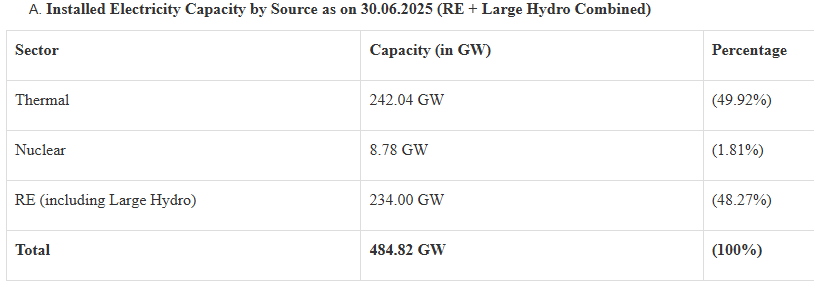
- Status of installed energy capacity – India’s renewable energy share is 50% of its total electric power capacity i.e. 484 gigawatts.
- Notable achievement - It is emphasizing that India is five years ahead of the target set under its Nationally Determined Contributions [NDCs] to the Paris Agreement.
|
Year
|
Share of Renewable energy in India’s installed electricity capacity
|
|
2014-15
|
30%
|
|
2024-25
|
50%
|
The quantum of clean energy (non-fossil) produced annually has risen quite significantly from 190 billion units in 2014-15 to 460 billion units in 2024-25.
- Importance -This underscores the country’s steadfast commitment to climate action and sustainable development, and signals India’s clean energy transition.
- Issue addressed – Despite the share of clean/renewable energy is 50%, its share of actual electricity supplied is below 30%.
- Causes - Lower capacity utilization factor - CUF values for clean energy have been lower than that of coal or nuclear sources.
Capacity utilization factor (CUF) is a measure of how much available energy was usable.
- Solar has CUF of approximately 20% and wind around 25-30%, compared to coal’s 60% or nuclear is 80%.
- This means despite high installed capacity, their contribution to actual generation remains limited.
- Major electricity contributor – Coal is the largest contributor to India’s Base load demand, or power that is available through the day.
- It shares about 75% of India’s energy mix.
- Measures -Grid flexibility i.e. grid needs to adapt quickly to changes in solar power supply, which can fluctuate based on weather and time of day.
- Improved battery storage - Advanced batteries are required to store excess solar energy generated during the day for use at night or during cloudy periods.
- Differential tariffs - Charging lower rates for electricity during solar-rich daytime hours encourages consumers to use more power when solar supply is highest, matching demand with supply.
- Develop ‘hybrid’ power projects - That combine solar, wind, hydro and storage elements to meet India’s growing peak and round-the-clock power.
- These hybrids can store surplus energy and release it during peak demand hours, particularly in the evening.
- Challenges - Land-aggregation issues
- Lack of coordinated transmission planning
- High cost of storage components.
Reference
The Hindu| Capacity Utilization of Renewable Energy
PIB | India’s Renewable Rise



