Bar-Tailed Godwits
Recently, the naturalist spotted a 5 bar-tailed godwits at Pulicat lake in Andhar Pradesh.
- Scientific Name – Limosa lapponica.
- It is a small bird with long, sharp beaks.
- Appearance – It is a large long-legged wader, predominantly brown above, pale below, with a long tapering and slightly upturned bi-coloured bill, pink at the base and black towards the tip.
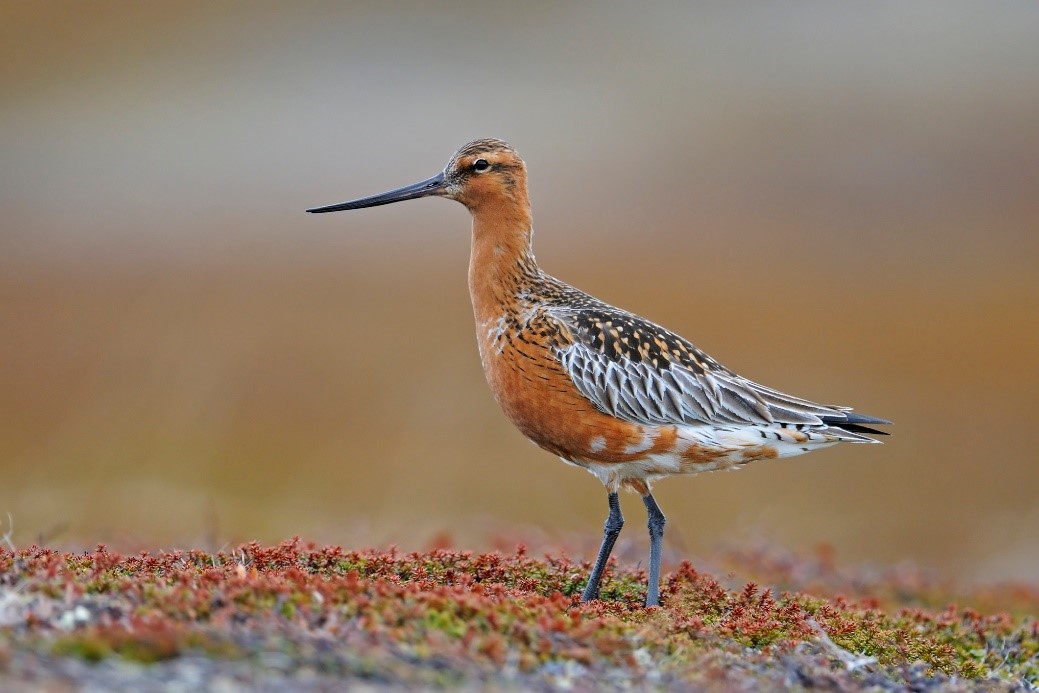
- Size – Males are smaller with shorter bills than females.
- Male – 39 cm
- Female – 41 cm
- Wingspan – 70-80cm.
- Call – It is onomatopoeic, which means it sounds similar to their name going ‘godwit, godwit’.
- Habitat – Marine and Intertidal, Wetland, Grassland, Mudflats, shores, tundra.
- Distribution – Widespread in summer across northern Europe and Asia.
- Diet – Mainly shellfish, marine snails and worms and shrimps.
- Breeding – It is in the Arctic of Scandinavia and Siberia.
- Conservation Status – IUCN – Near Threatened.
- Other Similar species
- Hudsonian godwit
- Marbled Godwit
- Whimbrel
- Terek Sandpiper
References
- The Hindu| Bar-Tailed Godwits
- RSPB| Bar-Tailed Godwits
- NZBO| Bar-Tailed Godwits
Japanese Encephalitis Virus (JEV)
Recently, a suspected case of Japanese Encephalitis Virus was reported in Bindapur, New Delhi.
- JEV – It is a mosquito-borne flavivirus that belongs to the same genus as dengue, Zika, yellow fever and West Nile viruses.
- It is spread through the bite of an infected mosquito especially a mosquitoes called Culex tritaeniorhynchus.
- This virus infection resulted in febrile illness, including meningitis or encephalitis.
- First case – Reported on 1871 in Japan.
- Symptoms – It doesn’t have any symptoms or have only mild symptoms in most of the people.
- Initial – Includes fever, headache, Seizures, gastrointestinal pain and vomiting.
- Severe – High fever, headache, neck stiffness, disorientation, weakness, coma, seizures, spastic paralysis and ultimately death.
- Signs – The time from infection until illness onset is typically 5–15 days.
- Transmission – It circulates in the environment between mosquitoes and other animals, namely wading birds and pigs.
- Humans infected with the virus when mosquitoes feed on other infected animals and then bite people.
- It is not transmitted from person-to-person, except rarely by blood transfusion.
- Region – In temperate areas of Asia, transmitted mainly during the warm season.
- In tropics and subtropics, transmission intensifies during the rainy season.
- Risk Factors – Majorly occur to children below 15 years of age.
- Less than 1% - Develop neurologic illness.
- 20–30% - Die due to inflammation in the brain.
- 30%-50% - Suffer permanent cognitive, behavioural illness such as seizures, hearing or vision loss, speech, language, memory, and communication problems or weakness of the limbs.
- Treatment - There is no antiviral treatment.
- It is focused on relieving severe signs and supporting the patients to overcome the infection.
- Vaccine - It is available to prevent disease.
- Rest, fluids, and counter pain medicine relieve some symptoms.
24 countries in the World Health Organisation (WHO) South-East Asia and Western Pacific Regions have endemic JEV transmission, exposing more than 3 billion people to risks of infection.
References
- The Indian Express| Japanese Encephalitis Virus (JEV)
- WHO| Japanese Encephalitis Virus (JEV)
- CDC| Japanese Encephalitis Virus (JEV)
Gelephu Mindfulness City
The Prime Minister recently inaugurated the International Cooperative Alliance (ICA) with Bhutan for the upcoming Gelephu Mindfulness City project.
- Gelephu Mindfulness City – It is an innovative urban development project that integrates economic growth with mindfulness, holistic living, and sustainability.
- Located on – The Indian border, about 30 km to the east of Sarpang in Bhutan.
- It is the biggest “co-operative project” in Bhutan.
- It is being developed as a “Zero Carbon” city.
- Government – It is a special administrative region in Bhutan, envisioned by the Majesty King Jigme Khesar Namgyel Wangchuck.
- It have its own government and the independence to have its own lawmaking, as well as an independent judiciary.
- Area – It is a massive city spread over 2,500 square km.
- 2 protected areas
- National Park.
- Wildlife Sanctuary.
- Its forests and biological corridors are teeming with wildlife.
- Land – It is beautiful and pristine, which is a biological hot spot with abundant potential for clean energy.
- Features - It is around a series of inhabitable bridges.
- It is a low-rise city which will have its own university, health care facilities for both western and traditional medicine.
- Its rivers have the potential to generate 4,000 to 5,000 megawatts of electricity through renewable energy.
- It plans to build a hydroelectric power project and a hydroponic greenhouse.
- Benefits – It is designed to be a hub of knowledge, technology, and finance, grounded in the values of mindfulness, sustainability and harmony.
- It is the place where people can live with harmony with others from all over the world.
- It is to improve the lives of Bhutanese people and take to the next level.
References
- The Hindu| Gelephu Mindfulness City
- GMC| Gelephu Mindfulness City
- NDTV| Gelephu Mindfulness City



