Stardust 1.0
- The United States of America’s Stardust 1.0 became the first commercial space launch powered by biofuel.
- Stardust 1.0 is a launch vehicle suited for student and budget payloads.
- It has a mass of 250 kg and can carry a maximum payload mass of 8 kg.
- It is manufactured by bluShift, an aerospace company that is developing rockets that are powered by bio-derived fuels.
- These rockets will help to launch small satellites called cubesats into space in a way that is relatively cheaper than using traditional rocket fuel and is less toxic for the environment.
Biofuel
- It is a blend of substances that can be had from any farm across the US.
- But broadly, biofuels are obtained from biomass, which can be converted directly into liquid fuels that can be used as transportation fuels.
- The two most common kinds of biofuels in use are ethanol and biodiesel and they both represent the first generation of biofuel technology.
- Ethanol is renewable and made from many kinds of plants.
- Biodiesel is produced by combining alcohol with new and used vegetable oils, animal fats or recycled cooking grease.
Green Tax
- To dissuade people from using polluting vehicles, the Union Transport
Ministry has approved a ‘green tax’ on vehicles of specified vintage.
- Green tax funds are to be kept in a separate account to help States measure pollution and tackle it.
- The policy is scheduled to come into force on April 1, 2022.
- Additional green tax of 10%-25% on the road tax is payable by commercial transport vehicles that are older than eight years at the time of fitness certification renewal, and for personal vehicles after 15 years.
- The policy provides exemptions for tractors, harvesters and tillers used in farms, hybrid, electric, ethanol, LPG and CNG-powered vehicles.
- It provides a lower green tax for public transport vehicles such as buses.
- A higher additional 50% of road tax is proposed for vehicles in highly polluted cities, and differential tax based on fuel and vehicle type.
- Vehicles of government departments and public sector units that are older than 15 years are to be deregistered and scrapped.
Neutrinos and Star Death
- Many stars, towards the end of their lifetimes, form supernovas - massive explosions that send their outer layers shooting into the space.
- Most of the energy of the supernova is carried away by neutrinos - tiny particles with no charge and which interact weakly with matter.
- Researching the mechanisms of Type II supernovas, IIT Guwahati has come up with new insights into the part played by neutrinos in the death of massive stars.
- They claim that a three-flavour model of neutrinos is needed to predict the dynamics of the supernova.
- They have found that the fast oscillations of neutrinos decide the flavour information of the supernova neutrinos.
Supernovas
- All stars burn nuclear fuel in their cores to produce energy.
- The heat generates internal pressure that pushes outwards.
- This pressure prevents the star from collapsing inward due to the action of gravity on its own mass.
- But when a star ages and runs out of fuel to burn, it starts to cool inside.
- This causes a lowering of its internal pressure and therefore the force of gravity wins; the star starts to collapse inwards.
- This builds up shock waves because it happens very suddenly, and the shock wave sends the outer material of the star flying. This is supernova.
- In stars that are more than eight times as massive as the Sun, the supernova is accompanied by a collapsing of the inner material of the dying star - this is known as Type II or core collapse supernova.
- The collapsing core may form a black hole or a neutron star, according to its mass.
Neutrinos
- Neutrinos come in three ‘flavours’ or ‘types’, and each flavour is associated with a light elementary particle.
- Electron-neutrino is associated with the electron; the muon-neutrino with the muon and the tau-neutrino with the tau particle.
- As they spew out of the raging supernova, the neutrinos can change from one flavour to another in a process known as neutrino oscillations.
- Due to the high density and energy of the supernova, several interesting features emerge as this is a nonlinear phenomenon.
- This phenomenon may generate neutrino oscillations happening simultaneously over different energies (unlike normal neutrino oscillation), termed collective neutrino oscillation.
- The oscillation result may dramatically change when one allows the evolution with the angular asymmetry, the oscillations can happen at a nanosecond time scale, termed fast oscillation.
MITRA Scheme
- The Government has proposed the Mega Investment Textiles Parks (MITRA) scheme, a game changer for the Indian Textiles Industry.
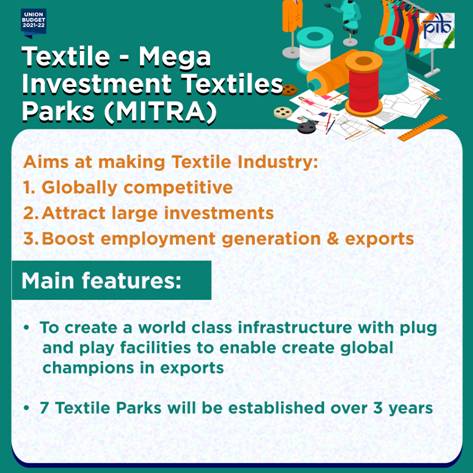
- This will create world class infrastructure with plug and play facilities to enable create global champions in exports.
- It would enable the textile industry to become globally competitive, attract large investments, boost employment generation and exports.
- Along with the Production Linked Incentive (PLI) scheme, MITRA will lead to increased investments and enhanced employment opportunities.
Jal Jeevan Mission Urban
- The Union Budget 2021-22 announced Jal Jeevan Mission (Urban).
- This mission aims to bring safe water to 2.86 crore households through tap connection with the target year as 2024.
- There is a need to roll out the urban mission with an aim to ensure sustainable supply of household drinking water in urban India.
- This mission in line with the Centre’s rural water supply project (2019).
- Jal Jeevan Mission (Rural) has covered only around 34% of the targeted households in rural India, which was haunted by the ‘slippage’ problem.
- [Slippage means villages or habitations covered with safe drinking water facilities slipping back to 'not-covered' status.]
- An equal emphasis on treatment of faecal sludge is also necessary.
- The current budget allocates Rs 9,994 crore for the toilet++ programme.
Green Hydrogen Energy Mission
- The Union Budget proposed to launch a Hydrogen Energy Mission in 2021-22 for generating hydrogen from green power sources.
- Hydrogen can be generated from many sources. But India stresses on the hydrogen sources from renewable sources.
- This mission would decarbonise heavy industries, and also holds the key to clean electric mobility that doesn’t depend on rare minerals.
- Hydrogen can act as an energy storage option, which would be essential to meet intermittencies (of renewable energy) in the future.
- Green hydrogen energy is vital for India to meet its Nationally Determined Contributions and ensure regional and national energy security, access and availability.
Source: PIB, The Indian Express, The Hindu, Down To Earth



