|
One Liners 23-06-2026
|
|
History, Art and Culture
|
|
Kalamkari Paintings
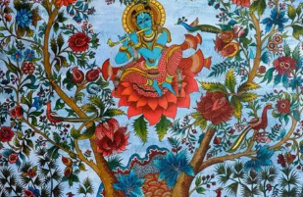
Recently, the Prime Minister of India gifted a Kalamkari Mahabharata painting to the French President.
-
It is an Indian art of hand-painting using natural dyes.
-
Name origin – Persian words “kalam (pen)” and “kari (craftsmanship)”, literally means "pen-work."
-
Practiced in – Andhra Pradesh.
-
Features –
Two traditional styles
-
Srikalahasti Style –
-
Relies on freehand drawing.
-
Uses a bamboo pen (kalam) with a cloth wrapped around it to absorb the dye.
-
Focuses on – Religious narratives, Hindu deities, scenes from Ramayana and Mahabharata, and Tree of Life motif.
-
Machilipatnam Style –
-
Relies on hand-carved wooden blocks to stamp outlines and primary patterns onto the cloth.
-
Origin – Islamic art influences.
-
Features – Dense, repeating floral patterns, vines, and geometric designs.
|
|
Rakhigarhi
AnSI recently received ancient skeletal remains from the site at Rakhigarhi for DNA analysis.
-
It is the largest known archaeological site of the Indus Valley (Harappan) Civilization.
-
Location – Hisar district of Haryana.
-
Archaeological findings –
-
Burnt-brick houses, drainage systems, and paved streets.
-
Jewellery-making units, copper and gold ornaments.
-
Extensive burial ground.
|
|
Anthropological Survey of India (AnSI)
-
It is an Apex authority for mapping India's vast cultural and biological diversity.
-
Founded in – 1945, Varanasi.
-
Headquarters – Indian Museum Complex, Kolkata.
-
Nodal ministry – Ministry of Culture.
-
Objectives –
-
To study indigenous communities and Particularly Vulnerable Tribal Groups.
-
To maintain high-tech facilities for DNA sequencing, paleoanthropology and biochemistry.
-
To document disappearing languages, creating ethnographic films, and archiving folk art.
|
|
Government Policies & Interventions
|
|
National Mission for Clean Ganga (NMCG)
Recently the International Day of Yoga 2026 Celebrations held across the Ganga Basin by NMCG.
-
Established in – 2011, under Societies Registration Act 1860.
-
Nodal ministry – Ministry of Jal Shakti.
-
Implementation arm of – National Ganga Council.
-
Management structure –
-
Governing Council.
-
Executive Committee.
-
Guiding principles –
-
Objectives –
|
|
National Ganga Council (NGC)
-
Establishment in – 2009, under Environment Protection Act, 1986.
-
Background – Initially National Ganga River Basin Authority dissolved and replaced by NGC in 2016.
-
Structure –
-
Chairperson – Prime Minister.
-
Members – Union Ministers and Chief Ministers of the five Ganga basin states (Uttarakhand, Uttar Pradesh, Bihar, Jharkhand, and West Bengal).
-
Implementation – NMCG under Ministry of Jal Shakti.
-
Responsible for – Superintendence, pollution prevention, and rejuvenation of the Ganga River Basin.
|
|
Development of Vehicle Service Facilities
NHAI directs development of vehicle repair and puncture service facilities at wayside amenities along national highways
-
To improving the travel experience, reducing vehicle downtime.
-
To enhancing road safety and ensuring prompt assistance.
-
To avoid inconvenience, delays, and potential safety concerns.
-
To develop a network of modern wayside amenities under the Public-Private Partnership.
|
|
National Highways Authority of India (NHAI)
-
Established – under the National Highways Authority of India Act, 1988.
-
Headquarters – New Delhi,
-
Nodal body for – Ministry of Road Transport and Highways (MoRTH).
-
Objectives –
-
To handles over 50,000 km of National Highways across the country.
-
To oversees major highway upgrades and greenfield expressway layouts.
-
To manage highway monetization via Toll-Operate-Transfer (TOT).
|
|
Agriculture
|
|
NAFED’s auction portal ‘NAFEX.in
Recently, Union Home Minister is set to launch NAFED’s auction portal ‘NAFEX.in’.
|
|
National Agricultural Cooperative Marketing Federation of India (NAFED)
|
|
Security
|
|
Central Industrial Security Force (CISF)
Recently union home minister lays foundation stone of new CISF Headquarters building in New Delhi.
-
It is the only Central Armed Police Force featuring its own specialized, industrial Fire Wing.
-
Nodal ministry – Ministry of Home Affairs (MHA)
-
Features – It bills commercial public and private establishments for its security deployment, and reimburse later.
-
Objectives –
-
To provide security to airports, space centers, and the Delhi Metro.
-
To safeguard the Parliament House Complex.
-
To strengthen CISF's operational and training capabilities
|