|
One Liners 05-10-2026
|
|
Polity & Governance
|
|
Intelligent Traffic Management System (ITMS)
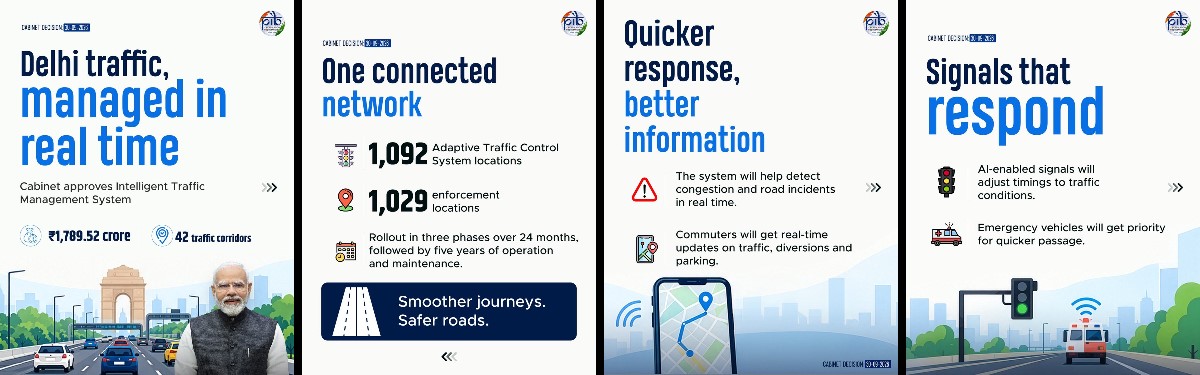
The Union Cabinet approved the Intelligent Traffic Management System (ITMS) project for Delhi, titled "One Network, Smarter Traffic," at an estimated cost of ₹1,789.52 crore.
- Key Project Details
- Cost – Rs.1, 789.52 crore (inclusive of taxes).
- Implementing Agency – Delhi Police.
- Timeline – Implemented in three phases over 24 months, followed by five years of operation and maintenance.
- Coverage – 42 major traffic corridors across Delhi.
- Main Features
- AI-Enabled Signals – Shifts from fixed timing signals to adaptive traffic control systems responding to real-time congestion.
- Emergency Priority – Facilitates green corridors and priority movement for ambulances.
- Automated Enforcement – Technology-driven violation detection and management.
- Real-Time Data: Integrated command-and-control systems providing live traffic information to commuters.
|
|
Standardisisation of names in Ladakh
India has standardized the names of 28 places and geographical features in Ladakh on the official Survey of India map to ensure accurate recognition and reinforce territorial sovereignty
- Overview of the Initiative
- Announcement – The Ministry of Home Affairs (MHA) announced the formal mapping in October 2026, carried out in consultation with the Union Territory administration of Ladakh.
- Strategic Context – The move serves as an authoritative national cartographic record and counters cartographic aggression or renaming attempts by China along the Line of Actual Control (LAC).
- Nodal Agency – The Survey of India (SoI) incorporated the updated nomenclature into official maps.
- Breakdown of the 28 Features
- Peaks (11) – Includes features like Zorawar Peak, Kanishka Peak, Atisha Giri, Martand Giri, Rinchen Zangpo, Sakyashree Giri, Marpa Lotsawa Ri, Milarepa Kangri, Shiva Ri, and Maheshwar Ri.
- Mountains (5) – Includes Karun Pir, Drak Karpo, and Zolmori mountains.
- Land Areas (6) – Includes strategic or known locations such as Brangsa, Kuksel, Dehra Compass (in the Aksai Chin region), Gogra, Kumarayana Point, Panglung, and Shamal Lungpa.
- Glaciers (2) – Parpik and Skamri Glacier.
- Passes (2) – Chapchingal Pass and Shachmirk Pass.
- Valley (1) – Shkorga Valley.
- River (1) – Yangpa River.
- Lake (1) – Guru Rinpoche.
- Other Water Body (1) – Hot Spring

|
|
International Relations and Issues
|
|
Indian Parliamentary Delegation to the 153rd Assembly of the Inter-Parliamentary Union (IPU)
Rajya Sabha Deputy Chairman Shri Harivansh is leading the Indian Parliamentary Delegation to the 153rd Assembly of the Inter-Parliamentary Union (IPU) in Arusha, Tanzania, taking place from October 5 to 9, 2026.
- Assembly Details
- Dates – October 5 to 9, 2026.
- Location – Arusha, United Republic of Tanzania.
- Theme – “Enhancing good governance and empowering communities through inclusivity, trust and opportunities for all.”
- Indian Delegation Members
- Leader – Shri Harivansh (Deputy Chairman, Rajya Sabha)
- Members – Shri Anurag Singh Thakur, Smt. Aparajita Sarangi, Dr. Sasmit Patra, Dr. Sanjay Jaiswal, Smt. Kamaljeet Sehrawat, Dr. Lata Wankhede, Smt. Bijuli Kalita Medhi, and Shri N. K. Premachandran.
- Key Focus Areas
- Engagements – Shri Harivansh is participating in the Governing Council, General Debate, emergency item debates, and the hearing for IPU President candidates.
- Topics – Discussions cover sustainable development, health, artificial intelligence, climate change, democracy, and human rights.

|
|
Economy
|
|
OECD’s Growth forecast for India
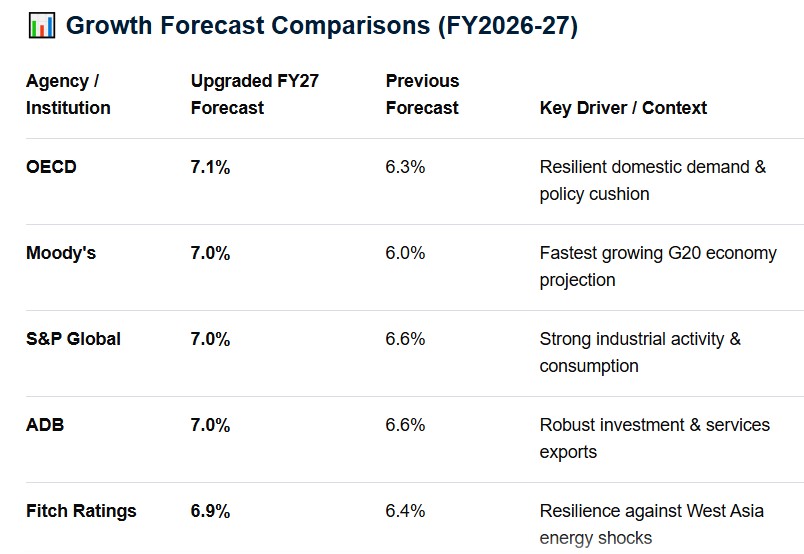
The OECD upgraded India’s FY2026-27 real GDP growth forecast by 80 basis points to 7.1%, joining other major global agencies in revising their outlooks upward following a stronger-than-expected 7.8% growth in the June quarter.
Growth Drivers
- Domestic Demand – Healthy private consumption and household resilience.
- Government Spending – Accelerating public capital expenditure and investment.
- Sector Performance – Robust manufacturing activity and strong services exports.
Downside Risks
- Second-Half Slowdown – Expected purchasing power moderation and fading tax-cut impacts.
- External Pressures – Elevated global energy prices driven by West Asia geopolitical tensions.
- Inflation & Rates – Potential policy rate hikes by the Reserve Bank of India to manage persistent inflation.
|
|
Infrastructure
|
|
First post-independence international cargo voyage
Union Minister for Ports, Shipping and Waterways Sarbananda Sonowal flagged off the first post-independence international cargo voyage from the Bogibeel Terminal in Dibrugarh, Assam, on October 5, 2026.
- Voyage Details
- Route – From Bogibeel Terminal (Dibrugarh, Assam) to Pangaon Port (Dhaka, Bangladesh) via National Waterway-2 (Brahmaputra River) and the Indo-Bangladesh Protocol Route.
- Cargo – Methanol (540 metric tons in the initial barge/vessel batch, part of a total 1,080-tonne planned consignment) produced by Assam Petro-Chemicals Limited (APCL) at Namrup.
- Vessel – Barge DLB Patkai pushed by tug Kushal Konwar.
- Significance
- Historical revival – Restores upper Assam's direct riverine trade link to global markets for the first time in nearly 70–80 years, reviving a pre-independence legacy.
- Economic impact – Provides a greener, cost-effective, and efficient logistics alternative to road and rail transport for Northeast India.

|
|
Environment
|
|
UN Pre-COP31 climate summit
The UN Pre-COP31 climate summit kicked off on October 5, 2026, in Nadi, Fiji, serving as a vital preparatory meeting ahead of the major COP31 global climate conference in Antalya, Türkiye, next month.
- Definition – A Pre-COP is an official preparatory meeting where ministers and climate negotiators from around 50 countries gather to iron out political differences, build consensus, and lay the groundwork for the upcoming annual UN climate summit (COP).
- The COP31 Context – Türkiye is hosting the official COP31 presidency, while Australia is leading the formal negotiations. As part of this arrangement, Australia partnered with Fiji and Tuvalu to host this year's Pre-COP in the Pacific.]
- Key Focus Areas of the Fiji Pre-COP
- Frontline Realities – Holding the summit in Fiji and the low-lying atoll nation of Tuvalu puts a direct spotlight on Pacific island nations facing existential threats from rising sea levels and extreme weather.
- Core Demands: Pacific leaders are strongly pushing to keep the critical global warming limit of 1.5°C within reach.
- Climate Finance: Attendees are addressing how to unlock and ease access to climate finance for vulnerable developing nations.
- Ocean Protection – Leaders are demanding a larger, more formal focus on the health of the world's oceans and marine ecosystems within UN climate policies.
|
|
Science
|
|
1,000-Km Milestone in Quantum Secure Communication
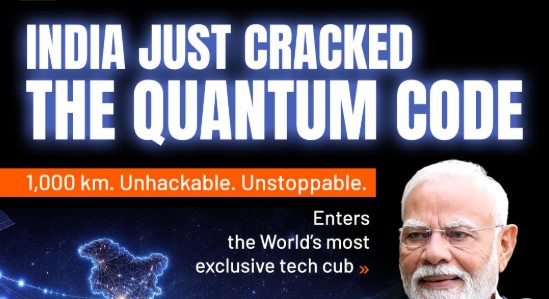
India has crossed the 1,000-kilometer milestone in quantum-secure communication in under three years, achieving more than half of its eight-year National Quantum Mission target ahead of schedule.
Key Details of the Milestone
- The Achievement – India successfully validated a terrestrial quantum communication link exceeding 1,000 km, placing the country alongside global leaders like the United States, China, and Europe in large-scale quantum deployment.
- The Technology – The network is powered by indigenous Quantum Key Distribution (QKD) technology (specifically platforms like ARMOS) developed by Bengaluru-based deep-tech startup QNu Labs, which was incubated at the IIT Madras Research Park.
- How It Works – QKD uses the principles of quantum physics rather than traditional mathematical algorithms to secure data.
- Any attempt by an outside party to intercept or observe the key changes the quantum state instantly, exposing the breach and preventing hidden attacks or silent data theft.
- Strategic Impact – This unhackable infrastructure directly integrates with existing commercial optical fiber telecom networks and heavily strengthens cybersecurity for defense, banking and financial systems, government communication, and critical national infrastructure.
- National Quantum Mission (NQM) – Approved with a substantial multi-crore outlay, the broader mission aims to eventually scale quantum-secure links to 2,000 km, build intermediate quantum computers, and foster deep-tech startup ecosystems.
|
|
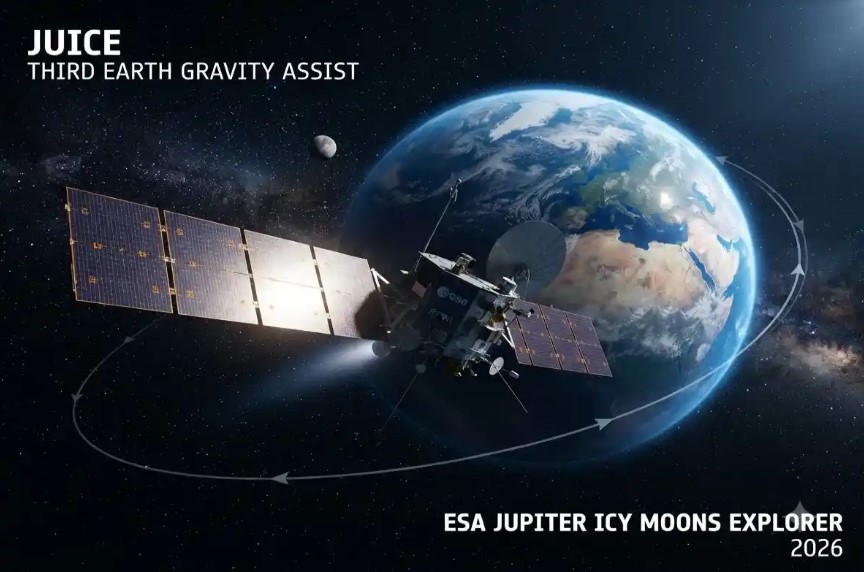
JUICE Mission – Third Earth Gravity Assist
JUICE (Jupiter Icy Moons Explorer), an ESA mission, completed its third Earth gravity assist on 28 September 2026.
- The spacecraft passed about 8,640 km above Earth over the Indian Ocean.
- Its trajectory was altered by approximately 20°.
- A gravity assist, or slingshot manoeuvre, uses the gravity and orbital motion of a planet or moon to change a spacecraft’s speed and direction.
- It helps spacecraft travel long distances while saving fuel.
- JUICE Mission
- Agency – European Space Agency (ESA)
- Objective – Study Jupiter and its three large icy moons:
- Primary focus – Ganymede, the largest moon in the Solar System.
- 2026 Earth Flyby
- During the September 2026 flyby, JUICE gained about 12,606 km/h (3.5 km/s) in speed.
- Only one small course correction was required before the encounter.
- The flyby helped modify JUICE's trajectory toward the Jupiter system.
- Mission Timeline
- 2031 – Planned arrival and orbit insertion around Jupiter.
- 2034 – Planned entry into Ganymede orbit.
- The mission uses multiple planetary flybys to achieve the required velocity while minimising fuel consumption.
|
|
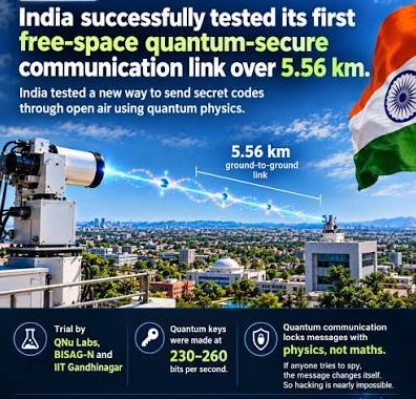
India’s First Free-Space QKD Link
QNu Labs, in collaboration with BISAG-N and IIT Gandhinagar, demonstrated India’s first free-space Quantum Key Distribution (QKD) link.
- The link covered 5.56 km between BISAG-N and IIT Gandhinagar.
- The field trial was conducted during 27–28 September 2026.
- Key Achievements
- Achieved a stable Quantum Bit Error Rate (QBER) below 5%.
- Generated secure quantum keys at 230–260 bits per second (bps).
- Enabled successful end-to-end encryption and decryption of test messages.
- Technology Used
- QNu Labs’ Armos – Hardware-based QKD system operating through free-space optical channels.
- Pointing, Acquisition and Tracking (PAT): Used to maintain the optical communication link.
- BISAG-N’s Vedic Kavach – Software-based post-quantum cryptography platform.
- Quantum Random Number Generation (QRNG): Added another layer of security.
- Two-Layer Quantum Security
- The demonstration combined:
- QKD-based physical security for secure key generation and distribution.
- Post-quantum cryptography (PQC) to protect communications against future quantum-computing threats.
- This architecture can maintain security even if the quantum channel is temporarily unavailable.
- Strategic Significance
- Strengthens India’s capabilities in quantum-secure communication.
- Provides a foundation for developing longer-distance quantum networks.
- May support future satellite-based quantum communication.
- Demonstrates collaboration between indigenous industry, academia and government institutions.
|
|
Miscellaneous
|
|
World Habitat Day 2026
World Habitat Day 2026 was observed on October 5, 2026, focusing on the global theme "Adequate Housing for All" to address the housing crisis affecting billions worldwide.
- Key Details of World Habitat Day 2026
- Global Observance Location – Held in Muscat, Oman, at the Oman Convention and Exhibition Centre from October 5 to 8, 2026.
- Official Theme – "Adequate Housing for All" (highlighting that nearly 3.4 billion people lack adequate housing or live in informal settlements/slums).
- Significance – The day officially marks the launch of Urban October, a month-long focus on sustainable urbanization ending with World Cities Day on October 31.
- UN-Habitat Scroll of Honour – Five global winners were recognized on October 5 for exceptional contributions to sustainable housing and Sustainable Development Goal 11 (SDG 11).

|



