|
One Liners 04-10-2026
|
|
History, Art and Culture
|
|
India's first lock museum
India's first lock museum is being built in Aligarh, Uttar Pradesh, to celebrate the city's rich lock-making history.
- Aligarh is famously known as Tala Nagri, or the City of Locks. The new museum will preserve this 150-year-old industrial heritage.
- History of Locks – Exhibits will show how locks evolved from the Vedic era to modern digital and cyber security systems.
- Local Craftsmanship – Displays will highlight Aligarh’s traditional handmade designs alongside modern hardware.
- The Wish Wall – A special area where visitors can attach locks as symbols of their prayers or messages
- Facilities for Visitors
- Workshops – Spaces where visitors can see live lock-making and learn traditional skills.
- Family Areas – A children's play zone, food courts, souvenir shops, and an auditorium.
- Business Platform – A space for local manufacturers to display modern products to global buyers.

|
|
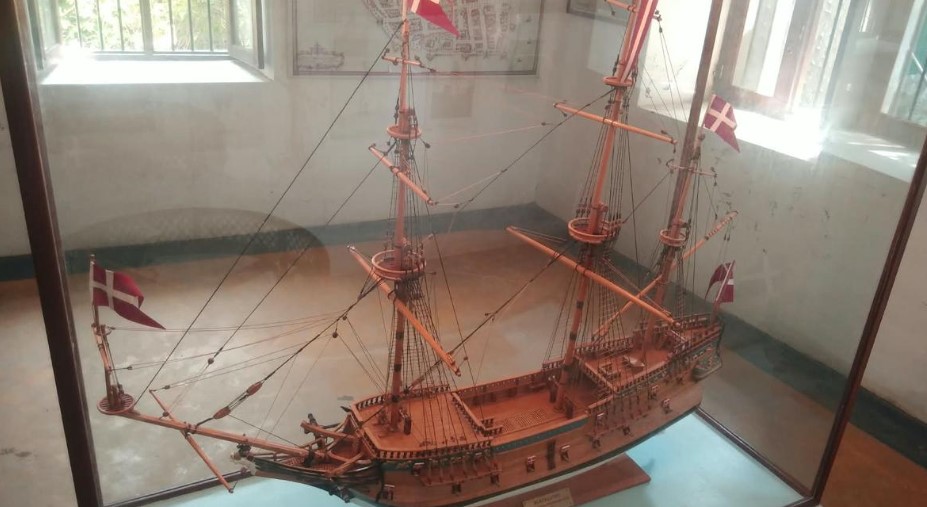
Danish Ship ‘Elephant’ – Tharangambadi
The model of ‘Elephant’, a Danish frigate, was donated to the Tranquebar Maritime Museum in Tamil Nadu by the Danish Tranquebar Association.
- Elephant is believed to be the first Danish ship to reach Tharangambadi in 1620.
- Danish Expedition – Elephant was part of a fleet of two warships and three merchant ships.
- The expedition aimed to establish trade links with South Asia.
- It was commanded by Admiral Ove Gedde.
- The fleet reached Tharangambadi on 13 September 1620.
- Treaty & Fort Dansborg – Admiral Ove Gedde subsequently signed a treaty with the Naik of Thanjavur, leading to the establishment of Danish presence and construction of Fort Dansborg at Tharangambadi.
- Museum Model – The ship model was built by Koge Maritime Model Builders’ Guild, Denmark, symbolising the historic friendship and cooperation between India and Denmark.
|
|
International Relations and Issues
|
|
FORTRESS America Initiative
FORTRESS America is a U.S. defense infrastructure and readiness initiative launched by Secretary of War Pete Hegseth on September 30, 2026.
- An acronym for Federal Operations for Resilience, Troop Resources, Energy, Supply, and Survivability, the program is designed as a "national insurance policy" to decouple domestic military capabilities from external vulnerabilities and foreign dependencies.
- Core Objectives
- Grid Independence – Mandates that every major domestic military installation generate its own power to maintain continuous operations during cyberattacks, blackouts, or sabotage.
- Supply-Chain Repatriation – Brings the manufacturing, mining, and refining of critical materials—such as rare earth elements, specialty metals, semiconductors, and propellants—back to the United States.
- Strategic Reserves – Builds up domestic stockpiles of essential wartime materials including fuel, munitions, blood, and medicine.
- Five Pillars of the Initiative
- Energy Independence – Self-sustaining power generation for military bases.
- Supply-Chain and Defense-Industrial Base Resilience – Securing domestic sources for critical production inputs.
- Strategic Defense Reserve – Enhancing stockpiles to survive major wartime supply line disruptions.
- Installation Hardening and Cyber Resilience – Protecting facilities against physical sabotage, drones, and cyber threats.
- Resilience in Space and Spectrum – Securing high-ground assets, communication airwaves, and satellite navigation.

|
|
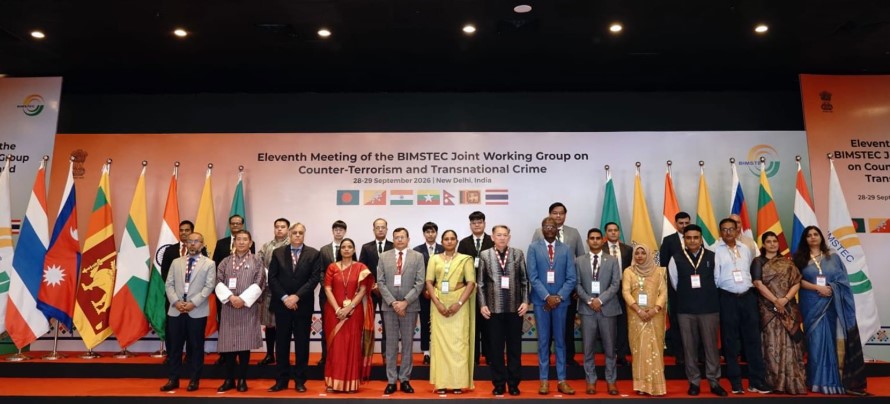
11th BIMSTEC Counter-Terrorism Meeting
The 11th Meeting of the BIMSTEC Joint Working Group on Counter Terrorism and Transnational Crime (JWG-CTTC) was held in New Delhi, India, on September 28–29, 2026.
- Key Details
- Host & Chair – Hosted by the Government of India and chaired by Dr. Suhel Ajaz Khan, Additional Secretary (Counter Terrorism) in the Ministry of External Affairs (MEA).
- Participants – Delegations from all seven BIMSTEC member states—Bangladesh, Bhutan, India, Myanmar, Nepal, Sri Lanka, and Thailand—attended.
- Core Focus – Discussions centered on traditional and emerging non-traditional security threats within the BIMSTEC region, as well as ways to strengthen regional collaboration.
- Major Agenda Items & Outcomes
- Sub-Group Reports – Reviewed reports from various sub-groups covering human trafficking, illicit drug and narcotic trafficking, anti-money laundering, counter-terrorism financing, legal enforcement, and countering radicalization.
- Action Plans & Endorsements – Endorsed outcome documents and action plans from constituent sub-groups regarding drug control, combating human trafficking, and illicit financial flows.
- Future Preparations – Laid the groundwork and prepared for upcoming meetings involving BIMSTEC Senior Officials of Home Ministries and Home Ministers.
|
|
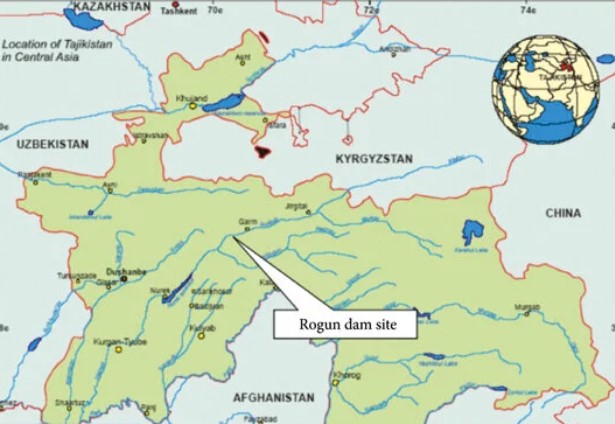
Tajikistan's Rogun Hydropower Project
It is a massive 335-meter-high clay-core rockfill dam on the Vakhsh River that is set to become the tallest dam in the world.
- Project Overview
- Location – Vakhsh River in Tajikistan, about 110 kilometers from the capital city of Dushanbe.
- Builder – Constructed by Italian engineering firm Webuild Group for OJSC Rogun HPP.
- Timeline – Construction began during the Soviet era in 1976, stopped in 1991, and restarted later to secure energy independence.
- Key Specifications
- Final Height – 335 meters (currently standing at about 190 meters and 1,155 meters above sea level).
- Power Capacity – 3,600 MW total capacity across six planned 600 MW turbines.
- Current Status – Two turbines are already active and generating electricity while construction continues upward. The third unit is scheduled for 2027.
- Benefits and Impact
- Energy Output – Doubles Tajikistan's national electricity production and helps eliminate severe winter power outages.
- Regional Supply – Provides reliable renewable energy to roughly 10 million people and supports export plans to neighboring countries.
- Financing – Backed significantly by the World Bank alongside other international and domestic funds.
|
|
Sports
|
|
Kumkum Mohod – Asian Games 2026
Kumkum Mohod, a 17-year-old Indian archer, won India’s first gold medal in the women’s individual recurve event at the Asian Games 2026.
- She defeated South Korea’s Oh Yejin in a shoot-off after the final ended 5–5.
- In the shoot-off, Kumkum scored a perfect 10, while Oh Yejin scored 8.
- Recurve Archery – It is an Olympic and Asian Games discipline governed by World Archery.
- The limbs of a recurve bow curve away from the archer when unstrung.
- It is used in target archery competitions.
- Match Format & Scoring – Individual recurve matches are conducted in sets.
- The first archer to reach 6 set points normally wins.
- If the match is tied, a shoot-off is conducted.
- Each archer shoots one arrow; the higher score wins.
- If scores are equal, proximity to the centre determines the winner.

|
|
Environment
|
|
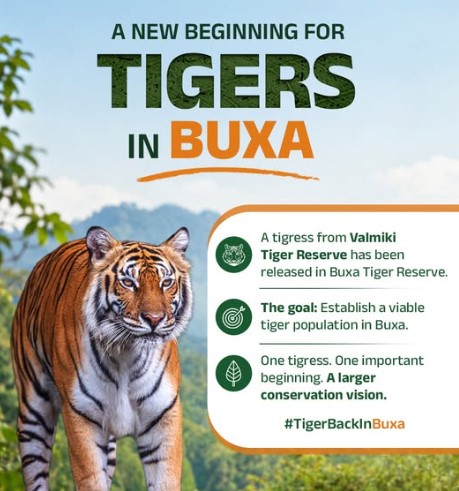
First Tigress in Buxa Tiger Reserve
The Union Environment Minister and the West Bengal Chief Minister released the first tigress translocated from Bihar’s Valmiki Tiger Reserve into Buxa Tiger Reserve.
- The initiative was undertaken to mark Wildlife Week 2026.
- It forms part of efforts to restore a self-sustaining tiger population in Buxa.
- Buxa Tiger Reserve
- Location – Dooars region, West Bengal.
- Tiger Reserve – Notified as India’s 15th Tiger Reserve in 1983.
- National Park – Declared in 1997.
- Altitude – Extends from plains to around 1,750 m.
- Vegetation – Moist tropical forests.
- Wildlife – Asian elephants, gaur, clouded leopards, leopard cats, marbled cats and dholes.
- Aquatic ecosystem – Hill streams provide habitat for mahseer.
- Important Wildlife Corridors
- Buxa forms part of a wider transboundary landscape connecting:
- Phipsoo Wildlife Sanctuary – Bhutan
- Jaldapara National Park – West Bengal
- Ripu Reserve Forest – Assam
- Manas Tiger Reserve – Assam
- Tiger Reintroduction Programme – A scientific conservation programme involving:
Translocation → Acclimatisation → Release → Monitoring
- Its objective is to restore self-sustaining breeding tiger populations in their historical habitats.
- Guided by the Wildlife (Protection) Act, 1972.
- National Tiger Conservation Authority (NTCA) provides the institutional framework.
- Wildlife Institute of India (WII) provides scientific and technical support.
- Buxa Recovery Project
- Tiger Augmentation and Recovery Project began in 2018.
- Collaboration among:
- West Bengal Forest Department
- NTCA
- Wildlife Institute of India (WII)
- Main Objectives
- Restore a self-sustaining tiger population.
- Improve prey availability.
- Enhance habitat quality and connectivity.
- Strengthen human–wildlife coexistence.
- Re-establish tigers within their historical range.
|
|
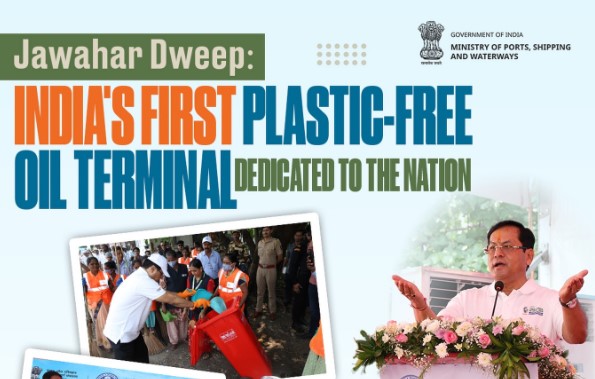
India's first plastic-free oil terminal
The Mumbai Port Authority declared the Jawahar Dweep Marine Oil Terminal India's first plastic-free oil terminal on October 2, 2026, during the Swachhata Abhiyan 2026 cleanliness campaign.
- Key Details of the Milestone
- Location – Jawahar Dweep (also called Butcher Island) sits about four kilometers off the coast of Mumbai in Maharashtra.
- Announcement Date – October 2, 2026 (Gandhi Jayanti), coinciding with the Swachhata Abhiyan drive led by Union Minister of Ports, Shipping and Waterways Sarbananda Sonowal.
- Operations – The offshore terminal features five berths/jetties handling crude oil and petroleum products for major refineries like BPCL, HPCL, IOCL, and ONGC.
- Significance – Single-use plastics have been completely banned and eliminated from the island facility to curb marine pollution.
- Broader Port Initiatives
- The Mumbai Port Authority plans to extend similar single-use plastic reductions to its docks, nearby residential colonies, and coastal areas.
- New Oil Spill Response facilities were also dedicated to the nation during the same event.
|
|
Science
|
|
TAPAS-1
TAPAS-1 (Thermal Access Platform for Analytics & Solutions) is India’s first indigenously designed commercial private thermal-imaging nanosatellite payload.
- It is a 1.5-kg modular CubeSat developed by Ahmedabad-based Satleo Labs.
- Launch & Orbit
- Launched aboard SpaceX’s Falcon 9 under the Transporter-18 rideshare mission from California.
- Deployed into a 500-km Sun-Synchronous Low Earth Orbit (LEO).
- Designed for a three-year operational mission.
- Technology & Objective
- TAPAS-1 captures thermal infrared radiation emitted by Earth’s surface, functioning as an orbital thermometer. It aims to provide cost-effective, high-resolution thermal intelligence to commercial, civic and defence users.
- Major Applications
- Urban – Urban Heat Island mapping and heat-stress management.
- Agriculture – Crop stress, soil moisture and irrigation monitoring.
- Disaster Management – Wildfire and industrial hotspot detection.
- Geology & Archaeology – Detection of buried structures and geological features.
- AI Analytics – Cloud-based machine learning converts thermal data into actionable insights.

|
|
Miscellaneous
|
|
India’s First WASH Social Bond
NABKISAN Finance Limited, a subsidiary of NABARD, listed India's first Water, Sanitation, and Hygiene (WASH) social bond on the National Stock Exchange (NSE) on October 1, 2026.
- Key Details of the Bond
- Amount Raised – Rs.180 crore (oversubscribed 1.8 times by investors).
- Tenure – 5 years, maturing in September 2031.
- Coupon Rate – 8.10%.
- Credit Ratings – CRISIL AAA (Stable) and CARE AAA (Stable).
- Use of Proceeds – To expand safe water, sanitation, and hygiene infrastructure in rural and underserved communities.
- Knowledge Partner – Water.org

|



