Prelims: Current events of national and international importance | Science & Technology
Why in News?
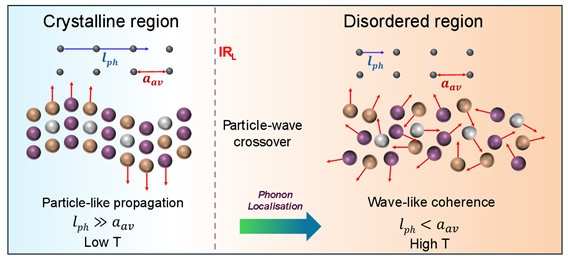
Recently, Indian researchers discovered a rare particle-to-wave-like phonon heat transport mechanism in Tl₂AgI₃.
- Tl₂AgI₃ – It is a zero-dimensional inorganic metal halide crystalline material with discrete cluster-like building blocks.
- i.e., A crystal made of tiny isolated groups of atoms.
- Developed by – Researchers at Jawaharlal Nehru Centre for Advanced Scientific Research (JNCASR), Bengaluru.
- Nodal Authority – Department of Science and Technology (DST).
- Components – Tl₂AgI₃ is composed of Thallium (Tl), Silver (Ag), and Iodine (I) atoms.
- Discrete cluster of subunits include (Tl₆I)⁵⁺ and (Ag₃I₈)⁵⁻ in the crystal structure.
- Working Principle – Atomic Repulsion and Distortion – Pauling’s third rule–driven cation–cation repulsion causes local structural distortions and anharmonicity.
- i.e., Positive atoms pushed too close move out of place, creating a shaky structure that blocks heat flow.
- Phonon Trapping – This leads to phonon localization and breakdown of the phonon-gas model.
- i.e., Heat vibrations get trapped instead of flowing normally through the material.
- Wave-like Heat Tunnelling – With rising temperature, heat transport shifts from particle-like scattering to wave-like coherent tunnelling, analysed using the linearized Wigner transport equation (LWTE).
- i.e., At higher temperatures, heat moves like waves tunnelling through obstacles rather than flowing smoothly.
- Key Features – Ultralow heat flow – The material blocks heat so effectively that it performs ultralow thermal conductivity.
- Heat-proof stability – Once the material reaches a certain warmth, its ability to block heat stays constant regardless of how much hotter it gets, unlike most materials that change.
- Applications –
- Thermal insulators.
- Thermoelectric materials.
- Advanced thermal management technologies.
- Benefits – Provides a new design strategy to suppress heat transport using structural confinement and local disorder.
- Enhances understanding of phonon physics in low-dimensional solids.
- Significance – Challenges the classical phonon-gas model of heat conduction in crystals.
- Establishes a mixed phononic regime (particle + wave) in crystalline solids.
- Positions India as a leader in fundamental materials research with technological relevance.
|
Quick Fact
|
- Phonons – They are quantised sound waves that represent the collective vibrations of atoms in a solid crystalline structure.
- Relevant to the behaviour of heat and sound in crystals.
- Phonons play a critical role in heat conduction, particularly in insulating materials where they facilitate thermal energy transfer, and they also influence electrical resistance in metals.
|
Reference
PIB | Unusual Particle-to-Wave Phonon Heat Transport in Solids



