0.1080
7667766266
x

UNSC - United Nations Security Council

iasparliament Logo
August 17, 2026

Mains: GS II – International organisations

Why in News?

India has recently launched its campaign for a two-year term on the United Nations Security Council (UNSC) for 2028–29. The election is scheduled for June 2027.
What is UNSC?

  • UNSC – The United Nations Security Council (UNSC) is one of the six main organs of the United Nations established under the UN Charter.
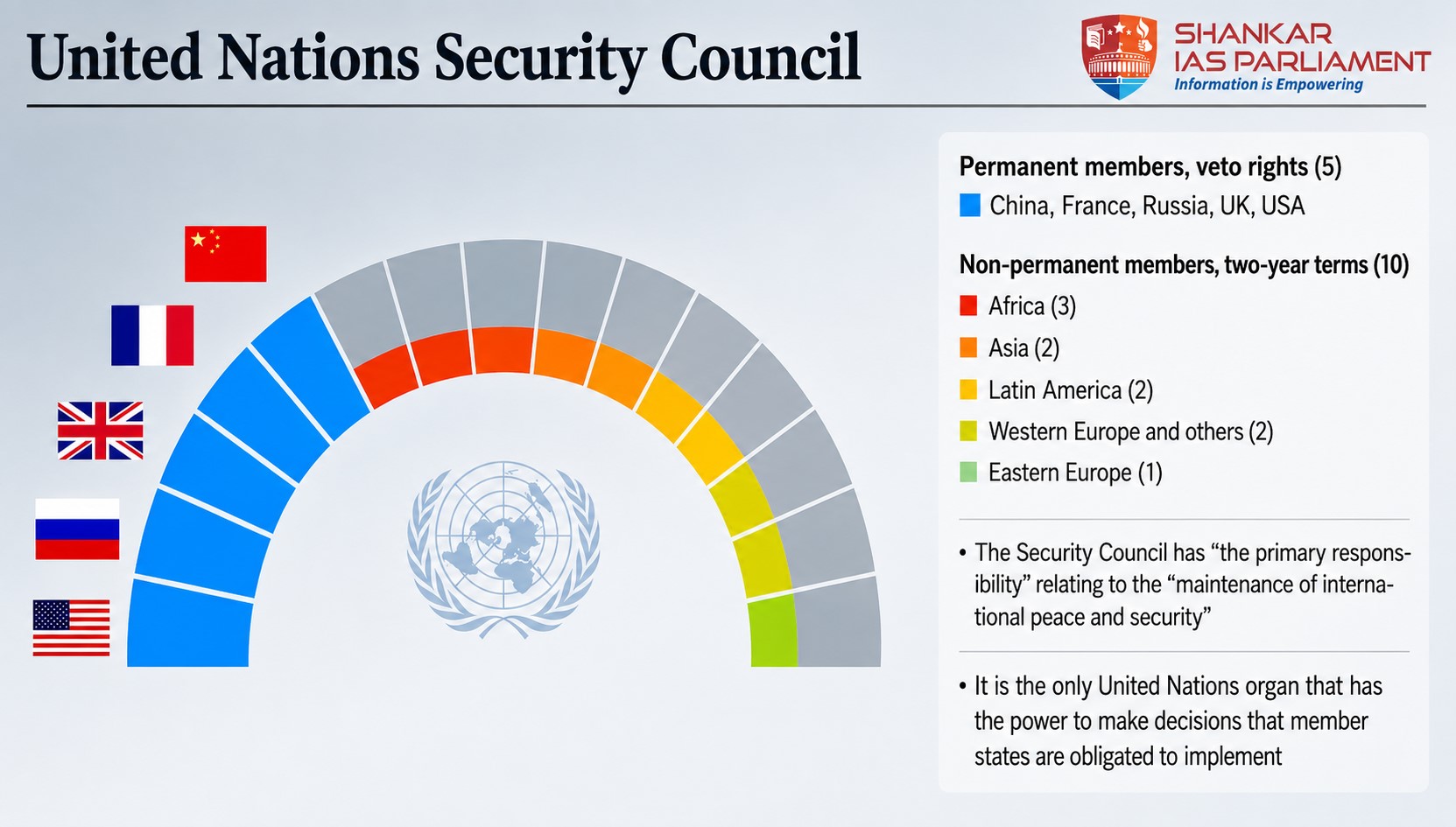
  • Mandate – The Security Council has primary responsibility for the maintenance of international peace and security.
  • Composition – The United Nations is divided into five regional groups: Asia, Africa, Latin America, Eastern Europe & Western Europe and Others (WEOG).
  • The WEOG grouping includes countries such as the United States, Canada, Australia, New Zealand and Israel.

UNSC India

  • Structure & members – The structure of the UNSC also reflects the historical legacy of the Second World War and the Cold War.
  • Permanent members – The United States, United Kingdom, France, Russia and China constitute the P5.
  • Non-permanent members – The ten other members are non-permanent members elected by the UN General Assembly for two-year terms.
  • The distribution of the ten elected seats is based on regional representation. Africa gets three seats, Eastern Europe gets one, while Asia and Latin America receive two seats each.
  • WEOG also receives two seats.
  • Five elected members retire every year, allowing for a regular rotation among the non-permanent members.

Why a permanent seat in UNSC matters?

  • Veto PowerAny of the five permanent members can block any substantive resolution single-handedly, even if the rest of the world agrees.
  • Binding DecisionsThe UNSC can issue legally binding mandates on all UN member states, such as imposing economic sanctions or authorizing military force.
  • Institutional PermanenceUnlike elected two-year non-permanent members, permanent members maintain uninterrupted influence and strategic presence.

A permanent seat on the United Nations Security Council (UNSC) matters because it grants exclusive veto power, permanent global decision-making authority, and the ability to shape international laws, peacekeeping missions, and global security responses.

Why India is demanding a permanent seat in UNSC?

  • Global RepresentationIndia represents roughly 1.4 billion people about 18% of the human population, who currently lack permanent representation on the council.
  • Voice of the Global SouthIndia champions the developing world, using platforms like the L.69 Group to advocate for marginalized nations.
  • Peacekeeping ContributionsIndia has served on the UNSC eight times as a non-permanent member and remains one of the largest troop contributors to UN peacekeeping missions globally.
  • Economic and Strategic WeightIndia is one of the world's fastest-growing major economies and possesses nuclear capabilities, positioning it as a responsible pillar of regional and international stability.

What are the key obstacles to India’s effort?

  • Veto Power and Charter ReformExpanding permanent seats requires amending the UN Charter, which demands a two-thirds majority in the General Assembly and approval from all current permanent members (P5).
  • Geopolitical ResistanceChina opposes India's inclusion, and regional competitor groups like the "Coffee Club" (or Uniting for Consensus) actively block competitive permanent expansion.
  • AlliancesWhile the U.S., France, the UK, and Russia express support for India's bid, turning diplomatic backing into structural reform remains an uphill battle.

What is the recent issue?

  • Competition for Non-permanent seat – India faces competition from Tajikistan for the single seat allocated to Asia.
  • From an outsider’s perspective, India’s candidature may appear straightforward, considering its global standing, G20 membership and long engagement with the United Nations.
  • However, recent UN elections demonstrate that diplomatic contests can produce unexpected outcomes.
  • Therefore, India’s campaign requires sustained and carefully planned diplomatic outreach across the international community.
  • If elected, this would be India’s ninth term as a non-permanent member of the UNSC.
  • The contest is significant not only for India’s immediate diplomatic interests but also for its larger aspiration for permanent membership of the Security Council.

What lies ahead?

  • India’s campaign for the 2028–29 UNSC term is therefore more than a contest against Tajikistan for a single Asian seat.
  • It is an opportunity to demonstrate India’s diplomatic reach, strengthen its engagement with countries across the Global South and reinforce its larger claim for permanent membership of the Security Council.
  • Recent UN elections show that outcomes cannot be taken for granted.
  • The experiences of Germany, the Philippines and Kyrgyzstan demonstrate the importance of group solidarity, political positions, bilateral relationships and the support of smaller states.
  • India’s successful experience in 2010 also shows that sustained diplomatic engagement can produce a strong electoral mandate.
  • With the election scheduled for June 2027, the early launch of India’s campaign provides an opportunity for extensive diplomatic outreach.
  • A robust and sustained campaign, building on India’s global standing while remaining attentive to the concerns and preferences of UN member states, will be essential for securing the required support.

Reference

The Indian Express| India & UNSC


Login or Register to Post Comments
There are no reviews yet. Be the first one to review.

ARCHIVES

sidetext


