0.2818
7667766266
x

The India-Middle East-Europe Economic Corridor (IMEC)

iasparliament Logo
June 05, 2026

Mains: GS II – International Relations

Why in News?

Recently, the evolving geopolitical landscape of West Asia, particularly the recent Iran conflict, has highlighted both the necessity and vulnerability of transnational connectivity projects.
What is IMEC?

  • IMEC – The India-Middle East-Europe Economic Corridor (IMEC) represents a landmark initiative aimed at enhancing economic integration across Asia, the Middle East, and Europe.
  • Announced – It was announced during the G20 Summit in New Delhi in 2023.
  • Signatories – India, the United States, Saudi Arabia, the United Arab Emirates, France, Germany, Italy, and the European Union.
  • Vision – It is a transformative initiative linking India, the Middle East, and Europe through an integrated network of ports, railways, energy pipelines, and digital infrastructure.
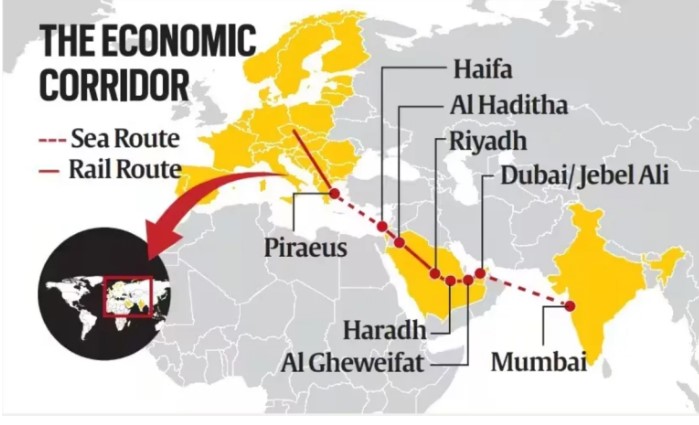
  • Key ComponentsThe corridor consists of three major segments:
    • Eastern Corridor – Connecting India with the United Arab Emirates through maritime links.
    • Middle Corridor – An overland network passing through the UAE, Saudi Arabia, Jordan, and Israel.
    • Western Corridor – Maritime connectivity from Israel’s Mediterranean coast to Europe.
  • Other components – Beyond transportation, IMEC seeks to establish the following:
    • Integrated railway networks
    • Modern port infrastructure
    • Energy transmission corridors
    • Green hydrogen pipelines
    • High-speed digital connectivity
    • Supply chain integration
  • Strategic ImportanceThe strategic significance of IMEC are as follows:
    • Reduce transportation time and logistics costs.
    • Diversify global trade routes.
    • Strengthen India's connectivity with Europe.
    • Enhance energy security.
    • Promote regional economic integration.
    • Provide an alternative to existing connectivity initiatives.
  • By creating a multimodal transport network, IMEC has the potential to reshape global commerce and supply chains.

IMEC

How the Iran Conflict Strengthens the Case for IMEC?

  • Need to bypass strategic choke points The blockade of the Strait of Hormuz has demonstrated the dangers of concentrating global trade through narrow maritime passages.
  • Similar vulnerabilities exist at other choke points such as the Suez Canal and the Strait of Malacca.
  • IMEC offers an alternative route that reduces dependence on these vulnerable maritime corridors and enhances supply chain resilience.
  • Strengthening energy securityEnergy security has emerged as a central concern for many countries.
  • The corridor’s proposed energy infrastructure, including electricity grids and green hydrogen pipelines, can diversify energy transportation routes and reduce risks arising from geopolitical conflicts.
  • Economic resilienceRecent disruptions in global supply chains—from the COVID-19 pandemic to regional conflicts—have highlighted the importance of diversified logistics networks.
  • IMEC can serve as a resilient economic corridor capable of sustaining trade even during geopolitical crises.
  • Strategic diversificationThe corridor aligns with the broader objective of creating multiple connectivity options rather than relying on a single route.
  • Such diversification enhances economic stability and reduces vulnerability to disruptions.

What are the challenges to IMEC in the current geopolitical environment?

  • Regional instabilityThe outbreak of the Gaza conflict soon after IMEC’s announcement significantly slowed progress.
  • Many sections of the planned corridor involve territories directly affected by regional tensions.
  • The subsequent escalation involving Iran has further complicated the security environment, raising concerns regarding infrastructure safety and investor confidence.
  • Vulnerability of key transit nodesMajor Gulf ports such as Jebel Ali and Fujairah have faced increasing security concerns due to their proximity to regional conflict zones.
  • Any disruption to these hubs can affect the corridor’s viability.
  • Similarly, Israel’s Port of Haifa, a crucial western terminal in the proposed corridor, remains exposed to geopolitical risks.
  • Divergence among regional partnersThe success of IMEC depends on close cooperation among participating countries.
  • However, emerging differences between key stakeholders, particularly Saudi Arabia and the UAE, present challenges.
  • Divergent foreign policy approaches, strategic competition, and evolving regional alliances may hinder the seamless coordination necessary for the corridor’s implementation.
  • Financial and security concernsLarge-scale infrastructure projects require substantial investments and long-term political stability.
  • Persistent regional conflicts increase project risks, discourage private investment, and raise insurance and transportation costs.

What is the need for adaptive connectivity strategies?

  • Exploring alternative routesOne possible strategy involves expanding the corridor framework to include alternative transit points.
  • On the eastern side, ports in Oman such as Salalah, Duqm, and Muscat offer attractive alternatives due to their location outside the Strait of Hormuz and relative insulation from regional conflicts.
  • On the western side, Egypt could emerge as a valuable partner. Its established logistics infrastructure, Mediterranean ports, and industrial zones can serve as alternative gateways connecting West Asia to Europe.
  • Building redundancy into supply chainsModern connectivity corridors must incorporate redundancy and multiple transit options.
  • A network-based approach rather than a single-route model can enhance resilience against geopolitical shocks.
  • Enhancing regional cooperationLong-term success requires sustained diplomatic engagement among participating countries.
  • Building institutional mechanisms for dispute resolution, economic coordination, and infrastructure governance will be critical.

What is India’s role in advancing IMEC?

  • Diplomatic bridge builderIndia enjoys constructive relations with Saudi Arabia, the UAE, Israel, Oman, and European partners.
  • This places it in a favourable position to facilitate dialogue and reduce regional tensions affecting the corridor.
  • Economic stakeholderAs one of the primary beneficiaries of IMEC, India has a strong incentive to ensure the project’s success.
  • Enhanced connectivity can support India's ambitions of becoming a major global manufacturing and trading hub.
  • Strategic leadershipIndia can provide leadership in developing resilient supply chains, promoting digital connectivity, and advancing sustainable energy partnerships under the IMEC framework.
  • Additionally, collaboration with European countries such as Italy and France can strengthen political support and mobilise investments for the project.

What are the ethical dimensions involved?

  • The IMEC reflects ethical commitments to global cooperation, equitable economic development, energy security, and resilient supply chains.
  • It raises questions of shared responsibility, regional peace, environmental sustainability through green energy, and inclusive growth.
  • Balancing geopolitical interests with collective welfare, stability, and trust among nations remains its central ethical challenge.

To take mains test click here

What lies ahead?

  • The Iran conflict has served as a powerful reminder of the vulnerabilities embedded in existing global trade and energy networks.
  • It has strengthened the strategic rationale for alternative connectivity initiatives such as the India-Middle East-Europe Economic Corridor.
  • However, the same conflict has also exposed the geopolitical complexities that threaten the corridor’s implementation.
  • The future of IMEC will depend on its ability to adapt to regional realities, diversify transit options, and foster cooperation among key stakeholders.
  • For India, IMEC represents not merely an infrastructure project but a strategic opportunity to shape emerging global connectivity networks.
  • Successfully navigating the intersection of commerce and geopolitics will determine whether IMEC becomes a transformative economic corridor or remains an unrealised geopolitical vision.

Reference

The Hindu| IMEC


Login or Register to Post Comments
There are no reviews yet. Be the first one to review.

ARCHIVES

MONTH/YEARWISE ARCHIVES

sidetext
Free UPSC Interview Guidance Programme
sidetext