Mains: GS I – World Geography| GS II International Relations
Why in News?
Recently, the Houthi authorities in Yemen have announced a maritime blockade targeting Saudi shipping and warned shipping companies against loading or unloading cargo at Saudi ports, according to Reuters.
What is Bab-el-Mandeb Strait?
- Description – The Bab el-Mandeb Strait is a vital 20-mile-wide waterway connecting the Red Sea to the Gulf of Aden and the Indian Ocean,
- Location – Located between Yemen on the Arabian Peninsula and Djibouti/Eritrea in East Africa.
- Often called the "Gate of Tears", it serves as a critical global shipping chokepoint linking Europe and Asia.
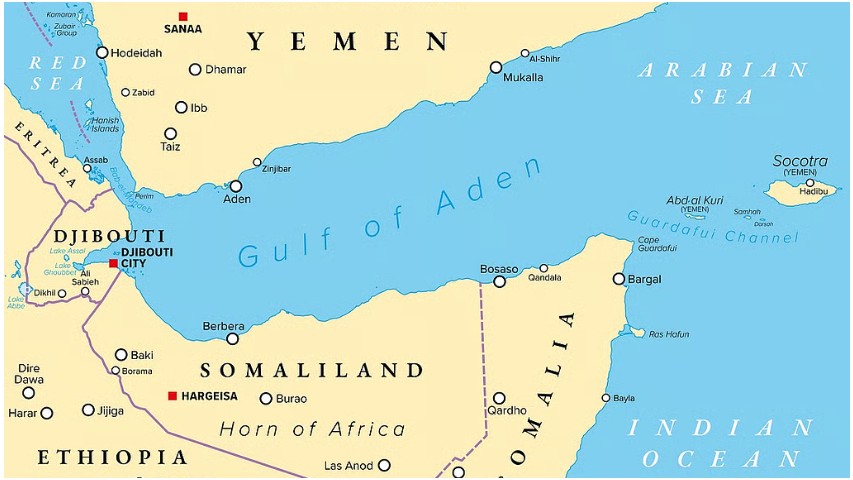
What is the significance of Bab-el-Mandab?
- Global Trade Artery – Roughly 10-12% of global trade and around 30% of global container traffic passes through this narrow strait.
- It is the shortest shipping route connecting manufacturing hubs in Asia to consumer markets in Europe and North America.
- Energy Security – It is one of the world's most critical chokepoints for crude oil, petroleum products, and liquefied natural gas (LNG), with millions of barrels per day flowing between the Persian Gulf and Western markets.
- Economic Leverage – The Bab el-Mandeb Strait links the Red Sea to the Gulf of Aden and serves as a critical gateway between Asia and Europe via the Suez Canal.
- It is one of the world's busiest maritime trade routes.
- If the strait is blocked or deemed too dangerous, shipping companies are forced to reroute vessels entirely around the Cape of Good Hope in South Africa.
- This diversion adds 10 to 14 days of transit time, sharply driving up global freight rates, insurance premiums, and consumer inflation.
- Geopolitics and Military Presence – Bordered by Yemen on the Arabian Peninsula and Djibouti and Eritrea on the Horn of Africa, the region is highly contested.
- Because of its proximity to both the Middle East and Africa, countries like the United States, China, and France maintain major military bases in neighboring Djibouti to monitor and protect this essential maritime corridor.
What are the current issues?
- Houthi Embargo – Yemen's Houthi movement has declared a maritime blockade targeting Saudi shipping and warning vessels against using Saudi ports, prompting tankers to reverse course.
- Iranian Signaling – Amid broader conflicts, Iran has instructed and positioned the Houthis with missiles and drones to potentially shut down the strait if U.S. forces strike Iranian infrastructure.
- Regional Instability – Ongoing conflict in Yemen and friction points involving neighboring Horn of Africa nations continue to destabilize the immediate coastal zones.
What are the past conflicts?
- The 2024 Red Sea Crisis – Following the outbreak of the Gaza war in October 2023, Yemen’s Houthi (Ansarallah) movement attacked vessels in the Red Sea that it claimed were linked to or bound for Israel.
- Between November 2023 and March 2024, at least 40 ships were targeted.
- International Response – The U.S. and its allies launched Operation Prosperity Guardian in December 2023 to safeguard freedom of navigation.
- The UN Security Council also adopted Resolution 2722 (2024), while Israel carried out strikes against Houthi positions.
- The Indian Navy rescued the crew of a British tanker during the crisis.
- Economic and Shipping Disruptions – The attacks forced more than 2,000 ships to avoid the Suez Canal and reroute around Africa’s Cape of Good Hope.
- This caused delays, increased shipping costs, disrupted India's imports, reduced Egypt’s Suez Canal revenues, and contributed to the bankruptcy of Israel’s Red Sea port of Eilat.
What will be the impacts if the strait is closed?
- Increase In Shipping Time And Cost – If the strait becomes inaccessible, ships would have to reroute around Africa’s Cape of Good Hope, adding 4,000–6,000 nautical miles and increasing transit times by 10–20 days.
- This would raise shipping costs and disrupt global supply chains.
- Global Trade at Risk – According to IMF data cited by The Economic Times, the Suez–Red Sea corridor carries about 12–15% of global maritime trade.
- It is a vital route for consumer goods, electronics, machinery, industrial inputs, chemicals, agricultural products, and energy supplies.
- Europe–Asia Supply Chains Could Be Disrupted – A significant share of Europe's trade with Asia depends on this corridor.
- Products such as electronics from East Asia, industrial equipment from China, consumer goods from South and Southeast Asia, and manufacturing components for Europe are transported through the Red Sea.
- Risks for India – Renewed Houthi attacks in the Bab el-Mandeb Strait could severely affect India's economy, particularly after disruptions in the Strait of Hormuz.
- Restricting Indian seafarers from operating on this busy route would be difficult and could affect the livelihoods and safety of thousands of Indian mariners.
IMO Reaffirms Freedom of Navigation At its 137th session on 13 July 2026, the International Maritime Organization (IMO) Council reaffirmed that transit through international straits must not be obstructed.
It also stressed that any regulation of traffic in key shipping lanes must comply with international law and the SOLAS Convention.
What could be done?
- India’s Recommended Strategy – India should work with France and Japan, both of which maintain military bases in Djibouti and have close naval cooperation with India, to establish a joint naval task force to deter attacks and secure commercial shipping in the Bab el-Mandeb.
- Strengthening Regional Cooperation – India should also engage Egypt and Saudi Arabia, whose economic interests are increasingly threatened by Red Sea disruptions.
- Their support could strengthen efforts to ensure safe navigation across the Red Sea.
- A Rules-Based Maritime Task Force – The proposed Trade Protection Task Force would focus on protecting commercial shipping rather than forming a military alliance.
- India’s Information Fusion Centre–Indian Ocean Region could provide maritime surveillance, while France and Japan could offer logistical support.
- The task force would escort vulnerable vessels, coordinate rules of engagement, and reinforce a rules-based maritime order under India's SAGAR (Security and Growth for All in the Region) vision.
References
- The Hindu| Bab-el-Mandeb
- BBC| Houthis in Bab-el-Mandeb



