Prelims– Current events of National and International Importance| Science & Technology
Why in News?
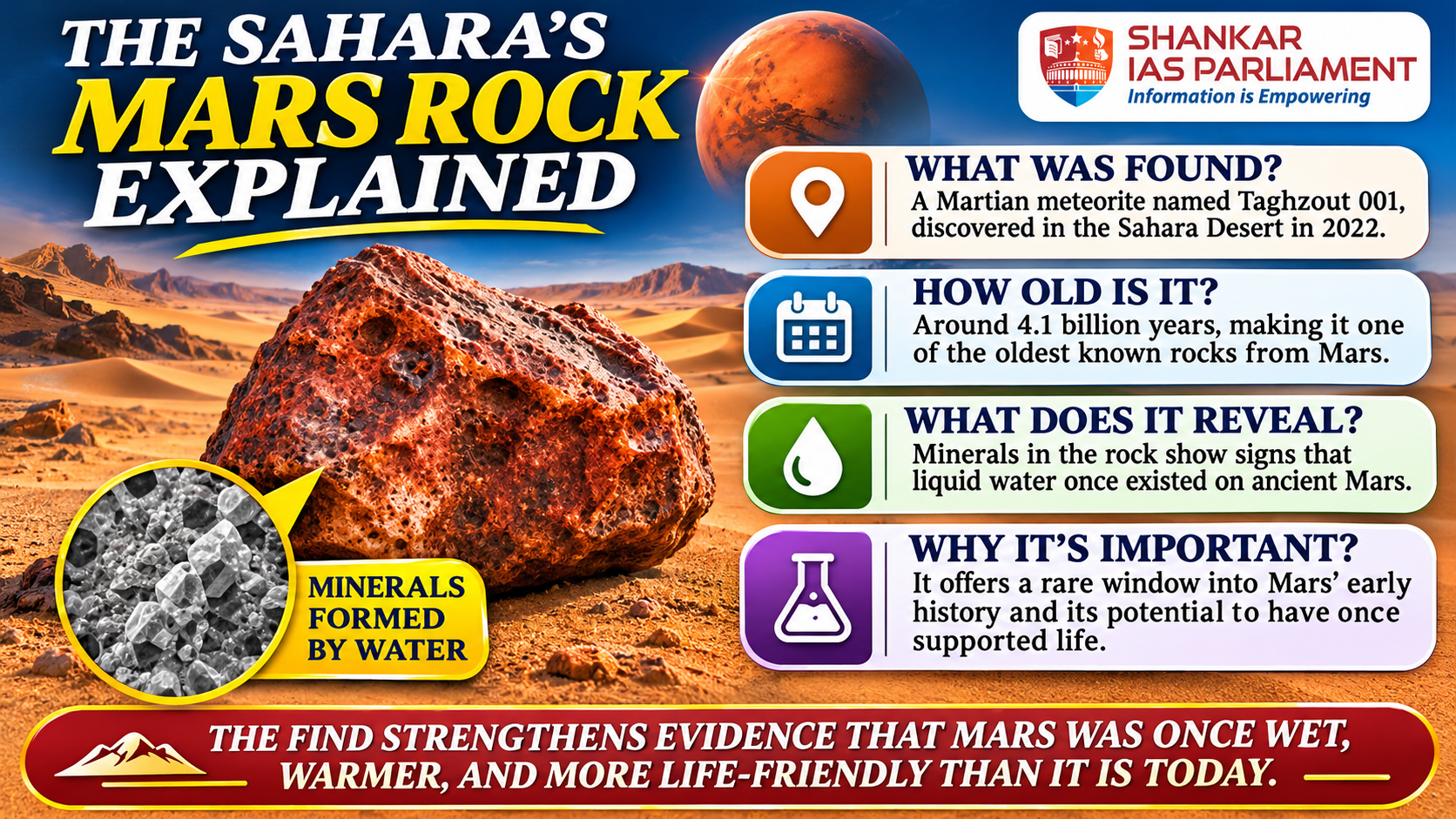
Teghaza 001 is a rare, rose-colored Martian meteorite—weighing about 800 grams and recovered from the Sahara Desert in Mali in 2022—that proves liquid water actively altered the Martian crust at least 4.1 billion years ago.
- Discoveries from Teghaza 001
- Age and Origin– Dated to over 4.1 billion years old using uranium-lead and rubidium-strontium dating on its zircon crystals, it is among the oldest Martian meteorites ever found on Earth. It formed as a coarse-grained gabbro rock deep in the Martian mantle before cooling in the crust.
- Water-Rock Interaction– Chemical analysis shows the mineral grains were altered by water while crystallizing underground, offering a snapshot of a dynamic, wet water cycle during the Noachian period.
- Unique Composition– Unlike other Martian samples (such as the SNC meteorite groups), Teghaza 001 features a distinct calcium-rich mineral makeup and unusual oxygen isotopes.
- Potential Habitability– The evidence of warm, water-rich conditions on early Mars strengthens the theory that the planet could have supported primordial or microbial life during its infancy.
- Geographic Match– Researchers used its chemical profile to trace its likely launch site back to 13 specific locations within Mars's cratered southern highlands.
Reference
The times of India| Teghaza 001



