Mains: GS-II – International relations
Why in news?
Switzerland remains neutral, but its approach reflects greater strategic flexibility - more than 70% of Swiss voters rejected a referendum seeking stricter neutrality, signalling a preference for flexible neutrality.
What are the provisions of Switzerland’s neutrality?
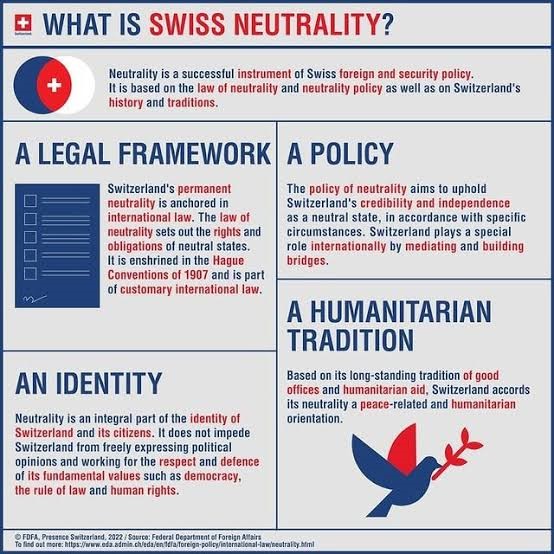
- Policy of neutrality – It means the country refuses to take part in armed conflicts, join military alliances, or provide military support to warring nations.
- Origin – The policy originated from the post-Napoleonic turbulence in Europe in the early 1800s.
- The policy became a defining feature of Swiss foreign policy as Europe experienced political and military upheavals.
- In addition to being a tax haven and celebrated for its chocolates, watches, and army knives, Switzerland became globally associated with neutrality.
- Constitutional status – The country’s neutral position has been enshrined in its Constitution since 1848, accepting a neutrality that is “permanent and armed”.
- Permanent nature – It prevents the country from taking part in any armed conflicts.
- Armed neutrality – Switzerland maintains armed forces to defend its territory and to prevent them from being misused for war-related purposes.
- However, this neutrality is not rigid, and policies have changed over time as the country has set up a buffer space to apply neutrality according to national interests.
- World War Scenarios – During the First World War, Switzerland managed to avoid being drawn into conflict by staying neutral.
- But following the war, it joined the League of Nations with “differential neutrality”, supporting its economic measures while being exempt from military obligations.
- In 1935, it adopted sanctions by the League against Italy, in a first major shift from neutrality.
- Following the Second World War, Switzerland reduced its involvement with the League and refrained from adopting sanctions.
- International engagement – Initially, hesitant to join the UN and kept its distance from the process of European integration in the second half of the 20th century.
- But, in the last two decades, Switzerland has increasingly made a space for itself in international organisations, becoming a UN Security Council member in 2022, and adopting UN and EU sanctions on other countries.
What did the referendum seek to achieve?
- Referendum background – Officially titled ‘Safeguard Swiss neutrality’, it sought amendments to the country’s Constitution, making neutrality stricter in practice.
- Introduced by – Pro Schweiz, a nationalist organisation, with former Federal Councillor Christoph Blocher and his right-wing Swiss People’s Party.
- Key triggers for the referendum – It was Switzerland taking part in sanctions on Russia by the European Union in 2022 in response to the invasion of Ukraine.
- Demands of referendum – Many of the proposals were already part of Switzerland's existing neutrality policy; supporters wanted them to be -
- Permanently embedded in the Constitution and declaring neutrality is “perpetual and armed”.
- Establish that the country will not join any military alliance, take part in armed conflicts between other countries, or impose sanctions against warring parties.
- Wanted to make sure that Switzerland is constitutionally obliged to use its neutrality to fulfil its role as mediator.
- Outcome – The referendum, which needed a double majority to be accepted, saw only 47.06% participation and was turned down with 70.15% no votes.
- All 26 cantons, or member states of the confederation, also rejected the referendum, showing overwhelming support for a “flexible neutrality”.
What was the government’s position regarding the referendum?
- Rejection of proposal – The Federal Council, a seven-member executive body which governs the country, had rejected the referendum without making any counterproposal.
- The Council argued that most of the initiative's demands were already being followed in practice.
- Existing Neutrality – According to the Federal Council, Switzerland already follows a policy of permanent neutrality and describing neutrality as "perpetual" would not bring any major change.
- Also, the demands of the initiative, which went beyond the current practice, could damage the country’s interests.
- Concerns – Stricter neutrality would curtail the current flexibility that the country enjoys in its foreign policy.
- The council said, stressing that “room for manoeuvre” was important amid a “deteriorating security situation”, in reference to the Russia-Ukraine war.
- It would impede cooperation on security policy, excluding the country from knowledge-sharing and making it less secure in the event of an attack.
What are the possible scenarios had the referendum passed?
- Government’s Concern – The Federal Council, in the run-up to the vote on the initiative, was of the view that, if passed, the referendum would mandate the country to lift sanctions against belligerent states, including those against Russia.
- This could lead to unfreeze Russian assets in Swiss banks.
- Impact on international order & Switzerland – Switzerland, as a small state, benefits from the international order being upheld and considers sanctions as a tool to respond to violations of and threats to this order.
- Switzerland would no longer be able to join sanctions by international agencies, like the UN, on warring countries, which could affect both its interests and reputation.
Reference
The Hindu | What is Switzerland’s ‘neutrality initiative’?



