Prelims: Current events of national and international importance | International Relations
Why in News?
Recently, Swiss voters voted on the “Safeguard Swiss Neutrality”, which sought to introduce a stricter definition of neutrality into Switzerland’s Federal Constitution.
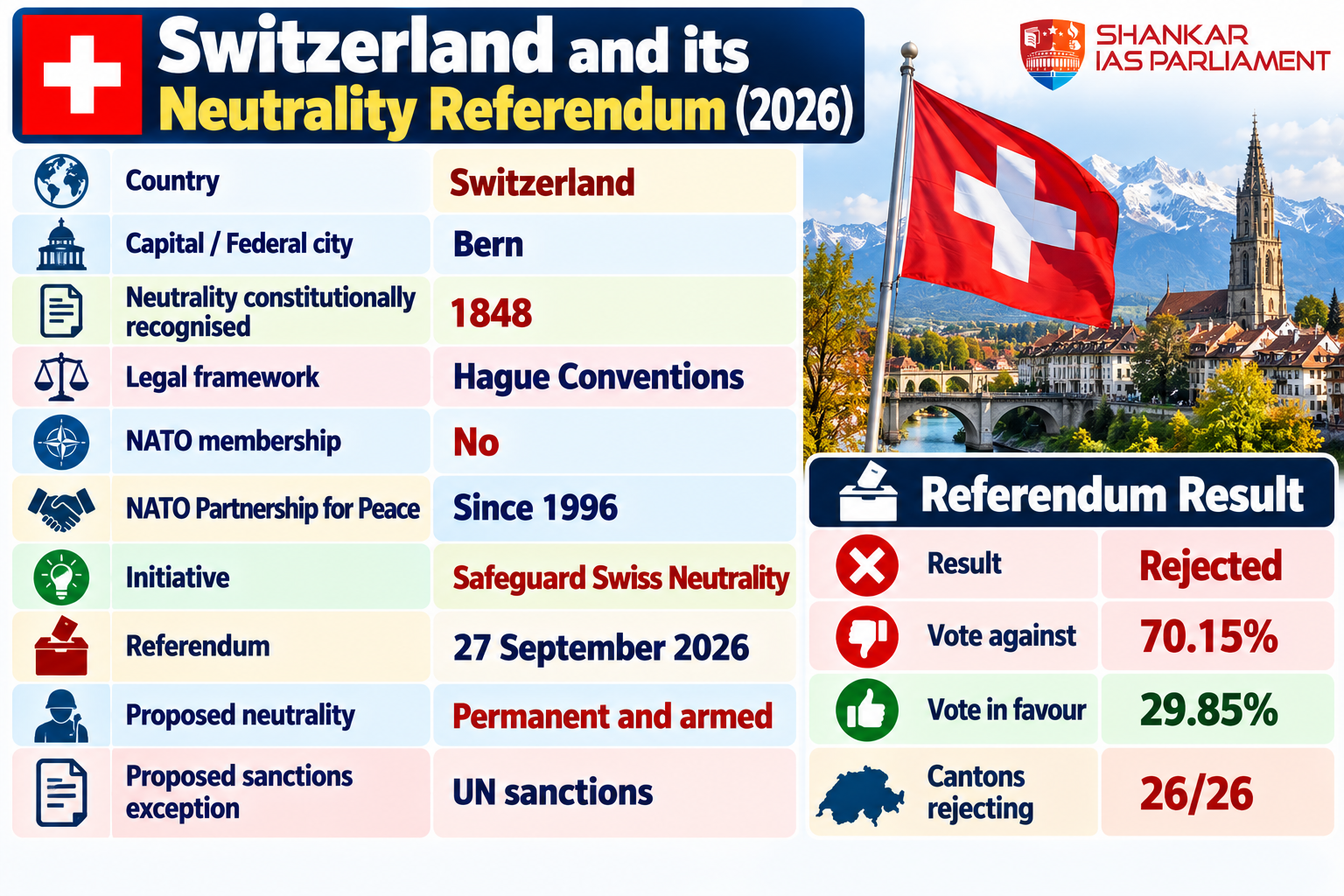
Proposal “Permanent and Armed Neutrality”
- Major provisions
- Switzerland would not join military or defence alliances.
- Switzerland would generally not cooperate with military alliances except in these cases:
- Switzerland is under military attack, or
- An attack is imminent or being prepared.
- Switzerland would not participate in armed conflicts between third countries.
- Switzerland would not impose sanctions against belligerent states.
- UN sanctions would remain an exception.
- Measures to prevent circumvention of sanctions would also be permitted.
- Neutrality would serve to strengthen Switzerland's role as an international mediator.
Switzerland is not a member of NATO.
- However, Switzerland has cooperated with NATO through various mechanisms, including Partnership for Peace (PfP).
- Switzerland has participated in NATO's Partnership for Peace since 1996.
- The PfP is a cooperative framework and does not constitute NATO membership.
- The proposed constitutional change would have significantly limited Switzerland’s military cooperation with NATO.
|
Background
|
- Swiss neutrality has been enshrined in the Federal Constitution since 1848.
- It is also recognised under international law.
- Switzerland adheres to the principle of armed neutrality, refraining from involvement in armed conflicts between other states while maintaining the capacity to defend its own territory.
- The legal framework of neutrality is linked to the Hague Conventions.
- Neutrality does not categorically prevent Switzerland from adopting political positions or implementing economic sanctions.
|
Reference
News on Air | Neutrality in Constitution



