Prelims – Current events of National and International importance| Science and Technology.
Why in News?
Recently, a team of scientists has discovered a rare quadruple star system in the milky way galaxy.
Milky Way Galaxy or Akasha Ganga is a huge collection of stars, dust and gas. It is called as a spiral galaxy because, when view it from the top or bottom, it would look like a spinning pinwheel.
- The system known as UPM J1040−3551 AabBab
- Composition – It consists of a pair of cold brown dwarfs orbiting a pair of young red dwarf stars.
- Location – 82 light-years from Earth in the constellation Antlia.
- Association with brown dwarfs – This is the 1st quadruple system ever discovered with a pair of T-type brown dwarfs orbiting 2 stars.
- Smaller stars and brown dwarfs are usually single, and the chance of a low-mass brown dwarf having a companion is below 5%.
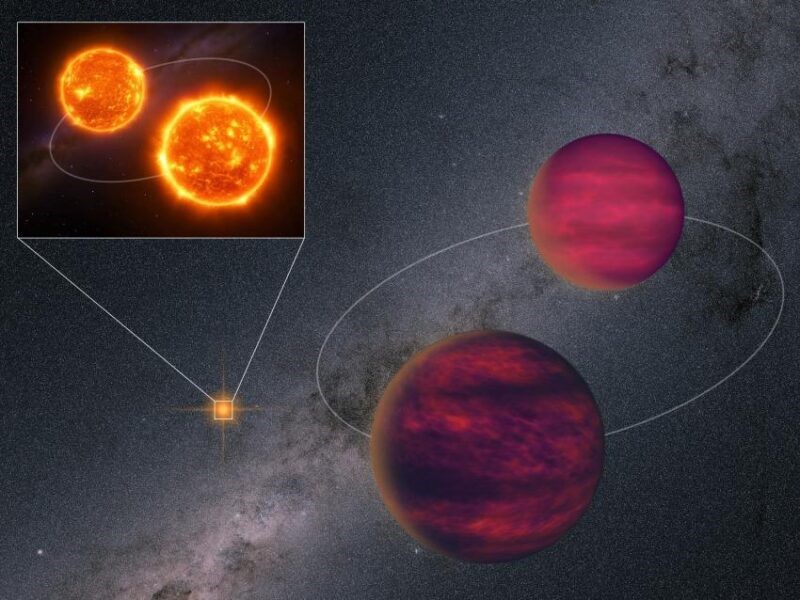
- It contains a pair of young red dwarfs, the most common type of stars in the Milky Way, which are much brighter than their companions.
- Significance of discovery – 2 brown dwarfs, which are about the size of Jupiter, in the system emit almost no visible light.
- It can help astronomers better understand the conditions that are necessary for the formation of stars and planets.
- The abundance and distribution of brown dwarfs help astronomers to understand mass distribution in the universe, much of which remains unseen as dark matter.
Brown Dwarfs
- Nature – They are curious celestial bodies that share some similarities with stars and others with planets.
- Formation – These objects form like stars from collapsing clouds of gas and dust.
- Detection – Brown dwarfs are difficult to detect as they are very cold and faint.
- Astronomers search for them in multiple-star systems, where brighter companion stars help in studying their properties.
- Size – 7 0 times more massive than Jupiter.
- Features – Atmospheres similar to gas giant planets such as Jupiter and Saturn, which consist of clouds and molecules like H2O.
- Failed stars – They do not have enough mass to consistently fuse hydrogen, a process that heats a star and makes it shine.
- Hence, they are often known as failed stars.
References
- The Indian Express| Rare Quadruple Star System
- Royal Astronomical Society| Unlock Mystery of Brown Dwarfs
Related News – Milkyway Galaxy | Dark Matters



