AT1 Bonds
The Bombay High Court Friday quashed the write-off of Additional Tier-1 (AT1) bonds issued by Yes Bank Ltd.
- AT1 bonds, short for Additional Tier 1 bonds, are a class of bonds issued by banks.
- These bonds are typically used by banks to bolster their core or tier-1 capital to meet Basel III norms.
- AT1 bonds are subordinate to all other debt and except common equity.
- They offer higher returns but also carry a higher risk.
- Tenor - AT1 bonds are unsecured bonds that have perpetual tenor.
- These bonds have no maturity date but have a call option by which the banks buy these bonds back from investors.
- Risks - AT1 bonds, like other bonds, pay regular interest.
- If the bank issuing is making losses or at risk of falling short of capital need, it has the discretion to either reduce or completely skip their interest pay out.
- When a bank becomes non-viable, AT-1 bonds are either converted into equity or written off based on the direction of the RBI.
References
- Business Line - What the Yes Bank AT1 bonds fiasco is all about
- IE - Additional Tier-1 bonds, and the case against Yes Bank
Kelp Forests
Kelp forests are declining because of climate change, showed a new study.
- Kelp forests are underwater ecosystems formed in shallow water by the dense growth of several different species known as kelps.
- Kelps are actually extremely large brown algae, although they look like plants.
- Kelp attaches to the seafloor and eventually grows to the water’s surface and relies on sunlight to generate food and energy.
- They thrive in cold, nutrient-rich waters.
- Kelp can sometimes persist at lower latitudes, aided by cool water upwelling or in deep-water refugia where they are protected by thermocline.
- Significance - Kelp forests have great ecological and economic value.
- They provide underwater habitats to hundreds of species of invertebrates, fishes, and other algae.
- Loss of kelp forests will also lead to a decline of the unique biodiversity that they support.
- The rear-edge populations (populations in warm, low-latitudes) of kelp may contain unique adaptive or evolutionary genetic diversity.
- Kelp populations at equatorward-range edges are particularly vulnerable to climate change and their unique trait is under threat.
Ecklonia radiate is a dominant and most widely distributed Laminarian kelp in the southern hemisphere which rapidly succumb to warmer temperatures (more than 27 °C).
References
- Down To Earth - Kelp forests losing unique traits due to climate change
National Mission for a Green India
India is lagging behind in the targets to increase the number and quality of tree- and forest-cover plantations set in the Green India Mission.
- National Mission for a Green India (GIM) is one of the eight Missions under the National Action Plan on Climate Change.
- It aims at protecting, restoring and enhancing India’s forest cover and responding to climate change.
- Improving tree cover is critical to sequester carbon and bolster India’s carbon stocks as part of its international commitments to mitigate greenhouse gas emissions.
- Target - The target under the Mission is 10 million hectares (Mha) on forest and non-forest lands for increasing the forest/tree cover and to improve the quality of existing forest.
- From 2015-16 to 2021-22, the Centre had approved a target of increasing tree/forest cover by 53,377 hectares and improving the quality of degraded forest by 1,66,656 ha in 17 districts.
- Achievement - From a RTI, it is known that the 17 States had increased tree/forest cover by 26,287 hectares and forest quality improved in only 1,02,096 hectares as of December 31, 2022.
- States with significant shortfall in tree cover include
|
States
|
Committed
|
Achieved
|
|
Andhra Pradesh
|
86 ha
|
75 ha
|
|
Uttarakhand
|
6,446 ha
|
1,505 ha
|
|
Madhya Pradesh
|
5,858 ha
|
1,882 ha
|
|
Kerala
|
1,686 ha
|
616 ha
|
- Punjab, committed to 629 ha but having delivered 1,082 ha.
- As per the India State of Forest Report-2021 , forest and tree cover in the country increased by 2,261 square kilometre since the last assessment in 2019.
- However critics have pointed out that the increase in green cover was almost entirely via commercial plantations.
|
National Action Plan on Climate Change
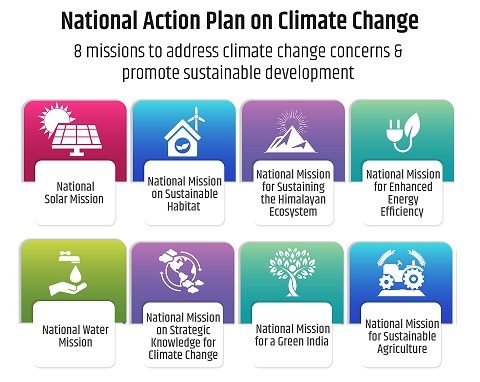 The National Action Plan on Climate Change (NAPCC) was launched in 2008. The National Action Plan on Climate Change (NAPCC) was launched in 2008.- There are 8 national missions forming the core of the NAPCC.
- They focus on promoting understanding of climate change, adaptation and mitigation, energy efficiency and natural resource conservation.
|
References
- The Hindu - States fall short of targets to improve forest cover
- Vikaspedia - National Action Plan on Climate change
Earth's Inner Core
A new research suggested that the Earth's inner core has stopped spinning faster than the planet's surface and might now be rotating slower than it.
- The Earth’s inner structure consists of 4 major layers:
- The outermost crust.
- The viscous but solid mantle below it.
- The liquid iron-nickel outer core.
- The solid iron inner core.
- Earth’s inner core is a hot iron ball in the size of Pluto, hence known as "planet within the planet".
- It is roughly 5,000 kilometers (3,100 miles) below the crust.
- Reason for rotation - Inner core can spin independently because it floats in the liquid metal outer core.
- The spin of the inner core is driven by the magnetic field generated in the outer core and balanced by the gravitational effects of the mantle.
- The rotation of the inner core is studied through various seismic records.
- Oscillation Cycle - The inner core rotates, relative to the Earth's surface, back and forth, like a swing and 1 cycle of the swing is about 7 decades.
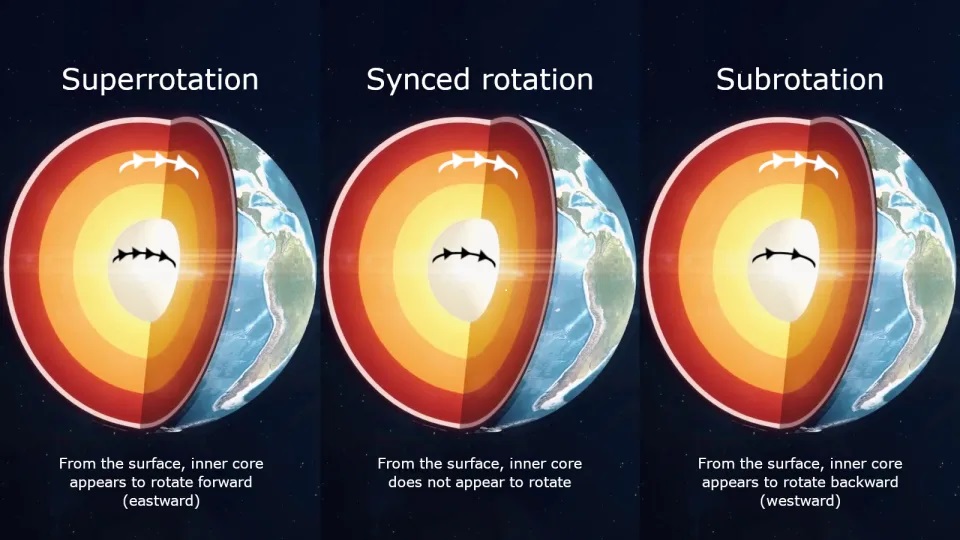
- The core is always rotating in the same direction that the entire planet rotates (eastward).
- Sometimes it rotates faster than the outer layers, other times it rotates slower, and there are times when the rotations match up.
|
Time Period
|
Relative to Earth
|
Name
|
|
1970s
|
Started rotating slightly faster
|
Super rotation
|
|
2009
|
Slowed down to rotate in sync
|
|
|
Since 2009
|
Started rotating slower
|
Sub rotation
|
|
Mid-2040s
|
predicted to have next change
|
|
- A new research suggested that the inner core's cycle is every 20 to 30 years, rather than the 70 proposed in the latest study.
- The changes rotation timeline is said to slightly impact the "length of day".
References
- The Hindu - Earth's inner core rotating slower than surface
- The Print - Earth’s inner core now spinning slower than planet?
Nitrate Radicals
A new study found that parts of China and India are night-time hotspots for the production of nitrate radicals, which makes air pollution worse.
- Nitrate radical is an oxide of nitrogen that consists of three oxygen atoms bound to a nitrogen atom.
- Nitrate radicals could increase the amount of unhealthy ozone and PM2.5 fine particulate matter in the atmosphere.
- Nitrate radicals will oxidise gas pollutants such as volatile organic compounds (VOCs).
- VOCs will then generate ozone and secondary organic aerosol, both deteriorates air quality.
- Ozone is an air pollutant that affects human health and crop yield.
- Secondary organic aerosol is an important component of PM2.5
- Reducing the emissions of VOCs could reduce this night-time oxidation in India and China.
References
- IE - 'Nitrate radicals’ are likely making air pollution worse
- Times Now - Nitrate Radicals: Making India, China air poisonous



