Gond Painting
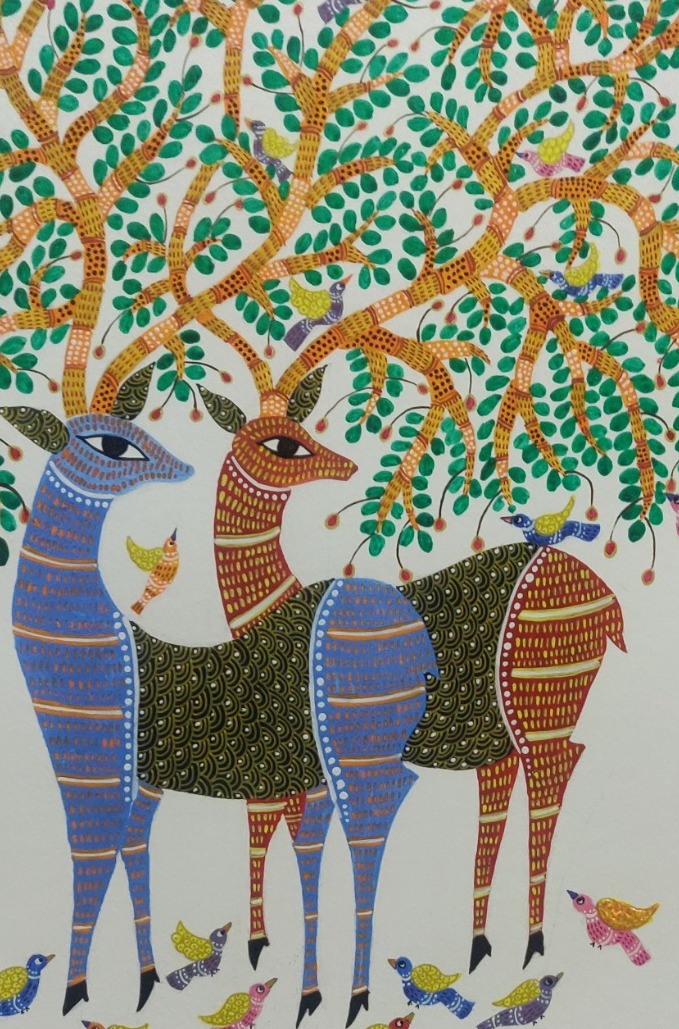
Gond painting from Madhya Pradesh receives GI tag.
Gond Tribes
- They are a community of aboriginal people located all over central and south-central India.
- Gonds have a recorded history of 1400 years.
- The word ‘Gond’ comes from the Dravidian expression ‘Kond’ which means ‘Green Mountain’.
- They live in the states of Madhya Pradesh, Maharashtra, Telangana, Andhra Pradesh, Bihar, and Odisha.
Gond Paintings
- The art is done with local colours and materials like charcoal, coloured soil, plant sap, leaves, cow dung, lime stone powder, etc.
- The images are tattoos or minimalist human, animal forms, the diminution of agricultural life and social patronage are used in this art form.
- The painting is done by first making dots and calculating the volume of the images.
- These dots are connected to bring about an outer shape, which is then filled with colours.
References
-
Britannica │Gond People
-
Indian Culture │ Gond Paintings
- Hindustan Times │ Gond painting from Madhya Pradesh receives GI tag
Mircha Rice
Mircha rice of Bihar's West Champaran gets GI tag.
- The size and shape of the grain appear like that of black pepper, hence it is known as Mircha or Marcha Rice.
- The grains and flakes of this rice have a unique aroma that makes it different.
- This rice is famous for its aroma, palatability and its aromatic chura (rice flakes) making qualities.
- The cooked rice is fluffy, non-sticky, sweet and easily digestible with a popcorn-like aroma.
- Other GI products from Bihar – Zardalu mango, Katarni rice of Bhagalpur, Shahi litchi of Muzaffarpur, Magahi paan of Magadh region, and Makhana of Mithila.
Reference
- Newson air │ ‘Mircha’ rice of Bihar’s West Champaran gets GI tag
Magnetoresistance
Graphene exhibits a unique property called magnetoresistance.
Graphene
- Graphene, building-block of Graphite, is a one-atom-thick layer of carbon atoms arranged in a hexagonal lattice (honeycomb pattern).
- Graphene is the thinnest material known to man and is incredibly strong, which is about 200 times stronger than steel.
- Graphene is an excellent conductor of heat and electricity and has light absorption abilities.
- Graphene has a multitude of properties which earns it the title as wonder material.
Magnetoresistance
- Magnetoresistance is the dependence of the electrical resistance of a body on an external magnetic field.
- Graphene displays an anomalous giant magnetoresistance (GMR) at room temperature.
- It is used in hard disk drives and magneto resistive RAM used in devices such as computers, biosensors, automotive sensors, microelectromechanical systems, and medical imagers.
GMR
- GMR is the result of the electrical resistance of a conductor being affected by magnetic fields in adjacent materials.
- Conventional GMR devices are cooled to low temperatures to suppress the kinetic energy of their constituent particles, keeping them from deflecting the electrons moving past them.
- In graphene, the researchers found this suppression unnecessary.
References
- The Hindu │What is magnetoresistance?
- Science Direct │Magnetoresistance
Uttaramerur Inscription
Prime Minister Narendra Modi referred to the Uttaramerur inscription in Kanchipuram, Tamil Nadu, while discussing India’s democratic history.
- The inscription has multiple inscriptions spanning centuries, the most famous is during the reign of Parantaka-I.
- Parantaka-I (907-953 AD) – He belongs to the Chola Dynasty.
- The inscriptions of Parantaka-I are found on the walls of the Vaikunda Perumal Temple.
- The inscription gives details of the functioning of the local Sabha, i.e., the village assembly.
- Sabha – It was an assembly exclusively of Brahmans and had specialised committees tasked with different things.
- This gave details about how members were selected, the required qualifications, their roles and responsibilities, and even the circumstances in which they could be removed.
- Qualifications – It includes ownership of a certain amount of land, having a house, being between the age of 35 and 70 and knowing mantras and Brahmans.
- An exception can be made on land ownership if the person has learnt at least one Veda and four Bhashyas.
- One must also be well-versed in business and virtuous.
- Selection Procedure – There were 30 wards and everyone living in these wards selected one representative for the village assembly.
- All the eligible candidates would write their names on palm leaves, following which the representative is chosen based on elaborate draw of lots.
- The procedure is conducted by priests in the inner hall of the building where the assembly meets.
- Disqualification – Not having submitted accounts while previously serving on a committee.
- Committing any of the first 4 of the 5 great sins (killing a Brahman, drinking alcohol, theft and adultery)
- Being associated with outcastes, and eating forbidden dishes.
References
- The Indian Express │What is the Uttaramerur inscription about?
- The Hindu │Uttaramerur model of democracy
Animal Pandemic Preparedness Initiative (APPI) and Animal Health System Support for One Health (AHSSOH)
Union Ministry of Fisheries, Animal Husbandry & Dairying launched the Animal Pandemic Preparedness Initiative (APPI) and Animal Health System Support for One Health (AHSSOH).
Animal Pandemic Preparedness Initiative (APPI)
- The initiative aims to enhance India’s preparedness and response to animal pandemics.
- The initiative works with a focus on zoonotic diseases that pose a threat to both animal and human health.
- This initiative will help to improve:
- Veterinary services and infrastructure
- Disease surveillance capabilities
- Early detection and response
- Build the capacity of animal health professionals
- Awareness among farmers through community outreach
- Animal Pandemic Preparedness Initiative is a proactive step to protect animal resources and ensure the safety and health of people.
- APPI covers all aspects of disease prevention, control and pandemic preparedness comprehensively.
Animal Health System Support for One Health (AHSSOH)
- It is a project funded by the World Bank.
- It aims at creating an ecosystem for a better animal health management system using the One Health approach covering five states in India.
- AHSSOH creates an ecosystem for a better animal health management system in India.
- The APPI and AHSSOH are the comprehensive efforts to address animal pandemics in a holistic manner.
One Health Initiative
- The approach that acknowledges the interconnectedness of animals, humans, and the environment is referred to as “One Health”.
- The father of modern pathology, Rudolf Virchow, emphasised in 1856 that there are essentially no dividing lines between animal and human medicine.
More about one health initiative.
References
- PIB │FAHD launches APPI and AHSSOH initiatives
- The Print │ Union Minister launches initiative to enhance India’s preparedness, response to animal pandemics



