Nataraja Sculpture
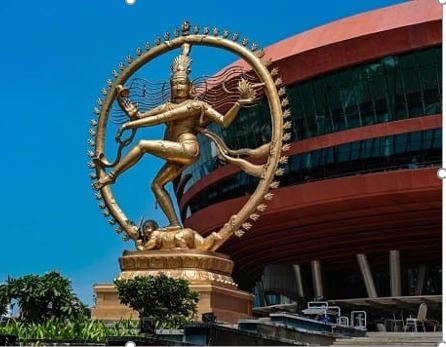
The World’s tallest 27-foot Nataraja sculpture has been installed at Bharat Mandapam, venue of the G20 Leaders' Summit.
- Metal - The Bharat Mandapam Nataraja statue is an ashtadhatu (8-metal alloy) piece of art.
- The eight metals – Copper, zinc and lead with traces of tin, silver, gold and mercury, with iron.
- Lord Shiva - The God Shiva evolved from the Vedic deity Rudra.
- Patronage by Cholas - Although Shiva was first portrayed in sculpture as Nataraja in the 5th century AD, its present form evolved under the Cholas.
- The design draws inspiration from 3 revered Nataraja idols
- The Thillai Nataraja Temple in Chidambaram,
- The Uma Maheswarar Temple in Konerirajapuram, and
- The Brihadeeswara (Big) Temple, a UNESCO World Heritage Site, in Thanjavur.
- All 3 temples the Bharat Mandapam Nataraja statue is inspired from were originally constructed by the Cholas.
Cholas were peak around the 9th-11th centuries AD, ruled over much of peninsular India.
- Technique - The crafting process adopted was the traditional ‘lost-wax’ casting method, indigenous to the Chola era.
- Lost wax method - First, a detailed wax model is made. Then it is covered with a paste made of alluvial soil found on the banks of the Cauvery River.
- After this coating, applied multiple times, has dried, the figure is be exposed to high heat, causing the wax to burn away, leaving a hollow, intricately carved mould.
- This is ultimately filled by molten metal to produce the sculpture.
References
- The Indian Express | The Lord of Dance
- The Times of India | Nataraja statue graces Bharat Mandapam
XRISM (X-Ray Imaging and Spectroscopy Mission)
A powerful X-ray observatory is launched along with Japan's SLIM mission.
- Aim - To investigate celestial X-ray objects in the Universe with high-throughput imaging and high-resolution spectroscopy.
- These observations will enable in determining the flows of mass and energy, revealing the composition and evolution of celestial objects.
- This mission acts as a semi-replacement for the Hitomi (Astro-H) X-ray observatory, launched in 2016.
Hitomi was a high-energy astrophysics space observatory, developed by the Japan Aerospace Exploration Agency (JAXA) in collaboration with institutions in Japan, the US, Canada, and Europe.
- Launch Vehicle - The H-IIA rocket that launched the SLIM Japan’s moon mission also carried the XRISM.
- Agency - NASA (National Aeronautics and Space Administration) and JAXA (Japan Aerospace Exploration Agency).
References
- The Indian Express | X-ray telescope
- NASA | XRISM
- JAXA | XRISM
- Sky and Telescope | XRISM
Central Empowered Committee (CEC)
The Supreme Court recently hands over its green watchdog committee, the Central Empowered Committee (CEC) to the Environment Ministry.
- Setup - It was set up in 2002, and reconstituted in 2008 by the Supreme Court.
- It served as a watchdog for issues pertaining to environmental conservation and compliance.
- Recent notification - Instead of an ad hoc body, CEC should be instituted as a permanent statutory body on environmental issues under the administrative control of the Environmental ministry.
- The notification completely removes non-governmental members from the committee.
The current CEC is chaired by retired IAS officer and includes retired Forest service officers and lawyer and naturalist.
- In the revised structure all (chairperson, a member secretary and three expert members) will now be civil servants appointed by the Ministry of Environment Forest and Climate Change (MoEFCC).
- The chairperson
- A minimum of 25 years of experience in environmental, forestry, or wildlife fields or substantial administrative expertise in government.
- Term - 3 years.
- The member secretary
- He must hold a rank not lower than deputy inspector general or director in the government and
- Possess at least 12 years of experience in environmental, forestry, or wildlife matters.
- The 3 expert members - One each from the environment, forest, and wildlife sectors, should have a minimum of 20 years of expertise.
- The committee will report to the ministry, instead of the SC.
- The ministry will fund the committee;
- The provision of having 2 NGOs in the committee has been done away with
References
- The Indian Express | Central Empowered Committee
- The Hindustan Times | Govt to nominate all members of top panel
- The Times of India | Environment ministry sets up new panel
Dark Patterns
Department of Consumer Affairs seeks public comments on Draft Guidelines for Prevention and Regulation of Dark Patterns recently.
- A dark pattern is a user interface that has been carefully crafted to trick users into doing things, such as buying overpriced insurance with their purchase or signing up for recurring bills.
- Dark patterns are also known as Deceptive Patterns.
- Dark patterns in turn benefit the company or platform employing the designs.
- Examples - Sponsored video ads scattered between reels and stories in Instagram that users originally opted to view, pop-ups and thumbnails of other videos in the final seconds of a video in YouTube.
- By using them, digital platforms take away a user’s right to full information about the services they are using, and reduce their control over their browsing experience.
Types of dark patterns
|
Dark Patterns
|
Purpose
|
|
False urgency
|
Falsely stating or implying the sense of urgency.
|
|
Basket Sneaking
|
Inclusion of additional items at the time of checkout without the consent of the user.
|
|
Confirm shaming
|
Using a phrase, video, audio or any other means to create a sense of fear or shame or ridicule or guilt in the mind of the user.
|
|
Forced action
|
Forces a user into taking an action that would require the user to buy any additional goods.
|
|
Subscription Trap
|
The process of making cancellation of a paid subscription impossible or a complex.
|
|
Interface Interference
|
The design element that manipulates the user interface.
|
|
Bait and Switch
|
The practice of advertising a particular outcome based on the user’s action.
|
|
Drip pricing
|
The practice whereby-elements of prices are not revealed upfront.
|
|
Disguised advertisement
|
The practice of posing, masking advertisements as other types of content such as user generated content or new articles or false advertisements.
|
|
Nagging
|
The practice in which users face an overload of requests, information, options, or interruptions; unrelated to the intended purchase of goods or services, which disrupts the intended transaction.
|
References
- PIB | Draft Guidelines for Prevention of Dark Patterns
- The Hindu | Centre to stop sites from weaving ‘dark patterns’
Visible Line Emission Coronagraph (VELC)
Aditya-L1 has been successfully launched from the Satish Dhawan Space Research Centre in Sriharikota recently carried the VELC payload.
- The Aditya-L1 mission (first Sun mission from India) carried by the Polar Satellite Launch Vehicle (PSLV)-C57 rocket is equipped with seven payloads.
- Among these, the Visible Line Emission Coronagraph (VELC) is the primary payload that Aditya-L1 will use to focus on the Sun's Corona.
- Landing Point - Aditya-L1 will be placed in a halo orbit around Lagrangian Point 1 (L1), which is 1.5 million kilometers from Earth in the direction of the Sun.
- Aim – It will create a total solar eclipse continuously since it will be positioned at L1, providing an unobstructed view of the Sun.
- Built by – Indian Institute of Astrophysics (IIA).
Coronagraph of Aditya-L1 will send 1,440 images of sun a day.
- VELC has the capability to capture images of the solar corona closer to the Sun's disc than any other solar space observatory.
- This allows it to observe the Sun as if it were a solar eclipse, enabling the study of the corona and its characteristics, including its origin and the source of coronal mass ejections.
References
- The Hindustan Times | What is the purpose of VELC?
- IIA | VELC
- The Hindu | Coronagraph of Aditya-L1



