Living Wage
The government is mulling shifting to ‘living wage’, which is indexed to inflation, from the existing ‘minimum wage’.
- A living wage is a socially acceptable level of income that provides adequate coverage for basic necessities such as food, shelter, child services, and healthcare.
- It is the remuneration received by a worker in a particular place sufficient to afford a decent standard of living for the worker and her or his family.
- Elements of a decent standard of living include basic needs and other essential needs including provision for unexpected events.
- The living wage is different from the minimum wage.
- Minimum wage is the lowest amount of money someone can earn as mandated by law.
- The minimum wage does not provide enough income to survive as it doesn't rise with inflation.
- Another alternative to minimum wages is a Universal Basic Income.
References
- Business Standard - What is a living wage?
Domestic Systemically Important Banks
The Reserve Bank of India (RBI) has released 2022 list of Domestic Systemically Important Banks (D-SIBs).
- State Bank of India, ICICI Bank, and HDFC Bank have again been named as Domestic Systemically Important Banks (D-SIBs) by RBI in 2022 list.
- SIBs – SIBs are perceived as banks that are ‘Too Big to Fail’ and their continued functioning is critical for the uninterrupted availability of essential banking services to the real economy.
- Genesis - The Financial Stability Board, in consultation with the Basel Committee on Banking Supervision (BCBS) and national authorities, has identified global systemically important banks (G-SIBs) since 2011.
- Similarly, RBI has identified Domestic Systemically import banks (D-SIBs) since 2015.
- D-SIBs - The RBI had issued the framework for dealing with Domestic Systemically Important Banks in July 2014.
- It requires to disclose the banks designated as D-SIBs and place them in buckets depending on Systemic Importance Scores.
- Criteria - In order to be listed as a D-SIB, a bank needs to have assets that exceed 2% of the national GDP.
- Classification - The D-SIBs are placed across the five buckets based on the level of their importance, with bucket five representing the most important D-SIBs.
- There are no bucket five D-SIB in India.
- Requirement - Banks classified as D-SIBs are subjected to additional Common Equity Tier 1 (CET1) capital requirements in addition to the Capital Conservation Buffer.
- The additional CET1 requirement is provisioned as a percentage of Risk Weighted Assets (RWA).
- The additional CET1 requirement for D-SIBs was phased-in from April 1, 2016 and became fully effective from April 1, 2019.
|
Since
|
Bank
|
Bucket
[1 - 5 ]
|
CET1 as percentage of RWAs
|
|
2015
|
SBI
|
3
|
0.60%
|
|
2016
|
ICICI Bank
|
1
|
0.20%
|
|
2017
|
HDFC Bank
|
1
|
0.20%
|
References
- The Hindu - RBI tags 3 banks as Systemically Important Banks
- Indian Express - Systemically Important Banks: RBI
- RBI - 2022 list of Domestic Systemically Important Banks
High Powered Committee on Ladakh
The Ministry of Home Affairs has constituted a high-powered committee to ensure protection of land and employment.
- Formation of Ladakh - On August 5, 2019, the special status of former State of Jammu & Kashmir under Article 370 was revoked by the Parliament.
- The former State of Jammu and Kashmir was bifurcated into two UTs - J&K and Ladakh, the latter without a Legislative Assembly.
According to the Census 2011, nearly 80% of the total population of Ladakh are tribals. The Union Territory has a majority Buddhist population, with a sizeable Muslim population in Kargil.
- The Ministry of Home Affairs has constituted a high-powered committee to protect Ladakh’s unique culture, language and employment.
- The 17-member committee is headed by Minister of State Nityanand Rai and includes Ladakh Lieutenant-Governor R.K. Mathur.
- It will discuss measures to protect the region’s unique culture and language taking into consideration its geographical location and its strategic importance.
- The committee will also discuss
- Measures for inclusive development and employment generation in the region
- Issues related to empowerment of Ladakh Autonomous Hill District Councils of Leh and Kargil.
References
- The Hindu - MHA constitutes high powered committee on Ladakh
- Outlook - Ladakh Welcomes MHA High-powered Committee
- News On Air - Centre constitutes High Powered Committee
Heat Dome
Several parts of Europe witnessed an unprecedented winter heat wave over New Year’s weekend.
- Several parts of Europe witnessed an unprecedented winter heat wave.
- Seven European countries which includes Poland, Denmark, the Czech Republic, the Netherlands, Belarus, Lithuania and Latvia, recorded their hottest January weather ever.
- This extreme warm spell experienced by Europe is because of the formation of a heat dome over the region.
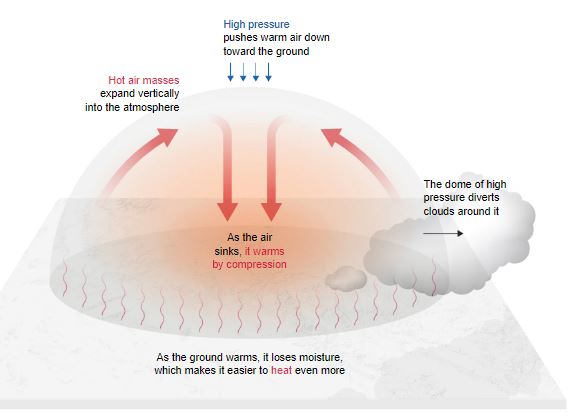
- Heat Dome - A heat dome occurs when an area of high-pressure traps warm air over a region (like a lid on a pot) for an extended period of time.
- The longer that air remains trapped, the more the sun works to heat the air, producing warmer conditions with every passing day.
- Heat domes generally stay for a few days but sometimes they can extend up to weeks, which might cause deadly heat waves.
- When this warm air sinks, it gets drier and further raises the temperature of the area.
Heat dome and Jet Streams
- The formation of heat dome is related to the behaviour of the jet stream.
Jet Stream - An area of fast-moving air high in the atmosphere which has a wave-like pattern that keeps moving from north to south and then north again.
- When these waves get bigger and elongated, they move slowly and sometimes can become stationary.
- This is when a high-pressure system gets stuck and leads to the occurrence of a heat dome.
Recent Heat Domes
- In 2021, a heat dome formed over western Canada and the US, causing deadly heat waves.
- Another heat dome settled over the US in September 2022 and raised temperatures which fuelled wildfires and stressed the power grid.
References
- Indian Express - Winter heat wave in Europe
Termites and Global warming
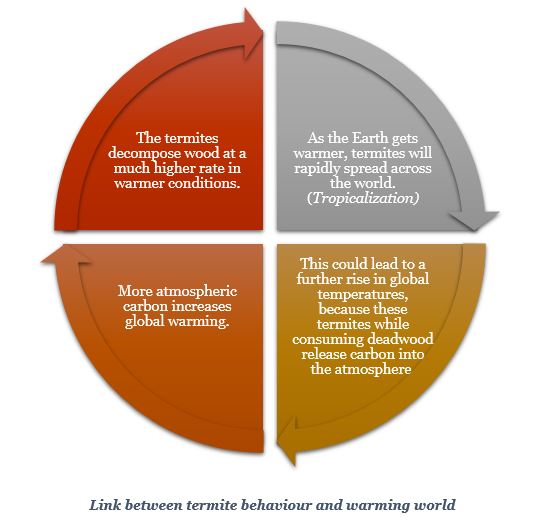
A study revealed that as the Earth gets warmer, termites will rapidly spread across the world which in turn, lead to a further rise in global temperatures.
- Termites are insects that feed on wood and dead plant matter.
- The termites’ ability to decompose dead wood makes them an important part of the planet’s ecosystem.
- They are found in colder areas as well but they play a limited role in the decaying of wood in comparison to fungi and bacteria.
- There are around 3,000 species of termites across the world, including the ones that consume plant material and even soil. The most famous are the wood-eating termites.
- These wood-eating termites were able to survive in warm and dry conditions, unlike microbes that need water to grow.
- Therefore, with tropicalization (Warming shifts to tropical climates), termite wood decay will likely increase as termites access more of Earth’s surface.
For every 10 °C increase in temperature, termites’ decomposition goes up by almost 7 times.
References
- Indian Express - Link between termite behaviour and warming world
- Science Alert - Termites May Make Global Warming Worse



