Mains: GS II – Governance
Why in News?
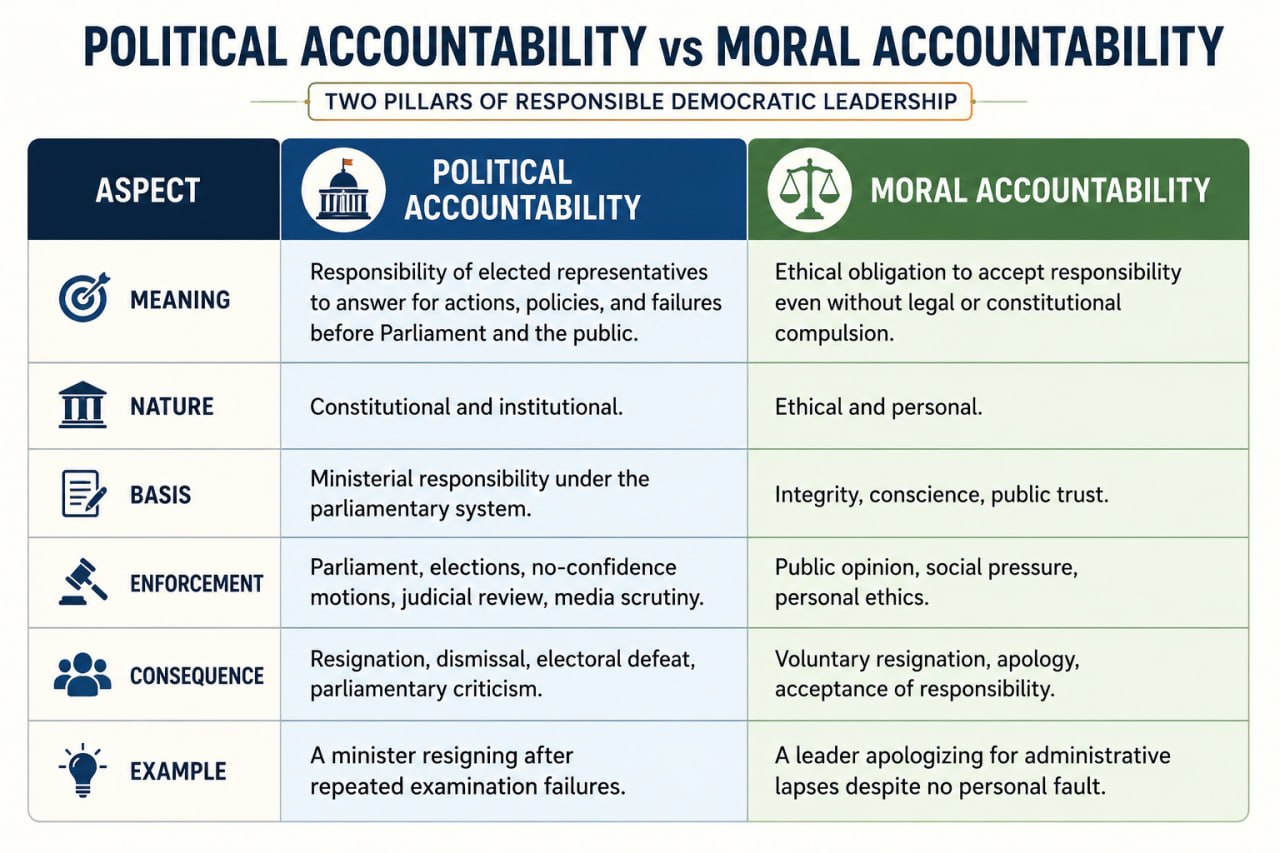
The recent resignation of the Union Education Minister over exam irregularities has renewed discussion about ministerial responsibility, a key principle of parliamentary governance.
Why should a minister accept political responsibility for departmental failures and controversies?
- Ministerial Responsibility – Ministers, serving as the political heads of departments, are required to uphold ministerial responsibility by ensuring that authority is consistently matched with accountability.
- Democratic Accountability – Ministers are required to uphold democratic values because citizens elect governments rather than bureaucrats, and responsibility cannot be delegated entirely to subordinate officials.
- Public Trust – A minister’s resignation restores public trust by demonstrating transparency, integrity, and respect for public confidence.
- Reform Catalyst – Acceptance of responsibility facilitates administrative reforms by initiating institutional review, policy correction, and the implementation of more robust oversight mechanisms.
- No Impunity – A lack of accountability leads to the normalization of failures, deterioration in governance quality, and a decline in public confidence.
- Preventing a culture of impunity necessitates ministerial responsibility.
What does the historical context reveal about political accountability?
- Lal Bahadur Shastri (1956) – Resigned as Railway Minister following a major train accident, despite no personal negligence.
- This is widely regarded as the finest example of constitutional morality.
- Mahatma Gandhi (1922) – Withdrew the Non‑Cooperation Movement after the Chauri Chaura violence, accepting moral responsibility.
- This represents moral rather than constitutional accountability.
- Kate Wilkinson (New Zealand, 2010) – Resigned as Labour Minister after the Pike River Mine disaster, accepting responsibility during her tenure, although no criminal liability was established.
What are the constitutional provisions that ensure political accountability in India?
- Collective Responsibility (Art. 75(3)) – The Council of Ministers is accountable to the Lok Sabha, a loss of confidence necessitates the resignation of the entire Council.
- Individual Ministerial Responsibility – Each minister is accountable for the administration and performance of their respective ministry.
- Parliamentary Questions – Members of Parliament hold ministers accountable by submitting starred, unstarred, and short-notice questions.
- Zero Hour – Members may raise urgent public issues without prior notice, requiring an immediate ministerial response.
- Calling Attention Motion – Ministers are required to provide explanations on urgent matters when directed by the House.
- No-Confidence Motion – The government is obligated to resign if it loses majority support in the Lok Sabha.
- Censure Motion – Parliament may formally criticize specific actions of the government, thereby enforcing accountability.
- Parliamentary Committees – Committees such as the Public Accounts Committee (PAC), Estimates Committee, and Committee on Public Undertakings scrutinize the functioning of the executive.
- Judicial Review – The judiciary evaluates executive actions to ensure their conformity with constitutional provisions.
- Comptroller and Auditor General (CAG) – The CAG audits public expenditure and reports financial irregularities.
- Election Commission – The Election Commission ensures the conduct of free and fair elections, thereby upholding electoral accountability.
- Right to Information (RTI) – Enables citizens to access government information and promotes transparency.
What are the extra-constitutional provisions that ensure political accountability in India?
- Free media – Investigative journalism, public debates, and the exposure of scandals serve to hold leaders accountable.
- Civil society organizations – Advocacy campaigns promote transparency, accountability, and governance reforms.
- Public protests – Peaceful demonstrations convey citizens’ grievances to governmental authorities.
- Social media – The rapid dissemination of information influences public opinion and exerts pressure on policymakers.
- Public opinion – Electoral outcomes serve as indicators of public perceptions regarding governmental performance.
- Whistle-blowers – Individuals who expose corruption and administrative failures facilitate corrective action.
- Academic institutions and think tanks – These organizations provide policy critiques and evidence-based recommendations.
- Citizen participation – Mechanisms such as petitions, consultations, and public interest litigations strengthen democratic accountability.
What are the key challenges to political accountability in India?
- Centralization of Power – Excessive concentration in the executive weakens checks and balances.
- Partisan Politics – Political rivalry delays accountability and undermines neutrality.
- Bureaucratic Blame‑Shifting – Officials deflect responsibility, reducing ministerial accountability.
- Weak Legislative Oversight – Parliament often fails to scrutinize executive actions rigorously.
- Criminalization of Politics – Entry of tainted leaders erodes credibility and accountability.
- Declining Ethics – Lower moral standards in public life weaken governance integrity.
- Excessive Police Powers – Peaceful protests are suppressed, curbing democratic accountability.
- Information Asymmetry – Misinformation and lack of transparency distort public judgment.
What could be done?
- Mandating Ministerial Responsibility – Strengthen the convention requiring ministers to resign in cases of administrative or policy failures.
- Transparency – Enhance openness in executive processes and decision-making procedures.
- Parliamentary Committees – Strengthen the authority of committees to enable more rigorous oversight of governance.
- Independent Investigations – Guarantee prompt and impartial investigations into institutional failures.
- Peaceful Protest – Safeguard the right of citizens to peaceful dissent and prevent disproportionate use of force by law enforcement.
- Ethical Leadership – Advance constitutional morality and uphold integrity within public office.
- Institutional Autonomy – Protect the independence of regulatory authorities and examination bodies.
- Civic Education – Promote public awareness regarding democratic accountability and responsibilities.
Reference
The Hindu | Ministerial Responsibility



