Why in news?
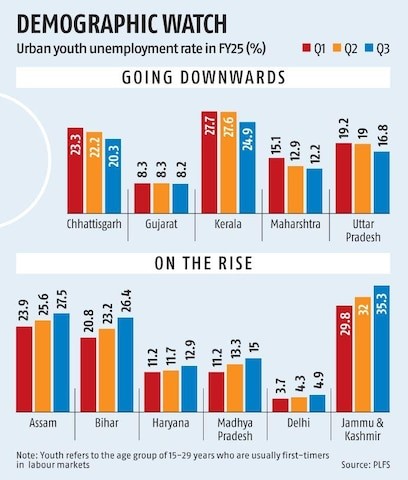
The national unemployment rate among urban youth is decreasing in FY25, but 6 states and UTs have seen an increase in unemployment rates from Q1 to Q3.
- PLFS is the primary source of data on employment and unemployment situation in India.
- The Periodic Labour Force Survey (PLFS) gives Indicators like the Labour Force Participation Rate (LFPR), Worker Population Ratio (WPR), Unemployment Rate (UR), etc.
- Released by - Ministry of Statistics and Program Implementation.
- Survey period - Quarterly Bulletin [October – December 2024].
Key Findings
- Labour Force Participation Rate (LFPR) - In urban areas among persons of age 15 years and above has increased from 49.9% to 50.4%.
- LFPR for male of age 15 years and above in urban areas increased from 74.1% to 75.4% reflecting overall increasing trend in male LFPR.
- LFPR among female of age 15 years and above for urban areas increased from 25.0% to 25.2%.
- Worker Population Ratio (WPR) - In urban areas among persons of age 15 years and above has increased from 46.6% to 47.2%.
- WPR for male of age 15 years and above for urban areas increased from 69.8% to 70.9% reflecting overall increasing trend in male WPR.
- Unemployment Rate (UR) - In urban areas among persons of age 15 years and above decreased from 6.5% to 6.4%.
- UR among males of age 15 years and above remained same as 5.8%.
- UR among female of age 15 years and above decreased from 8.6 % to 8.1%.
- State wise data – Rising unemployment states - Assam shows highest urban youth unemployment rate at 27. 5% in Q3, up from 23. 9% in Q1.
- Bihar's rate has increased to 26. 4% from 20. 8%, Madhya Pradesh to 15% from 11. 2%, and Haryana to 12. 9% from 11. 2%.
- In Jammu & Kashmir the rate rose to 35. 3% from 29. 8%,
- Delhi’s rate grew to 4. 9% from 3. 7%.
- Declined unemployment states – Kerala is followed by Chhattisgarh, Uttar Pradesh, Maharashtra, and Gujarat with slight decreases.
- International Labour Organisation (ILO) – The study states that youth comprise nearly 83% of the unemployed workforce, with educational attainment increasing significantly.
References
- PIB | Periodic Labour Force Survey (PLFS)
- Business Standard | Periodic Labour Force Survey (PLFS)



