Mains: GS II – International Relations
Why in News?
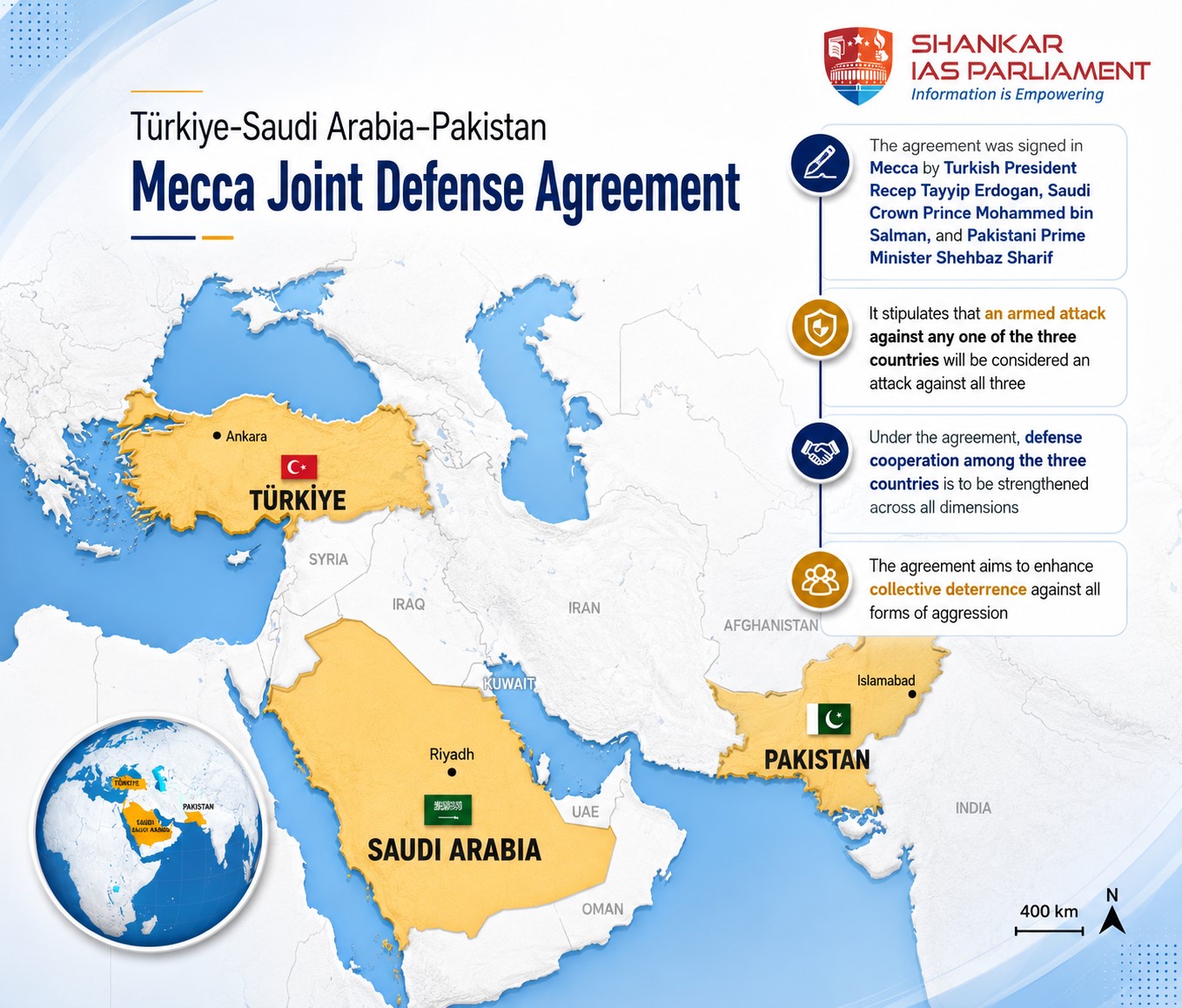
The recent signing of the Mecca Agreement by Saudi Arabia, Pakistan and Turkey marks an important development in the evolving security architecture of West Asia.
What is the Mecca Agreement?
- Framework for Collective Deterrence and Defence – The agreement establishes a broad framework for collective security cooperation among Saudi Arabia, Pakistan and Türkiye.
- Collective Defence Commitment – Its key provision treats an armed attack against one member as an attack against all.
- Clarity of Military Obligations – The deterrent value depends on clearly defined obligations and the members’ willingness to respond during a crisis.
- Limited Transparency Compared with NATO – Unlike NATO’s publicly available Article 5, the detailed provisions of the Mecca Agreement remain undisclosed, making its military commitments difficult to assess.
- Uncertainty over Automatic Military Intervention – Mutual defence agreements do not necessarily guarantee automatic military intervention in every crisis.
- Political Will as the Key to Credibility – The effectiveness of the pact ultimately depends on political commitment, military preparedness and the strategic interests of its individual members.
Who is the agreement primarily aimed at?
- Iran as an Implicit Security Concern – The agreement has relevance to Iran amid Gulf security vulnerabilities, missile and drone threats, and regional rivalries.
- Israel as a Broader Strategic Factor – From Turkey’s perspective, the pact appears increasingly connected to Israel’s growing military and strategic presence in the region.
- Emerging Turkey–Israel Strategic Competition – The weakening of Iranian influence in parts of Syria could intensify competition between Turkish and Israeli interests.
- Turkey’s Opposition to Israeli Military Actions – Ankara’s criticism of Israeli operations in Gaza, Lebanon and Syria has added a political and strategic dimension to their rivalry.
- Wider Regional Security Framework for Turkey – The agreement could provide Ankara with greater strategic space as its competition with Israel becomes more pronounced.
- Israel as the Long-Term Strategic Driver – While Iran remains an important security concern, Israel may represent the more significant long-term strategic factor behind the pact, particularly for Turkey.
What does Saudi Arabia gain?
- Pursuit of Military Self-Reliance – Saudi Arabia seeks to reduce its traditional dependence on Western, particularly American, military technology and security guarantees.
- Lessons from Regional Conflicts – Repeated conflicts have exposed vulnerabilities in critical infrastructure and the limitations of relying exclusively on external security providers.
- Building an Indigenous Defence Industry – The agreement can support Saudi Arabia’s ambition to develop a stronger domestic military-industrial complex.
- Leveraging Turkish and Pakistani Defence Capabilities – Turkey’s expertise in drones, combat aircraft and defence technologies, combined with Pakistan’s experience in defence production, offers Riyadh opportunities for technology diversification.
- China as a Strategic Background Factor – China’s growing defence-industrial partnerships with Pakistan and Saudi Arabia add another strategic dimension, despite Beijing not being a formal member of the pact.
- Diversifying Defence Partnerships – The arrangement could help Saudi Arabia broaden its sources of military technology and reduce excessive dependence on the United States.
What does Pakistan gain?
- Enhanced Strategic Relevance in the Gulf – Pakistan gains greater importance in the Gulf security architecture due to its nuclear capability, military experience and long-standing ties with Saudi Arabia.
- Expanding Defence-Industrial Cooperation – Pakistan can deepen defence cooperation with Saudi Arabia and Türkiye through platforms, training and a potential trilateral framework.
- Greater Diplomatic Leverage – Stronger security ties with Saudi Arabia can enhance Pakistan’s diplomatic influence amid its economic and geopolitical constraints.
- However, Pakistan must also balance its relations with Iran, particularly because of geographical proximity and the potential consequences of regional confrontation.
What does Turkey gain?
- Pursuit of Broader Geopolitical Influence – Turkey seeks to emerge as an independent regional power with influence spanning the Mediterranean, Gulf and South Asia.
- Access to Strategic Resources and Partnerships – Cooperation with Saudi Arabia provides Turkey access to financial resources and a major defence market, while Pakistan offers a capable military and strategic partner.
- Expansion of Defence-Industrial Exports – The agreement could create opportunities for Turkey to expand exports of drones, fighter aircraft and other advanced defence technologies to Saudi Arabia.
- Greater Influence in West Asian Security – The pact strengthens Turkey’s strategic position vis-à-vis Israel and enhances its role in shaping the evolving West Asian security architecture.
- Convergence of Geopolitical and Defence Interests – Overall, the agreement advances both Turkey’s geopolitical ambitions and its defence-industrial interests.
What are the implications for India?
- Greater Saudi–Pakistan–Turkey Strategic Convergence – The most important implication for India is the possibility of deeper strategic integration between Saudi Arabia, Pakistan and Turkey, with China operating as an important external partner.
- Turkey has historically maintained close defence relations with Pakistan and has often taken positions contrary to Indian interests on issues such as Jammu and Kashmir.
- Greater Saudi military cooperation with Pakistan and Turkey could therefore create a more difficult strategic environment for New Delhi.
- Pressure on India's Strategic Partnership with Saudi Arabia – India has invested significantly in its relationship with Saudi Arabia over the past decade.
- Economic ties, energy security, investment, counter-terrorism cooperation and people-to-people relations have expanded considerably.
- Historically, Saudi Arabia has attempted to maintain a degree of balance between India and Pakistan.
- However, if Riyadh's security dependence on Pakistan increases, Islamabad could gain greater leverage over Saudi strategic decision-making.
- This could complicate India's efforts to deepen its partnership with Riyadh.
- Defence and Technology Concerns – The agreement may accelerate the development of a regional defence-industrial ecosystem involving Turkey, Pakistan, Saudi Arabia and China.
- This is relevant to India because Pakistan's acquisition of advanced Turkish and Chinese defence technologies could alter the military balance in South Asia.
- India's experience of Turkish defence cooperation with Pakistan during the 2025 India–Pakistan conflict also underlines the need for greater vigilance.
- Changing West Asian Security Architecture – The pact demonstrates that Gulf countries are increasingly seeking multiple strategic partnerships rather than depending exclusively on the United States.
- Saudi Arabia's growing engagement with China, Turkey and Pakistan reflects a broader trend towards strategic diversification.
- For India, this means that its engagement with West Asia must move beyond traditional energy and diaspora-centric diplomacy towards deeper strategic and defence cooperation.
What should India do?
- Deepening India–Saudi Arabia Strategic Partnership – Energy, defence, investment, technology and counter-terrorism cooperation.
- Strengthening Gulf Defence and Maritime Security Cooperation – Enhancing ties with the UAE and Saudi Arabia and securing the Arabian Sea and western Indian Ocean.
- Pragmatic Engagement with Türkiye – Maintaining diplomatic engagement while firmly addressing Ankara’s positions on India’s internal affairs.
- Accelerating Indigenous Defence Production – Advancing Atmanirbhar Bharat in drones, counter-drone systems, air defence, electronic warfare and aerospace technologies.
- Continue pursuing a balanced West Asia policy – Involving Saudi Arabia, the UAE, Iran, Israel and other regional actors.
- Strategic autonomy and issue-based partnerships should remain the foundation of India's approach.
What lies ahead?
- The Mecca Agreement is unlikely to transform the West Asian security order overnight, but it represents an important step towards the institutionalisation of a new regional security and defence-industrial partnership.
- The appropriate Indian response is therefore not confrontation but deeper engagement, strategic diversification, defence modernisation and sustained diplomatic outreach.
- India's objective should be to ensure that the evolving West Asian security architecture remains inclusive of Indian interests rather than allowing it to consolidate into an arrangement strategically adverse to New Delhi.
Reference
The Indian Express| Mecca Agreement



