Prelims – Biodiversity, species migration, scientific innovations, and climate change impacts.
Mains (GS – I & III) – GS I (Biogeography, species adaptation) | GS III (Biodiversity conservation, climate change, scientific advancements).
Why in News?
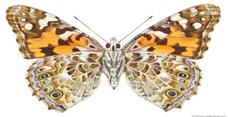
A recent study found that painted lady butterflies (Vanessa cardui) don’t have significant genetic differences between short- and long-distance migrants.
- Painted Lady butterfly is a medium-sized butterfly belonging to the Nymphalidae family.
- It is renowned for its extensive migratory patterns and adaptability to various habitats.
- Habitat – Thrives in diverse environments, from temperate grasslands to deserts.
- They can be found on every continent except Antarctica and South America.
- Conservation status – Listed as Least Concern on International Union for Conservation of Nature’s Red List.
- Migratory Behaviour – This species is a long-distance migrant, originating from areas like the desert fringes of North Africa, the Middle East, and Central Asia.
- Each year, it moves northwards, recolonizing mainland Europe and reaching Britain and Ireland.
Key findings of the study
- Isotope Tracking – Scientist studied about the species using the ratios of the isotopes in the wings of species.
- Wings retain hydrogen & strontium isotopes from larval food/water, revealing birthplace.
- No genetic difference in migration – Short- and long-distance painted lady butterflies belong to a single interbreeding population.
- Migration driven by environment – Distance covered depends on environmental factors, not genetics.
- Single migratory cycle – Painted Lady butterfly can travel up to 15,000 km in a single migratory cycle, one of the longest insect migrations on the earth.
A "single migratory cycle" refers an animal (like a bird) makes one round trip between two places—usually moving from a breeding area to a wintering area and back—due to seasonal changes or food needs.
- Multi-generational migration – The full migration cycle spans 8–10 generations.
- Super fly Adaptations – Thoracic muscles like "bodybuilders" enable high-speed, high-altitude flights.
- Wing shape/size doesn’t predict migration distance.
- Different from bird migration – Butterflies don’t return to a single breeding ground, unlike birds.
|
Phenotype
|
- Phenotype is a physical, biological, or behavioural characteristic shaped by genetics as well as environmental factors.
- Example – Skin and hair colour in humans, vocal behaviour among birds, and the migratory patterns of some animals.
- Scientists use phenotyping to study migration patterns in butterflies.
- Example – By examining butterfly wings, researchers can determine their place of origin based on isotopic composition.
|
References
- The Hindu | Painted Lady
- Britannica | Painted Lady



