Prelims: Current events of national and international importance| Others
Why in News?
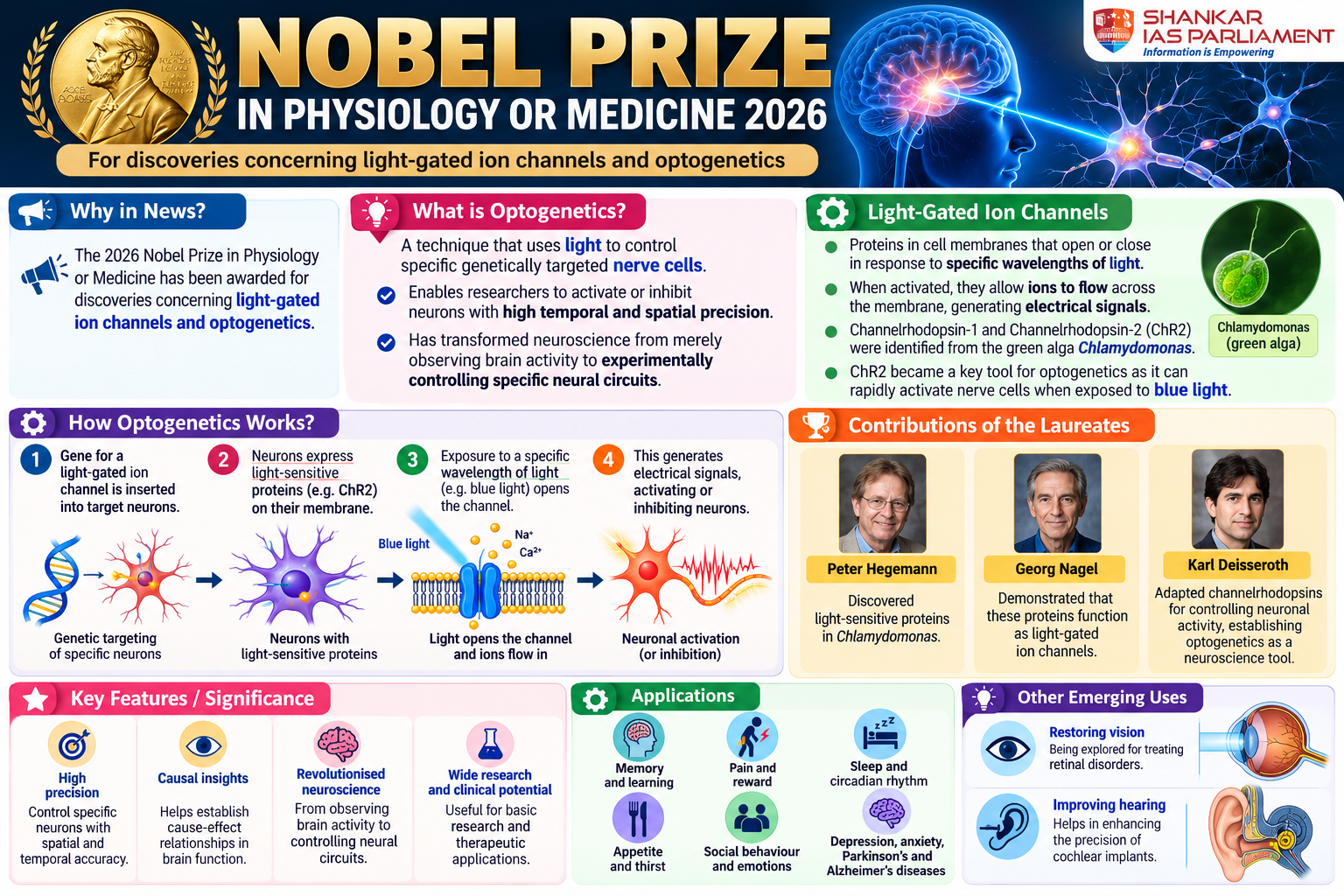
Recently the 2026 Nobel Prize in Physiology or Medicine for discoveries concerning light-gated ion channels and optogenetics has been awarded.
Optogenetics
- Optogenetics – It is a technique that uses light to control specific genetically targeted nerve cells.
- Enables – Researchers to activate or inhibit neurons with high temporal and spatial precision.
- Importance – It has transformed neuroscience from merely observing brain activity to experimentally controlling specific neural circuits.
Light-Gated Ion Channels
- These are proteins in cell membranes that open or close in response to specific wavelengths of light.
- When activated, they allow ions to flow across the membrane, generating electrical signals.
- Channelrhodopsin-1 and Channelrhodopsin-2 (ChR2) were identified from the green alga Chlamydomonas.
- ChR2 became a key tool for optogenetics as it can rapidly activate nerve cells when exposed to blue light.
- Contributions of the Laureates
|
Laureate
|
Contribution
|
|
Peter Hegemann
|
Discovered light-sensitive proteins in Chlamydomonas.
|
|
Georg Nagel
|
Demonstrated that these proteins function as light-gated ion channels.
|
|
Karl Deisseroth
|
Adapted channelrhodopsins for controlling neuronal activity, establishing optogenetics as a neuroscience tool.
|
- Applications – Optogenetics has helped study neural circuits associated with:
- Memory and learning
- Pain and reward
- Sleep and circadian rhythm
- Appetite and thirst
- Social behaviour and emotions
- Depression, anxiety, Parkinson’s and Alzheimer’s diseases
- It is also being explored for restoring vision in retinal disorders and improving the precision of cochlear implants.
Reference
The Indian Express| Medicine Nobel goes to scientists who can ‘control brain using light’



