Prelims: Current events of national and international importance | Environment
Why in News?
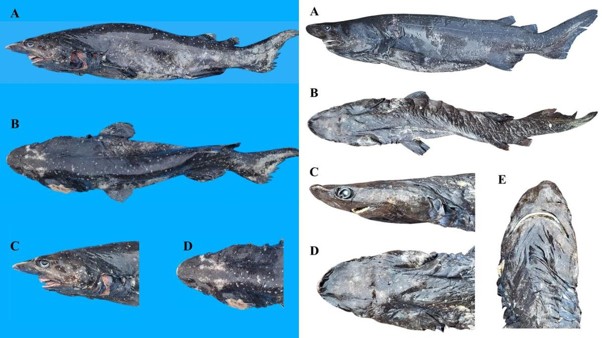
A collaborative team of researchers has officially identified and described a new deep-sea shark species in the Indian Ocean: Echinorhinus roinee, popularly known as the Indian Bramble Shark.
- For decades, specimens of this shark landed along India’s southwest coast were misclassified and assumed to be the Atlantic bramble shark (Echinorhinus brucus).
- Mitochondrial DNA analysis and distinct morphological profiling finally proved it to be a separate, endemic Indian Ocean genetic lineage.
Key Highlights
- Common Name - Indian Bramble Shark.
- Scientific Name - Echinorhinus roinee.
- Discovery Site - Type specimens were collected from the Sakthikulangara Fishing Harbour in Kollam district, Kerala.
- Habitat Zone - Deep continental slope waters (350–450 metres depth)
- Physical Characteristics
- Grows up to 3 metres in length.
- Features a dark brown to blackish body covered with prominent, thorn-like dermal denticles that fuse into multi-pointed plates as the shark matures.
- Distinguished from related counterparts by its relatively larger eyes, larger pelvic fins, and longer snout-to-gill region.
- Naming Significance - The specific name roinee honours Roinee, the daughter of Dr. Dhriti Banerjee, Director of the Zoological Survey of India.
- The study was published in the Records of the Zoological Survey of India and supported by the Ministry of Earth Sciences under India’s Deep Ocean Mission.
Significance for Marine Conservation
- Deep-sea sharks are highly vulnerable to commercial overexploitation because of their slow growth rates and low reproductive potential.
- These sharks frequently turn up as unmanaged deep-sea trawl bycatch.
- Thus, establishing a correct taxonomic baseline is vital to tracking their population status, assessing extinction risks, and designing targeted management strategies under Indian fisheries frameworks.
Reference
The Hindu | New shark species identified in Indian Ocean



