Prelims: Current events of national and international importance | Polity and Governance
Why in News?
Recently, The 5th Scientific Steering Committee Meeting of the National One Health Mission at New Delhi.
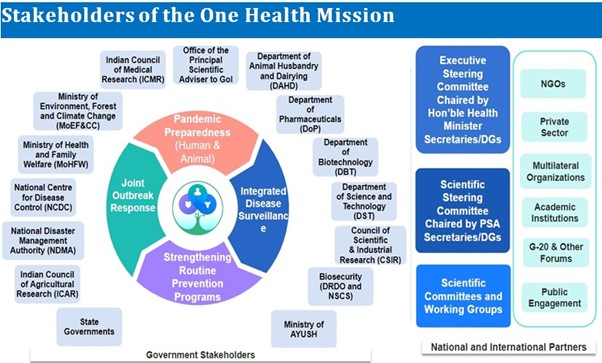
It is a cross-ministerial initiative that unifies human, animal, and environmental surveillance to strengthen pandemic preparedness and deliver integrated disease detection, response, and control.
Launched in – 2024.
Objectives
Strengthen preparedness against zoonotic and climate‑sensitive health threats.
Enhance inter‑sectoral coordination across ministries and departments.
Develop integrated surveillance, laboratory networks, AI‑enabled pathogen detection, and medical countermeasures.
Need for One Health
Risk Factors –India’s diverse wildlife, large livestock population, and high human density increase chances of inter‑compartmental disease spread.
Recent Outbreaks –COVID‑19, Lumpy Skin Disease, and Avian Influenza underscore vulnerabilities at the human‑animal‑environment interface.
Features
Targeted R&D – Development of key vaccines, drugs, diagnostics, and platforms.
Data Integration – Creation of databases and cross‑sectoral data sharing mechanisms.
Governance Mechanisms – Strengthening governance at local, national, and international levels.
Regulatory Streamlining – Simplifying regulatory and approval processes in the One Health domain.
Cross-Sectoral Integration (Human-Animal-Environment) – It aims to create an agile response system to prevent inter-compartmental disease spread like Zoonoses.
BSL‑3/4 Labs Network – National network for high‑risk pathogen research and outbreak response.
Genomics & Metagenomics Surveillance – AI tools, NGS (Next-Generation Sequencing) pipelines for novel pathogen discovery.
IRDLs (Infectious Disease Research & Diagnostic Labs) – Regional referral labs for bacteriology, mycology, parasitology; biorepositories and accredited diagnostics centres.
Multi-Layered Surveillance Systems – Wastewater Surveillance, Slaughterhouse and Market Surveillance and Syndromic Surveillance to spot unusual disease clusters early.