Why in News?
The expansion of Jan Vishwas interventions can address India's employment challenge by promoting formal, high-wage jobs through transparent and predictable regulation.
What is the Need for Expanding Jan Vishwas?
Jan Vishwas (Amendment of Provisions) Act, 2023 is an Indian government initiative aimed at promoting ease of doing business and ease of living by reducing unnecessary criminal penalties
- Employment Quality – India's challenge is not merely creating jobs but ensuring adequate wages, productivity and social security.
- Regulatory Barriers – Excessive compliance and regulatory uncertainty discourage enterprises from expanding and creating formal employment.
- Informal Employment – Informal wage work and low-productivity self-employment contribute to persistent poverty.
- Economic Growth – Regulatory barriers prevent entrepreneurs from combining land, labour and capital into productive, innovative and export-oriented enterprises.
- Role of Jan Vishwas – Trust-based regulation can reduce unnecessary government interference and strengthen confidence between the state and businesses.
What are the Three Proposed Interventions under Jan Vishwas?
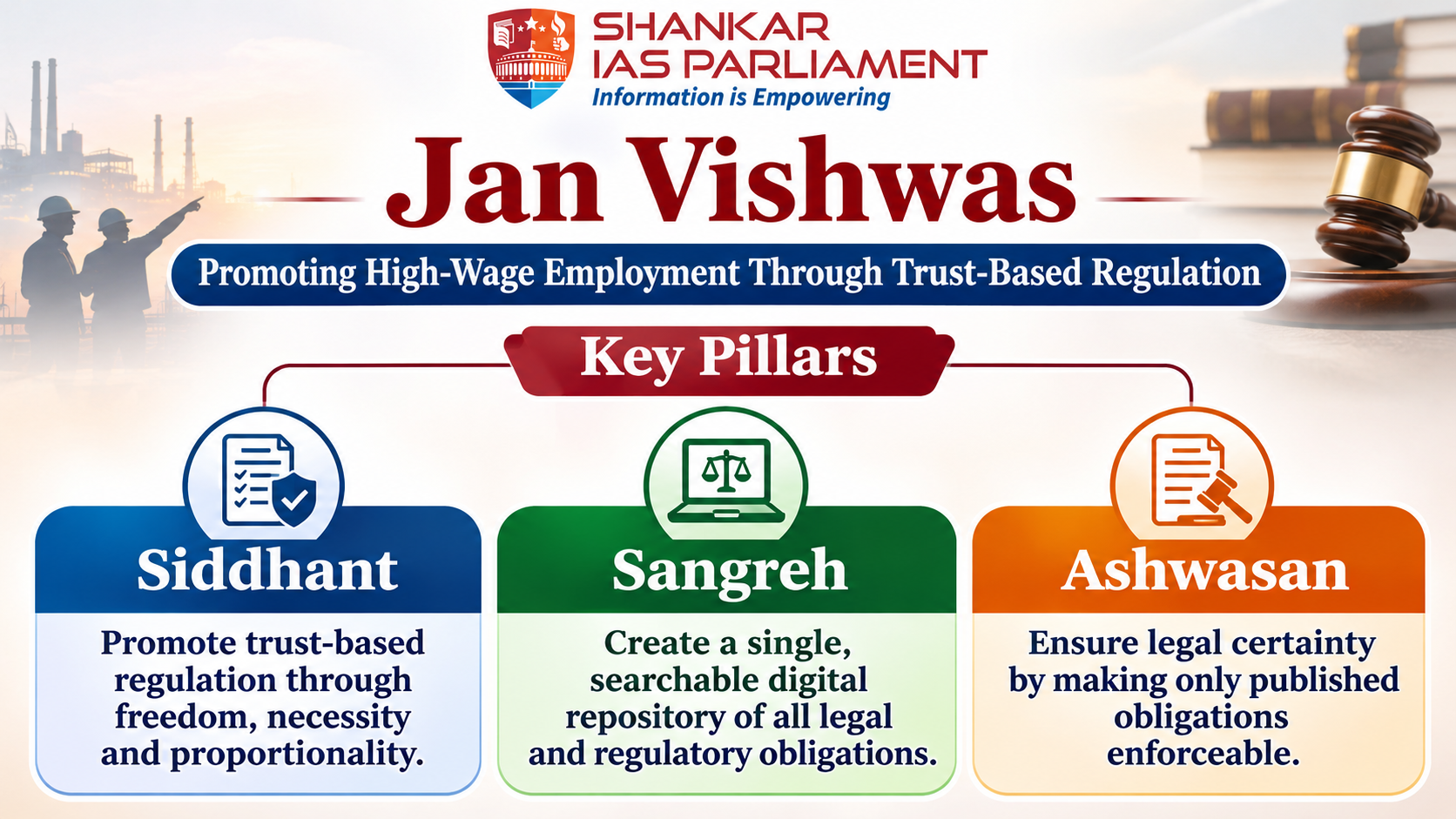
- Siddhant – How Can Trust-Based Regulation Be Promoted?
- Core Philosophy – Siddhant promotes freedom, necessity and proportionality in regulation, replacing excessive government control with trust-based governance.
- Harmful Regulatory Practices – These include prior approvals, unenforceable requirements, excessive procedural burdens, administrative compliance instruments, laws designed for exceptional cases and overcriminalisation.
- Ineffective Criminalisation – Excessive criminal penalties fail to deter violations when prosecution is rare or cases face prolonged delays.
- Administrative Transformation – Effective implementation requires changes in administrative thinking, institutional capacity and the practices of over 30 million civil servants.
- Sangreh – Why is a Single Source of Legislative Truth Necessary?
- Unified Legal Repository – Sangreh proposes a searchable, machine-readable and API-enabled digital repository of India's legal and regulatory obligations.
- Legal Accessibility – Citizens and businesses must be able to access and understand every enforceable legal requirement.
- Judicial Recognition – In Harla v. State of Rajasthan (1952), the Supreme Court rejected secret laws. In B.K. Srinivasan v. State of Karnataka (1987), it emphasised the need for accessible laws.
- Institutional Integration – Sangreh would integrate the physical Gazette, e-Gazette and India Code into a unified legal repository.
- Technological Development – Its implementation requires standardised legal language, digital public infrastructure and coordination between institutions.
- Ashwasan – How Can Legal Certainty Be Guaranteed?
- Enforceability of Rules – Ashwasan proposes that only obligations published on Sangreh should be legally enforceable.
- Transparency of Rules Act – Economist Sanjeev Sanyal's proposed TORA would require publication of obligations arising from Acts, rules and administrative instruments.
- Protection against Hidden Rules – This would prevent governments from imposing undisclosed compliance requirements on citizens and enterprises.
- Predictable Governance – Legal certainty would improve trust, reduce corruption and enable businesses to make informed investment decisions.
What are the Major Benefits of Expanding Jan Vishwas?
- High-Wage Employment – Reduced regulatory burdens would encourage formalisation, enterprise expansion and productive job creation.
- Ease of Doing Business – Transparent and predictable regulations would reduce compliance costs and uncertainty.
- Good Governance – Accessible laws would improve accountability, administrative efficiency and citizen trust.
- Economic Competitiveness – Formal enterprises could combine resources more productively, strengthening innovation and exports.
- Rule of Law – Publishing enforceable obligations would ensure transparent and consistent exercise of government power.
What are the Major Challenges in Implementation?
- Fragmented Legal Framework – Multiple legal repositories and overlapping administrative requirements complicate the creation of a unified regulatory system.
- Institutional Weaknesses – Limited capacity, technological constraints and insufficient coordination could undermine implementation.
- Administrative Resistance – Officials' resistance and inadequate political attention may prevent sustained regulatory reform.
- Legal Enforcement – A digital repository alone cannot ensure compliance unless publication becomes a legally binding requirement.
What Measures are Needed for Effective Implementation?
- Authoritative Legal Repository – Establish Sangreh as the national repository for all enforceable legal obligations.
- Legislative Guarantee – Enact legislation ensuring unpublished obligations cannot be enforced against citizens and businesses.
- Proportionate Regulation – Eliminate unnecessary criminal penalties and procedural burdens while promoting trust-based governance.
- Institutional Coordination – Strengthen cooperation between Union ministries, State governments and regulatory institutions.
- Digital Accessibility – Regularly update legal repositories and develop user-friendly, multilingual digital access systems.
What lies ahead?
- Jan Vishwas can strengthen India's economic freedom by combining trust-based regulation, accessible laws and enforceable legal certainty.
- Its successful implementation can encourage formalisation, improve wages and support inclusive economic growth.
Reference
The Indian Express| Jan Vishwas – Promoting High-Wage Employment Through Trust-Based Regulation



