Prelims: Current events of national and international importance | Species
Why in news?
The Andaman cobra is the only cobra species in India that lives in an island ecosystem and deserves robust protection.
- Scientific Name – Naja sagitiferra.
- Distribution – It is endemic to the Andaman Islands, meaning it is found nowhere else in the world.
- Habitat – Primarily moist tropical and undisturbed forests, and recorded up to about 500 meters in elevation in areas such as South, Middle, and Little Andaman.
- Limited knowledge – It was first described in 1913, and strangely, we know very little about the Andaman cobra even after a century, compared to the Indian, the Caspian, and the monocled cobras, or even the king cobra, which is its close relative from a different genus.
- Size – It is usually 0.9 to 1.8 meters long.
- Appearance & behaviour – It is a nocturnal, solitary snake, typically dark brown with lighter arrow-point patterns and a distinctive arrow-shaped hood mark.
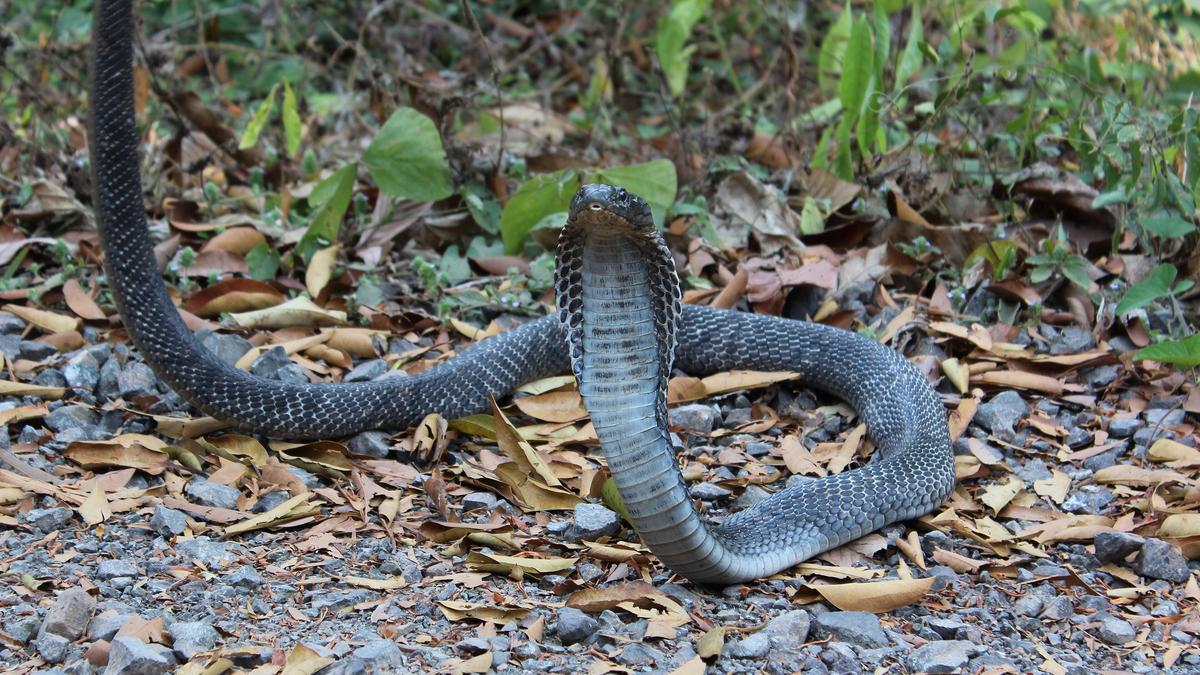
- Diet – It consists of rodents, frogs, and lizards.
- Conservation Status – The Andaman cobra is already vulnerable to extinction.
- IUCN – Endangered.
- Wildlife (Protection) Act, 1972 – Schedule I
- CITES – Appendix II
- Conservation Challenge
- Geographic isolation – It is an endemic species, and its endemism to the Andaman Islands, which are small and geographically enclosed, compounds this vulnerability.
- The absence of a larger, widespread population elsewhere also means no snakes can be brought from elsewhere to support population recovery efforts should such a need arise.
- Inbreeding risk – Living in an isolated, restricted area means the snake only has access to a small pool of potential mates, thus faces a high risk of inbreeding, which could lead to birth defects, poor fertility, and so on.
- Human-wildlife conflict – It is a highly venomous snake, and on top of that is capable of spitting venom as a defence mechanism. This raises the probability of people killing it out of fear.
- Habitat loss – Human activities such as deforestation and agricultural expansion are also altering or destroying cobra habitats.
- Mitigation – The only way to mitigate human-Andaman cobra conflicts is by raising awareness among communities sharing or living near Andaman cobra habitats, including how to contact snake handlers, avoid snakebites, protect livestock, and practice wildlife-friendly agriculture.
- Non-availability of antivenom – However, there is no commercially available antivenom for the Andaman cobra yet.
- The life-threatening risk associated with the snake creates restrictions in field research, habitat exploration, and conservation.
Reference
The Hindu | India’s sole island-dwelling cobra faces conservation challenges



