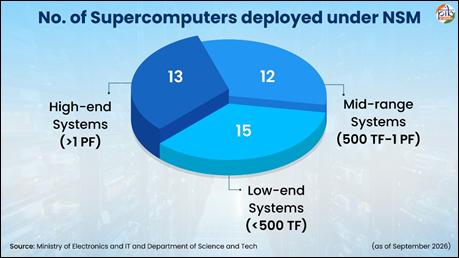
India’s National Supercomputing Mission (NSM) has expanded the country’s High-Performance Computing (HPC) ecosystem. As of September 2026, 40 supercomputers with a combined capacity of 68 PF have been deployed, with a target of 50 systems exceeding 123 PF.
What is Supercomputing?
Supercomputers use parallel processing, where multiple processors work simultaneously to perform complex calculations. Their performance is measured in FLOPS (Floating Point Operations Per Second); 1 PF equals one quadrillion operations per second.
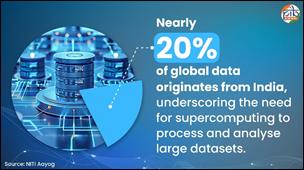
Evolution and National Supercomputing Mission
- India’s indigenous journey began with PARAM 8000 in 1991, developed by C-DAC.
- NSM was launched in 2015 with an outlay of about ₹4,500 crore, jointly steered by DST and MeitY.
- C-DAC, Pune and IISc, Bengaluru implement the Mission.
- It follows a “Build” approach covering assembly, manufacturing, and design/manufacturing support.
- India has developed indigenous servers, interconnects, cooling systems and HPC software, reducing dependence on imported technologies.
Current Status and Indigenous Capabilities
- 40 supercomputers → 68 PF capacity as of September 2026.
- 13 high-end systems have capacity above 1 PF.
- The PARAM Rudra series uses indigenously designed Rudra servers and software.
- Around 6,000 Rudra servers have been deployed, with 1,500 more under manufacturing.
- Indigenous 100/200 Gbps interconnect technology, cooling systems and PARAM Shavak have strengthened the domestic HPC ecosystem.
- The National Knowledge Network (NKN) connects supercomputing facilities and facilitates resource sharing and collaboration.
Applications for National Development
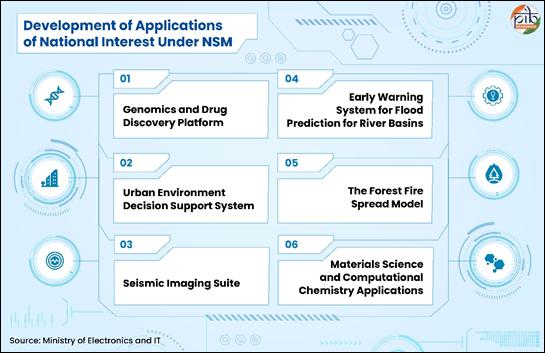
Supercomputing supports:
- Healthcare: genomics, drug discovery and disease modelling.
- Agriculture: crop-yield prediction and data-driven farming.
- Climate and disasters: weather forecasting, flood prediction and forest-fire modelling.
- Environment: air-pollution modelling and climate simulations.
- Energy: seismic imaging for oil and gas exploration.
- Science: astrophysics, materials science, computational chemistry and engineering.
For instance, the Mahanadi flood-warning system can provide forecasts up to two days in advance.
Significance for India
- Scientific advancement: Accelerates complex simulations and research.
- Strategic autonomy: Builds indigenous hardware and software capabilities.
- AI readiness: Provides the computational foundation for AI and big-data applications.
- Disaster resilience: Improves early-warning and climate modelling.
- Human capital: NSM infrastructure has supported 16,000+ researchers across 400+ institutions.
- Aatmanirbhar Bharat: Strengthens domestic HPC manufacturing and innovation.
Challenges
- High capital and energy requirements.
- Need for advanced semiconductor and component capabilities.
- Shortage of specialised HPC and AI talent.
- Need for greater industry–academia collaboration and wider accessibility.
- Growing demand for energy-efficient and sustainable computing.
Way Forward
India should focus on exascale computing, energy-efficient systems, indigenous semiconductor capabilities and AI-HPC integration. Greater participation of startups, industry, academia and research institutions can convert computing capacity into practical solutions.
Conclusion: India’s transition from PARAM 8000 to PARAM Rudra reflects a shift from acquiring computing power to building a self-reliant supercomputing ecosystem, supporting the objectives of Aatmanirbhar Bharat and Viksit Bharat 2047.



