Prelims: Current events of national and international importance | Science & Technology
Why in News?
Recently, scientists from the Raman Research Institute (RRI), Bengaluru made a breakthrough discovery regarding Centaurus X-3, one of the brightest and most widely studied X-ray pulsars in the universe.
Key Technical Mechanisms
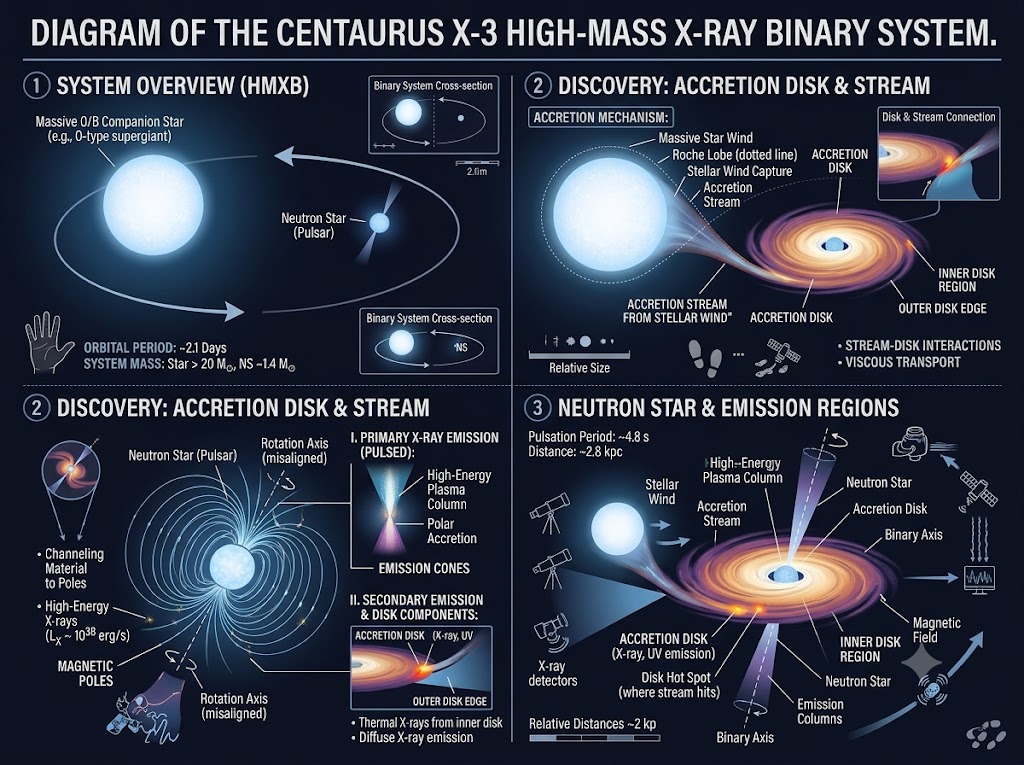
Centaurus X-3
- It is a High-Mass X-ray Binary (HMXB) system located roughly 24,000 light-years away in the constellation Centaurus.
- It features a highly magnetized neutron star (pulsar) coupled with a companion star more than 10 times the mass of the Sun.
Primary vs. Secondary Emission
- Primary Emission - Intense radiation beamed directly out of the pulsar’s magnetic poles.
- Secondary Emission- Radiation absorbed and re-emitted by the intricate structures surrounding the neutron star.
- Because distant X-ray binaries appear merely as point sources, tracking the rotational variations of these secondary emission lines acts as an optical/X-ray "diagnostic tool".
The Accretion Discovery
- By analyzing four specific secondary emission lines, RRI researchers found that the emitting structure co-rotates with the pulsar.
- This confirmed the existence of an accretion stream channeling matter from an accretion disk directly onto the neutron star.
Scientific Significance
- High-mass X-ray pulsars typically draw material via stellar winds rather than a distinct, disk-fed accretion mechanism. This discovery mandates a revision of standard evolutionary models for systems like Centaurus X-3.
- Accurately mapping these circumstellar structures allows astrophysicists to determine critical physical parameters—such as the system's orbital orientation, plasma dynamics, and extreme magnetic field strengths.
Reference
PIB | Signals reveal hidden structure around a famous neutron star



