Prelims: Current events of national importance | Biodiversity & Conservation
Why in News?
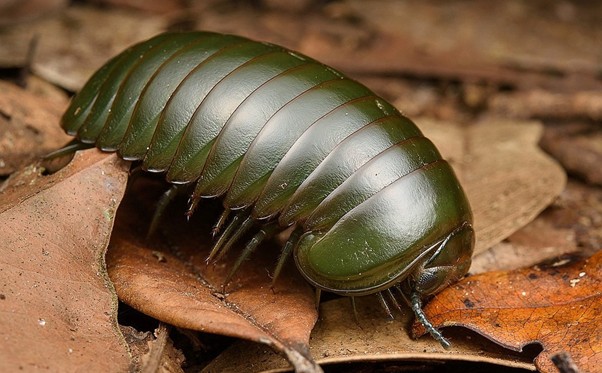
A new study has revealed the self‑cleaning mechanism of the green pill millipede (Arthrosphaera lutescens), demonstrating advanced hydrophobic properties similar to the ‘lotus effect’.
- Scientific Name – Arthrosphaera lutescens.
- Family – Arthrosphaeridae.
- Kingdom – Animalia.
- Habitat – Decaying organic matter and vegetable waste in moist forest ecosystems.
- Distribution – Endemic to Western Ghats, Primarily Munnar (Idukki) and Nelliampathy (Palakkad), Kerala.
- Appearance - Vibrant green, small pill-shaped body.
- Defense - Unlike other millipedes that use chemical defenses, pill millipedes (Order Sphaerotheriida) rely on rolling into an armored, impenetrable ball.
- Self-cleaning mechanism - It has a complex surface filled with microscopic “peaks and valleys”.
- This uneven structure, along with tiny hair-like projections and a water-repellent coating, allows water droplets to bead up and roll off easily, thereby removing dirt particles and microbes.
- The mechanism closely resembles the well-known “lotus effect”, where surfaces naturally clean themselves.
- The exoskeleton acts like a highly evolved natural system that resists contamination even in muddy conditions.
- Ecological importance
- Ecosystem Indicator – Reflects the health of the Western Ghats ecosystem.
- Regional Variation – Colours of pill millipedes vary across Western Ghats regions.
- Scientific Importance
- Bio-inspired design - The millipede’s surface structure could inspire new water-repellent materials for industries like textiles, coatings, and packaging.
- Durability - Its shell is mineral-rich, lightweight, and strong, offering insights into sustainable material engineering.
- Threats - Deforestation, climate change, and human encroachment.
- Conservation value - Protecting this species preserves biodiversity and supports ongoing biomaterial research.
Reference
The Hindu | Green Pill Millipede



