Why in News?
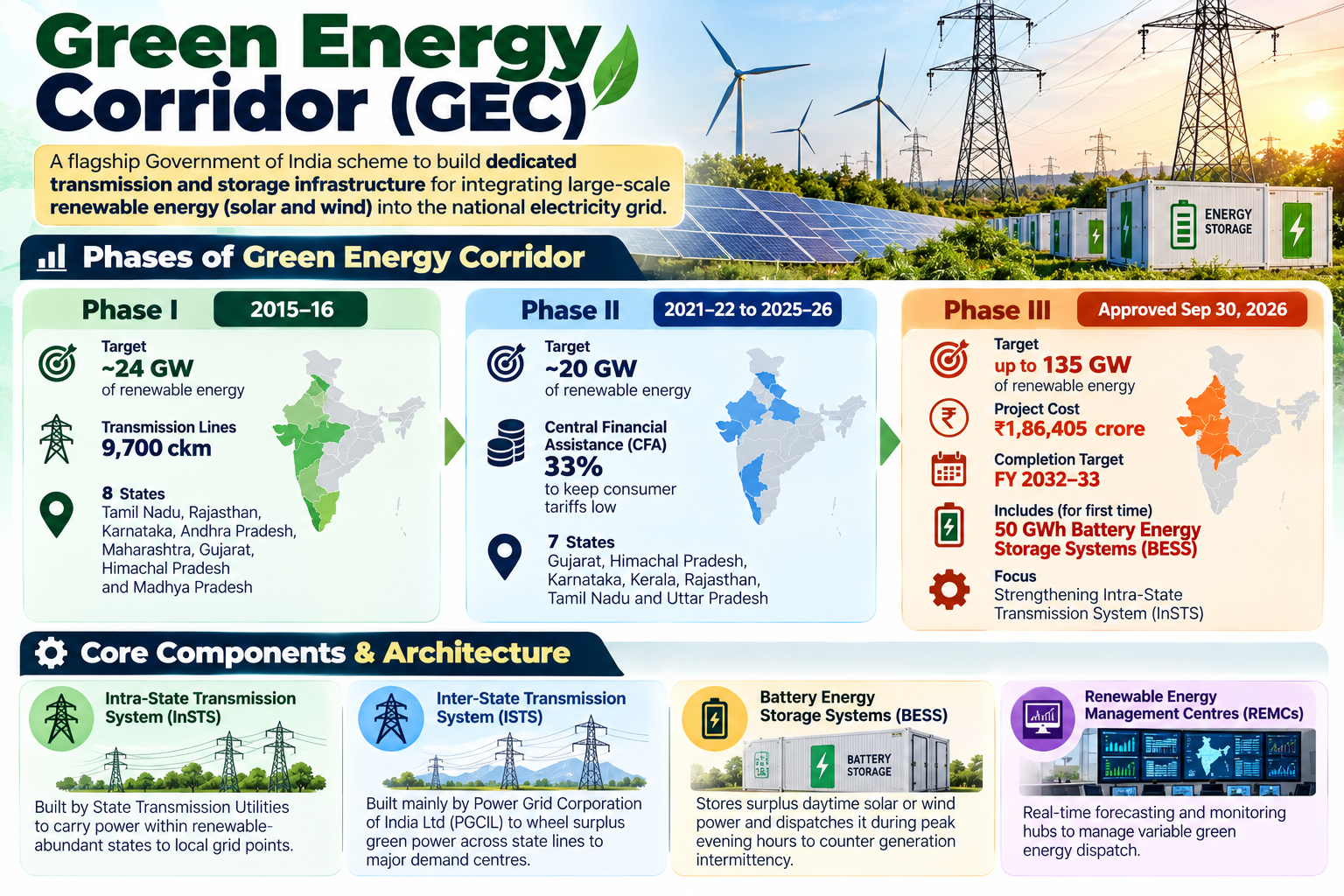
Recently, the Union Cabinet approves Green Energy Corridor Phase III (GEC-III) scheme.
What is GEC and its core objective of the GEC-III scheme?
- Green Energy Corridor (GEC) – A flagship program by the Ministry of New and Renewable Energy (MNRE) designed to build dedicated transmission infrastructure to evacuate and integrate large-scale solar and wind energy into India's national grid.
- Aim – To strengthen intra-state transmission systems to evacuate up to 135 GW of renewable energy and integrate 50 GWh of Battery Energy Storage Systems (BESS) by FY 2032–33.
- Resource Allocation – Dedicated intra-state transmission network expansion worth Rs. 1.36 trillion.
- Earmarked deploying 50 GWh of BESS for Rs. 50,000 crore.
- Implementation Model – Greenfield transmission projects will be awarded via Tariff-Based Competitive Bidding (TBCB).
- Brownfield capacity upgrades will follow a cost-plus model, with State Transmission Utilities (STUs) acting as overall implementing agencies.
- Strategic Paradigm Shift – Phases I and II focused primarily on inter-state and inter-regional corridors (such as the 8,000 MW Raigarh-Pugalur HVDC link) to move power across states.
- GEC-III shifts focus to granular, intra-state grid planning, strengthening internal state networks to absorb local generation in renewable-rich states like Gujarat, Rajasthan, Madhya Pradesh, and Andhra Pradesh.
Why is grid transmission lagging behind renewable energy generation?
- Mismatch in Construction Timelines – Solar generation capacity can be commissioned in 12 to 18 months, whereas establishing transmission lines and substations takes 12 to 24 months or longer due to civil engineering and regulatory hurdles.
- Evacuation Curtailment and Network Congestion – Data shows that nearly 21 GW of variable renewable energy capacity was evacuated under the Temporary General Network Access (T-GNA) mechanism.
- Out of this, 12 GW faced severe evacuation restrictions during peak generation hours, In FY 2025–26, around 6,900 GWh of clean electricity was curtailed due to the absence of matching transmission links.
What is the strategic role of Battery Energy Storage Systems (BESS) in GEC-III?
- Complementing, Not Replacing, Transmission – Storage acts as an operational complement to physical lines, while batteries cannot resolve structural, round-the-clock line capacity deficits, they smooth out peak solar generation spikes and prevent renewable curtailment.
- Grid Flexibility and Load Shifting – 50 GWh of BESS will absorb excess daytime generation and release power during non-solar peak hours, optimizing the utilization of existing transmission corridors without requiring immediate line duplication.
- Bridging the Pipeline-Execution Gap – While India’s operational BESS capacity stood at 8.5 to 9.3 GWh by mid-2026, the cumulative tender pipeline surpassed 281 GWh.
- Proper location-based planning is crucial to deploy batteries at actual grid congestion nodes rather than arbitrarily allocating them at generator sites.
What structural, legal, and operational hurdles challenge grid expansion?
- Right-of-Way (RoW) and Land Disputes – Transmission corridors require continuous stretches of land across private properties, often running into local resistance and protracted litigation over land compensation.
- Environmental and Wildlife Constraints – Linear infrastructure faces judicial and regulatory roadblocks in eco-sensitive zones.
- For instance, overhead transmission lines in Rajasthan faced severe construction halts due to Supreme Court mandates protecting the critically endangered Great Indian Bustard (GIB) habitat.
- Financial and Administrative Strain on STUs – State Transmission Utilities frequently suffer from delayed central fund disbursements, weak balance sheets, and poor inter-departmental coordination among state distribution companies (DISCOMs).
What policy measures are required for effective implementation?
- Milestone-Linked Fund Disbursements – Align Central Financial Assistance (CFA) directly with project commissioning and land readiness milestones rather than upfront sanctioning to curb project stalling.
- Location-Based BESS Revenue Frameworks – Establish clear, long-term ancillary service market mechanisms and tariff structures for BESS to make grid-scale storage commercially viable for private investors.
- Integrated Spatial and Multi-Stakeholder Planning – Incorporate transmission planning into the PM Gati Shakti spatial mapping framework to streamline forest clearances, RoW approvals, and community consultations before project bidding.
- Adoption of Modern Transmission Technologies – Accelerate the deployment of High-Temperature Low-Sag (HTLS) conductors, underground cabling in sensitive ecological zones, and dynamic line rating systems to maximize throughput on existing corridors.
Reference
Down To Earth | GEC III



