- Scientific Name - Rhinoceros unicornis.
- Habitat - Found in the Indo-Nepal terai, Northern West Bengal, and Assam, with Kaziranga National Park being a critical habitat.
- Distribution - It can be found in India and Nepal, particularly in the foothills of the Himalayas.
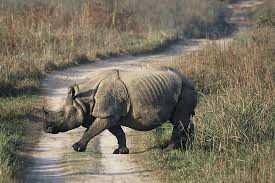
- Appearance – It is characterized by its large, bulky body covered in thick, grey-brown skin that forms distinctive armor-like folds, giving it an ancient appearance.
- It possesses a single, black horn on its snout made of keratin, a prehensile upper lip, and poor eyesight but excellent hearing and smell.
- They are the largest of the Asian rhinos, with males being significantly larger than females.
- Conservation Status - IUCN - Vulnerable.
- Major Threats
- Poaching - For their horns, which are highly valued in some cultures.
- Habitat Loss & Degradation - Due to factors like invasive plant species.
- Conservation Initiatives
- Indian Rhino Vision 2020 (IRV 2020): An ambitious campaign aiming to increase wild rhino numbers in Assam.
- National Rhino Conservation Strategy: A plan involving India and Nepal to manage rhino populations across the political boundary.
|



