Mains: GS III – Infrastructure
Recently, the Union Cabinet approved GOBARdhan – National Circular Bioenergy Scheme to boost domestic Compressed Bio Gas (CBG) and energy security.
GOBARdhan – Galvanizing Organic Bio-Agro Resources Dhan, was originally launched under the Swachh Bharat Mission (Grameen) in 2018.
Nodal Ministry – Ministry of Petroleum and Natural Gas (MoPNG)
Implementation Period – FY 2026-27 to FY 2035-36
Integral component of – Solid and Liquid Waste Management (SWM), converting bio-waste - animal waste, kitchen leftovers, crop residue and market waste, into biogas and bio-slurry, thereby ensuring cleanliness in villages and improving rural lives.
Objectives
To increase nearly ten-fold domestic CBG production.
Mobilize large-scale private investment.
Create a vibrant circular bioeconomy across the country.
Vision
India's waste will fuel India's growth.
India's villages will become centres of clean energy production.
India's farmers will become partners in the nation's energy security.
Assured CBG Offtake – It establishes a dedicated CBG Offtake Assurance framework to provide a reliable and predictable market for producers.
Procurement by City Gas Distribution (CGD) entities will support achievement of the notified CBG Obligation trajectory:
3% in FY 2026-27
4% in FY 2027-28
5% from FY 2028-29 onwards in CNG (Transport) and PNG (Domestic) segments
This framework turns blending obligation into long-term demand signal, boosting bankability, utilization, and private investment.
Stable CBG Pricing Framework – It introduces a government-backed administered price of Rs 2,110 per Metric Million British Thermal Unit (MMBTU).
It is equivalent to ₹105 per kilogram of CBG, ensuring stable and remunerative pricing.
Pricing framework ensures 10‑year revenue certainty with government support and cost‑sharing, balancing producer returns and consumer affordability.
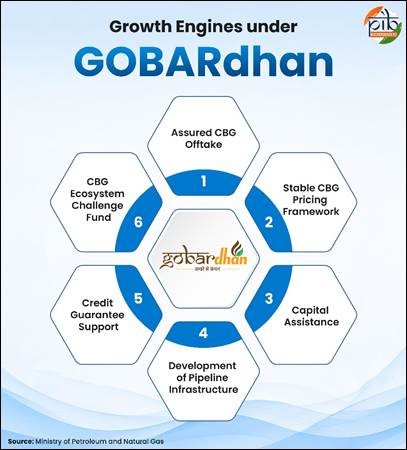
Capital Assistance – Eligible greenfield CBG projects will receive capital assistance of up to Rs. 2 crore per ton per day (TPD) of installed CBG capacity.
Support covers value‑chain assets and brownfield expansion, reducing capital burden and enabling wider private, MSME, cooperative, and rural participation.
Development of Pipeline Infrastructure – It supports both cluster-based and standalone pipeline infrastructure connecting CBG plants with trunk pipelines and City Gas Distribution networks.
Greater pipeline connectivity will reduce evacuation costs, improve reliability, expand market reach and enable higher utilization of domestically produced CBG.
Credit Guarantee Support – Credit Guarantee Mechanism boosts lender confidence and expands MSME access to institutional finance for CBG projects.
The mechanism will provide credit guarantee coverage of up to 85 % on eligible loans for such projects.
By sharing lending risk, the mechanism enables affordable finance, lowers collateral needs, speeds project development, and broadens MSME, women, and new‑developer participation in a competitive CBG industry.
CBG Ecosystem Challenge Fund – It establishes a dedicated CBG Ecosystem Challenge Fund to accelerate district-level implementation and strengthen local value chains across the CBG ecosystem.
The Fund will support:
Feedstock resource assessment and mapping
Feedstock aggregation infrastructure
District-level CBG development planning
Technology adoption and process improvement
Value addition of organic manure
Capacity building and stakeholder awareness
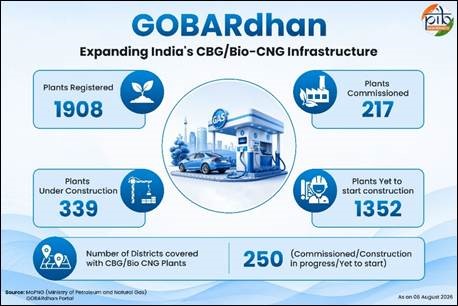
GOBARdhan Unified Registration Portal: Provides a single national platform for CBG/Bio‑CNG plant operators and developers to obtain a registration number, which is mandatory to access MoPNG benefits and support.
Growth & Security – Ten‑fold surge in CBG output builds a clean gas pillar and enhances energy security by cutting fossil fuel imports.
Investment & Rural Empowerment – Stable finance and project viability spur private investment while creating new income opportunities for farmers, cooperatives, and rural entrepreneurs.
Scientific Waste Utilization – Productive use of agri‑residue, dung, municipal waste, and biomass.
Emission Reduction – Lower GHGs via fossil fuel replacement and organic waste use.
Organic Manure Economy – Expansion through higher production, value addition, and FOM/LFOM use.
Streamlined Implementation – Faster projects via one national framework, digital governance, and simplified institutions.
Production Growth – Compressed biogas (CBG) output increased tenfold, which stimulated significant private sector investment.
Foreign Exchange Savings – Over ₹40,000 crore saved as a result of reduced energy imports.
Fuel Substitution – Clean gas replaced 10 million metric tonnes (MMT) of fossil fuels.
Economic Contribution – The initiative contributed over ₹75,000 crore to the gross domestic product (GDP).
Employment – More than 150,000 jobs were created throughout the value chain.
Climate Impact – Waste diversion efforts prevented 40 million tonnes (MT) of carbon dioxide (CO₂) emissions.
Agricultural Support – Production of 250 million metric tonnes (MMT) of organic fertilizer enhanced soil health.
GOBARdhan will scale India’s CBG journey from a strong base to a nationwide clean energy industry, reinforcing energy security, rural prosperity, waste‑to‑wealth, Atmanirbhar Bharat, and Viksit Bharat.



