Prelims – Economic and Social Development.
Mains (GS II & III) – GS I (Government Policies & Interventions NITI Aayog) |GS III (Inclusive Growth Growth & Development)
Why in News?
Niti Aayog’s Fiscal Health Index (FHI) 2025 has ranked Odisha as the top-performing state in terms of fiscal stability.
- Initiative by - NITI Aayog.
- Aim - To evolve an understanding of the fiscal health of states in India.
- The FHI analysis covers 18 major states that drive the Indian economy in terms of their contribution to India’s GDP, demography, total public expenditure, revenues, and overall fiscal stability.
- Objectives - To provide a comparative analysis of fiscal health across Indian states through standardized metrics.
- To identify areas of strength and concern in states' fiscal management practices.
- To promote transparency, accountability, and prudent fiscal management through empirical assessment.
- To assist policymakers in making informed decisions aimed at enhancing fiscal sustainability and resilience.
- Indicators - Revenue Generation and Mobilization - Assessment of states' own revenue receipts, tax buoyancy, and non-tax revenue generation.
- Expenditure Management and Prioritization - Evaluation of efficiency in expenditure allocation, prioritization of capital expenditure, and adherence to fiscal discipline.
- Debt Management - Analysis of states’ debt-to-GSDP ratios, interest payment burdens, and overall sustainability of debt portfolios.
- Fiscal Deficit Management - Measurement of states’ fiscal deficit as a percentage of Gross State Domestic Product (GSDP) and adherence to statutory limits.
- Overall Fiscal Sustainability - Composite analysis of revenue, expenditure, deficit, and debt indicators to gauge long-term fiscal health
Key Findings
- Top Performers - Odisha, Chhattisgarh, and Goa excel in Debt Index, Debt Sustainability, and Revenue Mobilization.
- Revenue Mobilization - Odisha, Jharkhand, Goa, and Chhattisgarh effectively mobilize non-tax revenue (average 21% of Total Revenue).
- Aspirational States - Punjab, Andhra Pradesh, West Bengal, and Kerala face fiscal challenges like poor debt sustainability and high deficits.
- Capital Expenditure - High allocation (27%) by Odisha, Goa, Madhya Pradesh, Karnataka, Uttar Pradesh; Low allocation (10%) by West Bengal, Andhra Pradesh, Punjab, Rajasthan.
- Debt Concerns - West Bengal and Punjab face growing debt burdens and increasing debt-to-GSDP ratios.
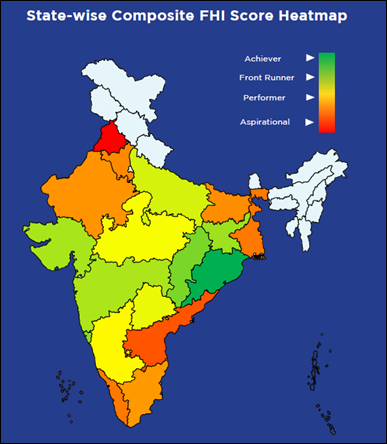
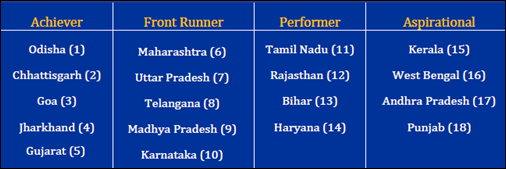
|
Quick Facts
|
- Tax Buoyancy – It is a ratio of change in tax revenue in relation to change in gross state domestic product or GSDP of a state. It measures how responsive a taxation policy is to growth in economic activities.
- Debt-to-GSDP – It is a metric that compares a state’s total public debt to its gross state domestic product (GSDP), indicating its ability to repay its debts, and is often expressed as a percentage.
- Sustainability of Debt Portfolios - It refers to state’s ability to meet its current and future debt obligations without defaulting or requiring exceptional financial assistance, focusing on both solvency and liquidity.
- Debt Index - The ratio of Interest Payments to Revenue Receipts (IP/RR) indicating the percentage of Revenue Receipts used for interest payment on account of outstanding debt.
|
Reference
PIB | Fiscal Health Index 2025



