Mains: GS Paper II | Governance
Why is in news?
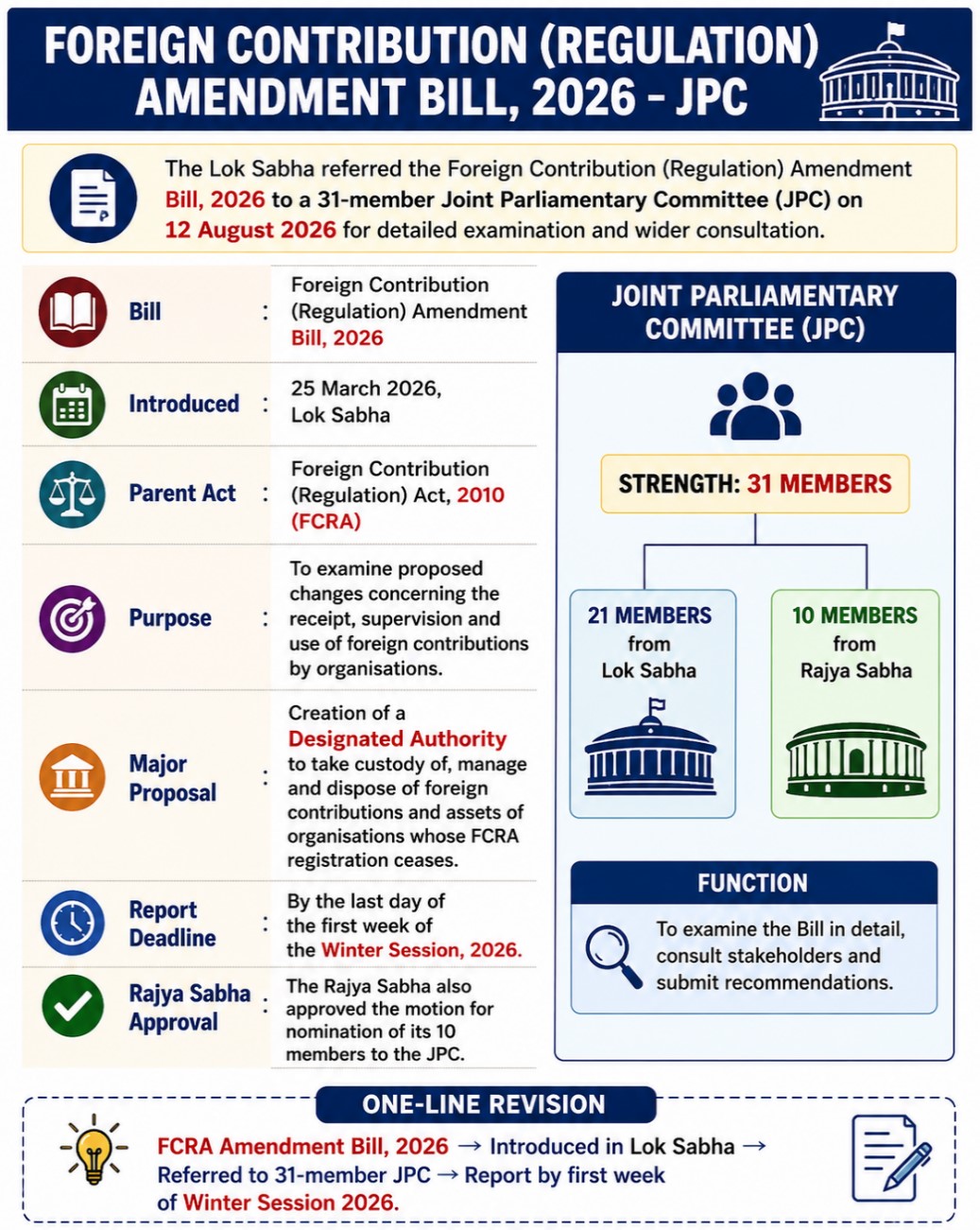
The Lok Sabha referred the Foreign Contribution (Regulation) Amendment Bill, 2026 to a Joint Parliamentary Committee (JPC).
What are the Objectives of the FCRA Bill?
- The bill aims to further amend the Foreign Contribution (Regulation) Act, 2010.
- The objective of the Bill is to make the use of foreign contributions more transparent and accountable.
What is the definition of JPC?
- JPC stands for Joint Parliamentary Committee, a temporary ad-hoc body set up by both houses (Lok Sabha and Rajya Sabha).
- Total Members: 31 MPs from both houses of Parliament.
- Lok Sabha: 21 members nominated by the Speaker.
- Rajya Sabha: 10 members nominated by the Chairman.
- The Committee will submit its report to this House by the last day of the first week of the winter session.
Why JPC?
- JPC can call witnesses, examine documents and suggest changes, but its recommendations are not binding on the government.
- These committees help examine complex legislation through detailed scrutiny and stakeholder consultation.
- The referral gives the Bill a second layer of scrutiny.
- The government could have pushed the Bill through Lok Sabha amid din; it has the numbers.
- Instead, following strong objections, it has chosen a JPC.
- The committee will now provide a formal forum for stakeholders to put their concerns on record and for the government to decide which of them it is prepared to accommodate.
What are Parliamentary committees?
- Parliamentary committees were created to address a basic limitation of Parliament itself: the two Houses have limited time to examine an increasingly complex body of legislation and government policy.
- Smaller committees can spend considerably more time examining a Bill, question officials, hear experts and stakeholders, and examine provisions clause by clause.
- The committee system is, therefore, not meant to be another forum for the political contest that takes place on the floor of the House.
- Its underlying philosophy is “influence, not direct control; advise, not command; criticism, not obstruction; scrutiny, not initiative; accountability, not prior approval.”
What are the Types of Parliamentary committees?
- The Department-related Standing Committees examine the functioning and policies of ministries on an ongoing basis.
- Financial committees scrutinize government expenditure.
- Select Committees are constituted by one House to examine a specific Bill, while a JPC has members from both Lok Sabha and Rajya Sabha and is constituted for a specific Bill or issue.
- Committees can call for persons, papers and records and take evidence, but their recommendations are not binding on the government.
What is the Limitation of JPC committee?
- JPC membership broadly reflects the strength of parties in Parliament.
- Since the ruling party or alliance normally has a majority in the Lok Sabha, it consequently has a majority in a JPC as well.
- The chairperson is also generally from the government benches.
- The committee can take decisions by majority; in the event of a tie, the chairperson has a casting vote.
- The Opposition has several tools within the committee: it can demand particular witnesses, question officials, put evidence on record, propose changes to the draft report and, ultimately, if they disagree with the majority, file a dissent note.
- The JPC’s conclusions, however, had limited influence on the subsequent legal and political trajectory.
- The partisan character of JPCs is not unique to the present government.
What is the Importance of JPC?
- The important point is that a JPC’s value lies in forcing the government to explain, amend, clarify or reconsider parts of a Bill.
What is the Final Conclusion?
- When a government regards an issue as politically important, its majority on the committee can be decisive.
- The most striking change is not in the number of JPCs, but in the broader decline in the use of parliamentary committees for Bills.
- The emerging pattern is that routine scrutiny has weakened while JPCs have increasingly been used for particularly contentious pieces of legislation.
Reference
Indian Express | FCRA Bill sent to JPC



