Prelims: Current events of national and international importance | Environment
Why in News?
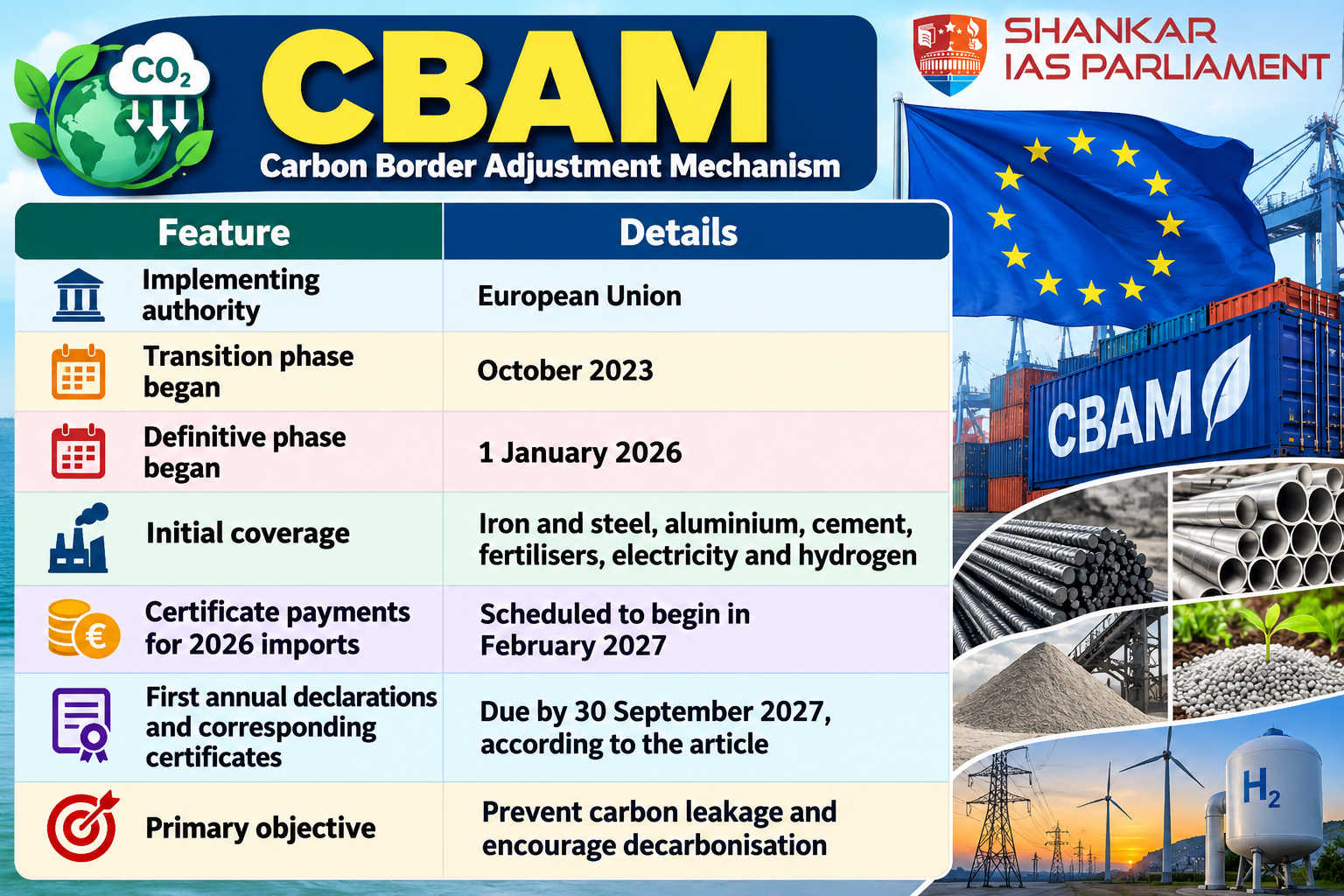
The Carbon Border Adjustment Mechanism (CBAM) of the European Union (EU) commenced its definitive implementation phase on 1 January 2026.
Carbon Border Adjustment Mechanism (CBAM)
- CBAT – It is a fee or tariff imposed on imported goods according to the greenhouse gas emissions generated during their production.
- Introduced by – European Union.
- Objective – To prevent carbon leakage by ensuring that selected carbon-intensive imported goods are subject to a carbon price equivalent to that imposed on goods produced within the European Union.
- Revenue – It is designated as an own resource for the EU budget under the proposed arrangements.
- The European Commission proposes the following allocation:
- 75% of certificate-sale revenue to the EU budget.
- 25% to a proposed Temporary Decarbonisation Fund for energy-intensive EU industries.
- The proposed arrangement does not include provisions for returning this revenue to exporting countries.
- Key Purposes
- Prevent Carbon Leakage – It discourages EU companies from relocating manufacturing to countries with less stringent environmental regulations to reduce expenses.
- Level the Playing Field – It requires foreign producers to incur carbon costs equivalent to those paid by EU manufacturers under the EU Emissions Trading System (EU ETS).
- Encourage Global Decarbonization – It incentivizes non-EU manufacturers to lower their greenhouse gas emissions.
Factors Affecting Indian MSMEs
- High compliance costs – The processes of emissions assessment, certification, and verification often incur significant expenses.
- Data gaps – Obtaining emissions data from raw material suppliers and electricity providers is frequently challenging.
- Limited technical capacity – Many MSMEs lack specialised personnel required for accurate calculation of product-level emissions.
- Supply-chain complexity – Emissions are influenced by the characteristics of raw materials, components, electricity sources, and manufacturing processes.
- Market uncertainty – Compliance requirements may prompt European buyers to delay orders or change suppliers.
- Commercial confidentiality – Emissions reporting can necessitate the disclosure of sensitive information regarding suppliers and production processes.
Potential Impacts on India
|
Area
|
Possible impact
|
|
Exports
|
Reduced competitiveness of carbon-intensive goods
|
|
MSMEs
|
Higher compliance and certification costs
|
|
Employment
|
Potential pressure on export-dependent manufacturing
|
|
Trade
|
Possible decline in exports to the EU
|
|
Investment
|
Greater incentives to adopt cleaner technologies
|
|
Supply chains
|
Increased demand for verified emissions data
|
|
Domestic industry
|
Greater pressure to improve energy efficiency and decarbonise
|
Reference
Down to Earth | EU’s CBAM



